
Swing trading is one of the most popular trading styles in the stock market because it offers a balance between short-term trading and long-term investing. Swing traders aim to capture price movements over a few days to several weeks using technical analysis, chart patterns, and market trends.
For beginners, swing trading can be easier than intraday trading because it requires less screen time and allows traders to make calmer decisions.
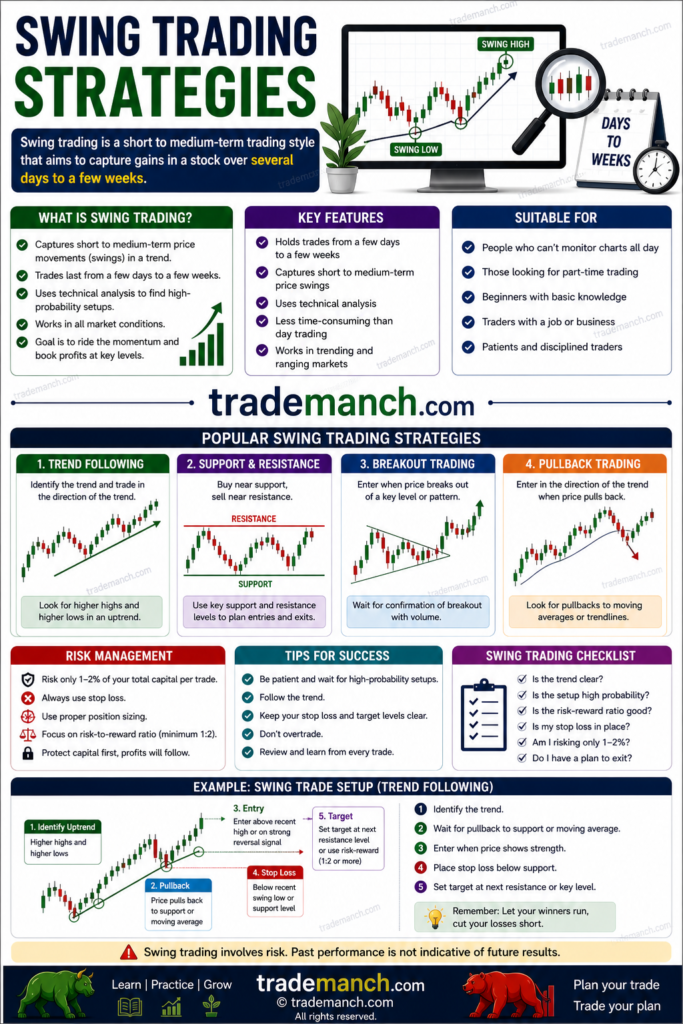
In this complete beginner-friendly guide, you will learn what swing trading is, how it works, popular swing trading strategies, risk management techniques, and tips to become a successful swing trader.
What Is Swing Trading?
Swing trading is a trading style where traders hold stocks or other assets for several days or weeks to profit from short-term price movements.
Swing traders try to capture:
- Small to medium market swings
- Trend movements
- Breakouts and reversals
Simple Definition of Swing Trading
Swing trading means buying and holding a stock for a few days or weeks to profit from price swings.
Example of Swing Trading
Suppose:
- You buy a stock at ₹500
- After one week, the price rises to ₹560
- You sell the stock
Profit:
560−500=60
Profit = ₹60 per share.
How Swing Trading Works
Swing traders:
- Identify market trends
- Analyze chart patterns
- Enter trades near support or breakout levels
- Hold trades for days or weeks
- Exit after reaching targets
Swing trading focuses on:
- Trend continuation
- Momentum
- Technical setups
Advantages of Swing Trading
1. Less Stress Than Intraday Trading
Swing trading does not require constant screen monitoring.
2. More Time for Analysis
Traders can make decisions calmly.
3. Suitable for Working Professionals
Trades can be managed part-time.
4. Better Profit Potential
Larger price movements may generate higher returns than intraday trading.
5. Lower Brokerage Costs
Fewer trades reduce transaction costs.
Disadvantages of Swing Trading
Overnight Risk
Positions are held overnight, exposing traders to:
- News events
- Gap openings
- Market volatility
Requires Patience
Trades may take days or weeks to complete.
False Breakouts
Some setups fail and reverse suddenly.
Difference Between Swing Trading and Intraday Trading
| Swing Trading | Intraday Trading |
|---|---|
| Positions held for days/weeks | Positions closed same day |
| Less stressful | Fast-paced |
| Lower screen time | Requires constant monitoring |
| Moderate risk | Higher short-term risk |
| Suitable for beginners | More difficult for beginners |
Important Concepts in Swing Trading
1. Trend Analysis
Trend identification is very important.
Uptrend
- Higher highs
- Higher lows
Downtrend
- Lower highs
- Lower lows
Swing traders prefer trading in the direction of the trend.
2. Support and Resistance
Support
A zone where buyers enter strongly.
Resistance
A zone where sellers become active.
Swing traders often:
- Buy near support
- Sell near resistance
3. Volume Analysis
Higher volume confirms stronger market movement.
Volume helps validate:
- Breakouts
- Trend strength
Best Timeframes for Swing Trading
Popular timeframes:
- Daily chart
- 4-hour chart
- Weekly chart
Beginners usually prefer daily charts because they are less noisy.
Best Swing Trading Strategies for Beginners
1. Trend Following Strategy
This is one of the simplest swing trading strategies.
Rules:
- Buy in uptrend
- Sell in downtrend
- Follow market direction
Trend trading works well in strong markets.
2. Breakout Strategy
Swing traders buy when price breaks important resistance levels.
Breakouts often lead to:
- Strong momentum
- Rapid price movement
Example of Breakout
Suppose:
- Stock repeatedly faces resistance at ₹500
- Price breaks above ₹500 with strong volume
This may signal bullish breakout.
3. Pullback Trading Strategy
In this strategy:
- Traders wait for temporary price correction
- Enter trade during pullback in an existing trend
This helps obtain better entry prices.
4. Support and Resistance Strategy
Swing traders:
- Buy near support
- Sell near resistance
This strategy works well in range-bound markets.
5. Moving Average Strategy
Although many swing traders use price action, moving averages can help identify trends.
Popular moving averages:
- 20 EMA
- 50 EMA
- 200 EMA
Candlestick Patterns Used in Swing Trading
Bullish Engulfing Pattern
Signals strong buying pressure.
Bearish Engulfing Pattern
Signals strong selling pressure.
Pin Bar Candle
Shows rejection from important levels.
Doji Candle
Shows market indecision.
Importance of Risk Management in Swing Trading
Risk management is essential for survival.
Use Stop Loss
Stop loss limits losses.
Example:
- Buy at ₹500
- Stop loss at ₹480
Risk:
500−480=20
Risk-Reward Ratio
Swing traders usually seek:
- Minimum 1:2 or 1:3 risk-reward ratio
Example:
- Risk = ₹20
- Target = ₹60
Risk-reward ratio:
2060=3:1
Position Sizing
Never risk large capital on one trade.
Many traders follow:
- 1–2% capital risk rule
Best Stocks for Swing Trading
Swing traders prefer:
- High liquidity
- Good volatility
- Strong trends
Popular stocks include:
- Reliance Industries
- HDFC Bank
- Infosys
How Beginners Should Start Swing Trading
Step 1: Learn Basics
Understand:
- Market trends
- Candlestick patterns
- Support and resistance
Step 2: Open Demat and Trading Account
Popular brokers:
- Zerodha
- Groww
- Upstox
Step 3: Start With Small Capital
Reduce emotional pressure.
Step 4: Practice on Demo Account
Gain confidence before using real money.
Step 5: Maintain Trading Journal
Track:
- Entries
- Exits
- Mistakes
- Performance
Common Mistakes Beginners Make
Overtrading
Taking too many trades.
Ignoring Stop Loss
Leads to large losses.
Emotional Trading
Fear and greed damage consistency.
Chasing Stocks
Entering after large moves increases risk.
Lack of Patience
Swing trading requires patience.
Swing Trading Psychology
Successful swing traders:
- Stay disciplined
- Avoid emotional decisions
- Follow trading plans
- Accept losses calmly
Psychology is as important as strategy.
Can Swing Trading Be Profitable?
Yes, swing trading can be profitable with:
- Proper strategy
- Discipline
- Risk management
- Patience
However, no strategy guarantees profits.
Swing Trading vs Investing
| Swing Trading | Investing |
|---|---|
| Short-to-medium term | Long-term |
| Technical analysis focus | Fundamental analysis focus |
| Faster profits/losses | Long-term wealth creation |
| Active management | Passive approach |
Tips for Successful Swing Trading
Follow the Trend
Trade with market direction.
Use Stop Loss Always
Protect capital first.
Focus on Quality Setups
Avoid random trades.
Stay Patient
Good opportunities take time.
Learn Continuously
Markets constantly evolve.
Swing trading is a popular trading style where traders hold positions for several days or weeks to capture market swings. It is less stressful than intraday trading and can be suitable for beginners who want flexibility and better trading opportunities.
Successful swing trading requires:
- Trend analysis
- Technical understanding
- Risk management
- Emotional discipline
- Patience
Beginners should focus on learning market structure, following trends, protecting capital, and developing consistent trading habits for long-term success.
Frequently Asked Questions (FAQs)
1. What is swing trading?
Swing trading means holding trades for several days or weeks to profit from price swings.
2. Is swing trading good for beginners?
Yes, swing trading is generally easier than intraday trading for beginners.
3. How long are swing trades held?
Usually from a few days to several weeks.
4. Is swing trading profitable?
Yes, with proper strategy and risk management.
5. What timeframe is best for swing trading?
Daily and 4-hour charts are commonly used.
6. What is the best swing trading strategy?
Trend following and breakout strategies are popular for beginners.
7. Is stop loss important in swing trading?
Yes, stop loss is essential for risk management.
8. Can swing trading be done part-time?
Yes, many working professionals do swing trading.
9. Which stocks are best for swing trading?
Liquid and trending stocks like Reliance Industries and Infosys are commonly preferred.
10. What is the difference between swing trading and investing?
Swing trading is short-term, while investing focuses on long-term wealth creation.