
Risk management is one of the most important skills in trading. Many traders focus only on strategies, indicators, and profit targets, but successful trading is mainly about protecting capital and controlling losses.
Even the best traders in the world face losing trades. What makes them successful is strong risk management. Without proper risk management, traders can lose their entire capital very quickly.
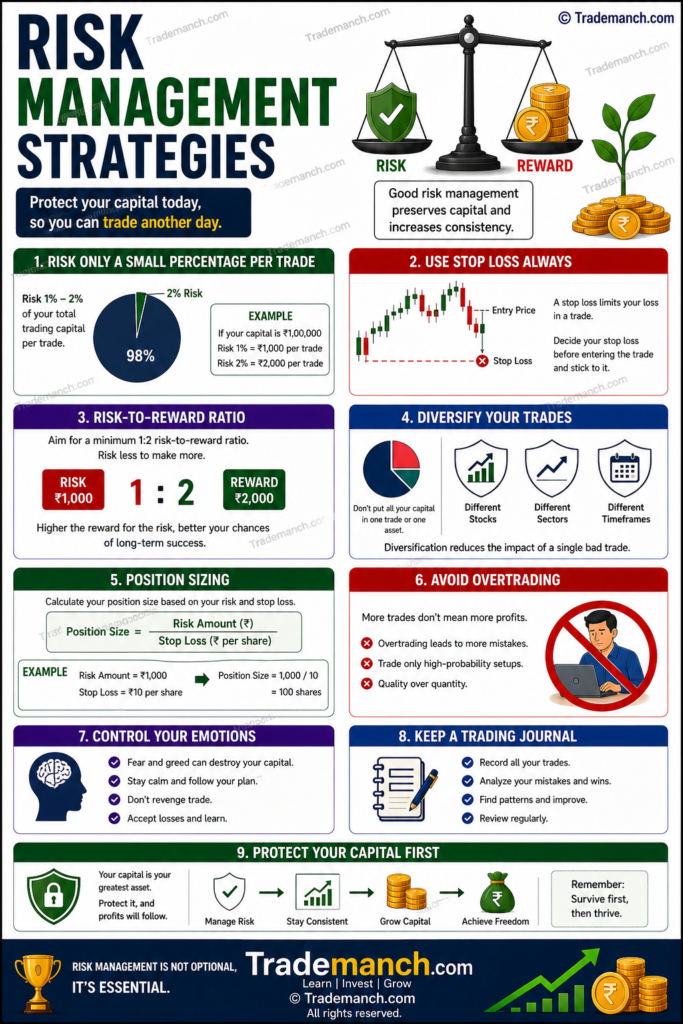
In this complete beginner-to-advanced guide, you will learn what risk management is, why it is important, popular risk management techniques, position sizing, stop loss strategies, and how professional traders protect their trading capital.
What Is Risk Management in Trading?
Risk management is the process of controlling and limiting losses in trading.
It includes:
- Managing trade size
- Using stop loss
- Protecting trading capital
- Controlling emotions
- Maintaining discipline
In simple words:
- Risk management helps traders survive in the market for the long term.
Simple Definition of Risk Management
Risk management means protecting your money from large losses while trading.
Why Risk Management Is Important
Many beginners lose money because they:
- Trade without stop loss
- Take excessive risk
- Use high leverage
- Overtrade emotionally
Good risk management helps traders:
- Protect capital
- Reduce stress
- Stay consistent
- Survive losing streaks
- Build long-term profitability
The Golden Rule of Trading
Professional traders focus on:
- Protecting capital first
- Profits second
Without capital, trading becomes impossible.
What Is Trading Risk?
Trading risk is the possibility of losing money in a trade.
Every trade has uncertainty because:
- Markets constantly change
- No strategy wins 100% of the time
Common Types of Trading Risk
1. Market Risk
Losses caused by overall market movement.
Example:
- Sudden market crash
- Economic news
- Global events
2. Volatility Risk
Rapid price fluctuations increase uncertainty.
Highly volatile markets can:
- Trigger stop losses quickly
- Increase emotional pressure
3. Leverage Risk
Using borrowed money increases both:
- Profit potential
- Loss potential
High leverage is very dangerous for beginners.
4. Liquidity Risk
Difficulty buying or selling positions quickly.
Low-volume stocks may:
- Move sharply
- Have larger spreads
5. Emotional Risk
Fear, greed, revenge trading, and overconfidence often cause losses.
What Is Stop Loss?
A stop loss is a predefined price level where a trade automatically exits to limit losses.
Example:
- Buy stock at ₹500
- Stop loss at ₹490
Maximum loss:
500−490=10
Loss = ₹10 per share.
Why Stop Loss Is Important
Stop loss:
- Protects trading capital
- Prevents emotional decisions
- Reduces large losses
- Maintains discipline
Professional traders always use stop loss.
Types of Stop Loss
1. Fixed Stop Loss
A fixed amount or percentage risk.
Example:
- 2% stop loss on every trade.
2. Technical Stop Loss
Placed according to:
- Support and resistance
- Swing highs/lows
- Candlestick structure
3. Trailing Stop Loss
Stop loss moves with price movement to lock profits.
Example:
- If stock rises, stop loss also rises gradually.
What Is Position Sizing?
Position sizing determines how much capital to use in one trade.
Good position sizing prevents:
- Large losses
- Emotional stress
1% Risk Rule
Many professional traders risk only:
- 1% to 2% of capital per trade.
Example:
Trading capital = ₹1,00,000
1% risk:
100000×0.01=1000
Maximum loss per trade = ₹1,000.
Position Size Formula
Position size can be calculated using:
Position Size=Stop Loss DistanceRisk Amount
Example of Position Sizing
Suppose:
- Capital = ₹1,00,000
- Risk per trade = ₹1,000
- Stop loss distance = ₹20
Position size:
201000=50
You can trade 50 shares.
What Is Risk-Reward Ratio?
Risk-reward ratio compares:
- Potential loss
- Potential profit
Example:
- Risk = ₹10
- Target = ₹30
Risk-reward ratio:
1030=3:1
Why Risk-Reward Ratio Matters
Good risk-reward ratios help traders remain profitable even with lower win rates.
Example:
- Win small number of trades
- Still remain profitable due to larger reward potential
What Is Drawdown?
Drawdown means reduction in trading capital after losses.
Example:
- Capital falls from ₹1,00,000 to ₹80,000
Drawdown:
10000020000×100=20%
20% drawdown.
Importance of Capital Preservation
Recovering losses becomes harder after large drawdowns.
Example:
- 50% loss requires 100% gain to recover.
Risk Management for Beginners
Start With Small Capital
Small risk reduces emotional pressure.
Avoid High Leverage
Leverage increases losses quickly.
Use Stop Loss Always
Never trade without predefined risk.
Focus on Learning
Beginners should prioritize:
- Skill development
- Discipline
- Consistency
Advanced Risk Management Techniques
1. Portfolio Diversification
Avoid putting all money into one stock or sector.
Diversify across:
- Stocks
- Sectors
- Asset classes
2. Correlation Management
Avoid trading multiple highly correlated assets simultaneously.
Example:
- Banking stocks often move together.
3. Volatility-Based Position Sizing
Reduce position size during high volatility.
4. Scaling In and Scaling Out
Enter or exit trades gradually instead of full quantity at once.
5. Hedging
Using opposite positions to reduce risk.
Advanced traders may use:
- Options
- Futures
- ETFs
Psychological Risk Management
Trading psychology is closely connected to risk management.
Avoid Revenge Trading
Do not chase losses emotionally.
Accept Losses Calmly
Losses are part of trading.
Stay Disciplined
Follow rules consistently.
Maintain Patience
Avoid forcing trades.
Common Risk Management Mistakes
Trading Without Stop Loss
Can cause very large losses.
Risking Too Much on One Trade
High risk destroys consistency.
Overtrading
Too many trades increase mistakes.
Ignoring Position Sizing
Large positions increase emotional pressure.
Emotional Trading
Fear and greed damage discipline.
Best Risk Management Rules
Never Risk More Than You Can Afford to Lose
Protect financial stability.
Focus on Consistency
Long-term consistency matters more than quick profits.
Follow Risk-Reward Ratios
Seek favorable setups.
Protect Capital First
Survival is the first goal in trading.
Difference Between Gambling and Risk Management
| Gambling | Professional Trading |
|---|---|
| Random risk-taking | Controlled risk |
| Emotional decisions | Planned strategy |
| No stop loss | Strict risk management |
| High unpredictability | Disciplined execution |
Is Risk Management More Important Than Strategy?
Yes, many professional traders believe:
- Risk management is more important than strategy.
Even average strategies can become profitable with proper risk management.
Risk Management in Intraday Trading
Intraday trading requires strict risk control because:
- Volatility is high
- Leverage increases risk
- Emotional pressure is stronger
Intraday traders should:
- Use tight stop losses
- Avoid overtrading
- Follow strict discipline
How Professional Traders Think About Risk
Professional traders focus on:
- Long-term consistency
- Capital preservation
- Probability
- Controlled risk
They do not focus on winning every trade.
Risk management is the foundation of successful trading. It helps traders protect capital, reduce emotional stress, survive losing streaks, and achieve long-term consistency in the stock market.
No trading strategy can guarantee profits, but strong risk management can prevent large losses and improve overall trading performance. Beginners should focus on stop losses, position sizing, discipline, and patience before trying advanced trading strategies.
In trading, protecting capital is more important than chasing profits.
Frequently Asked Questions (FAQs)
1. What is risk management in trading?
Risk management means controlling and limiting trading losses.
2. Why is risk management important?
It protects trading capital and improves long-term survival.
3. What is stop loss?
Stop loss automatically limits losses when price moves against a trade.
4. What is the 1% risk rule?
Risk only 1% of total capital on one trade.
5. What is risk-reward ratio?
It compares potential profit with potential loss.
6. What is position sizing?
Position sizing determines how much capital to use per trade.
7. Is leverage risky?
Yes, leverage increases both profits and losses.
8. What is drawdown in trading?
Drawdown is the reduction in trading capital after losses.
9. Can beginners learn risk management?
Yes, risk management can be learned with practice and discipline.
10. Is risk management more important than strategy?
Many professional traders believe risk management is more important than strategy.