
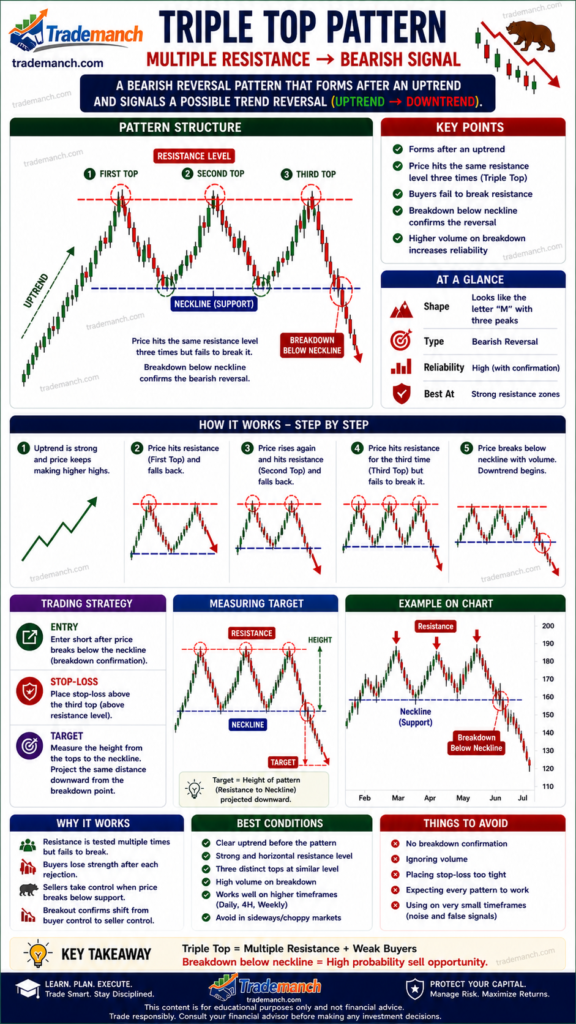
The Triple Top is a strong bearish reversal pattern that appears after a sustained uptrend. It signals that the price has tested a resistance level three times and failed—indicating a high probability of a downward move.
🔍 What is a Triple Top?
A Triple Top forms when the price hits the same resistance level three times but cannot break above it. This creates a structure similar to an extended “M” pattern with three peaks.
📊 Structure of the Pattern
- First Top
- Price rises and faces resistance
- Pulls back due to selling pressure
- Second Top
- Price retests resistance
- Fails again → weakness starts showing
- Third Top
- Another attempt to break resistance
- Fails → strong sign of buyer exhaustion
- Neckline (Support Level)
- Drawn by connecting the lows between peaks
- Acts as the breakdown level
⚠️ Why It Is Bearish?
This pattern shows:
- Buyers are unable to break resistance repeatedly
- Uptrend is losing strength
- Sellers are gradually taking control
📉 When price breaks below the neckline, it confirms a bearish reversal
📌 How to Trade Triple Top
✅ Entry Point:
- Enter a SELL trade after a confirmed breakdown below the neckline
🎯 Target:
- Measure the distance from Top to Neckline
- Project the same distance downward
🛑 Stop Loss:
- Place above the third top
📈 Example Strategy
- Wait for clear 3-touch resistance formation
- Confirm breakdown with high volume
- Use indicators:
- RSI below 50
- MACD bearish crossover
🚨 Common Mistakes to Avoid
❌ Entering before neckline break
❌ Ignoring false breakouts
❌ Misidentifying consolidation as triple top
❌ No risk management
💡 Pro Tips
✔ Stronger when all three tops are at similar levels
✔ Works best on higher timeframes (4H, Daily)
✔ Combine with resistance zones for confirmation
🔄 Opposite Pattern: Triple Bottom
- Forms after a downtrend
- Shows strong support tested three times
- Signals a bullish reversal
The Triple Top pattern is highly effective for:
- Identifying market tops
- Avoiding buying near resistance
- Entering high-probability sell trades
⚠️ Disclaimer
This content is for educational purposes only and not financial advice. Always do your own research before trading.