
MACD (Moving Average Convergence Divergence) is one of the most popular technical indicators used in trading and investing. Traders use MACD to identify:
- Trend direction
- Momentum strength
- Buy and sell signals
- Trend reversals
- Market momentum
MACD is widely used in:
- Intraday trading
- Swing trading
- Stock trading
- Forex trading
- Cryptocurrency trading
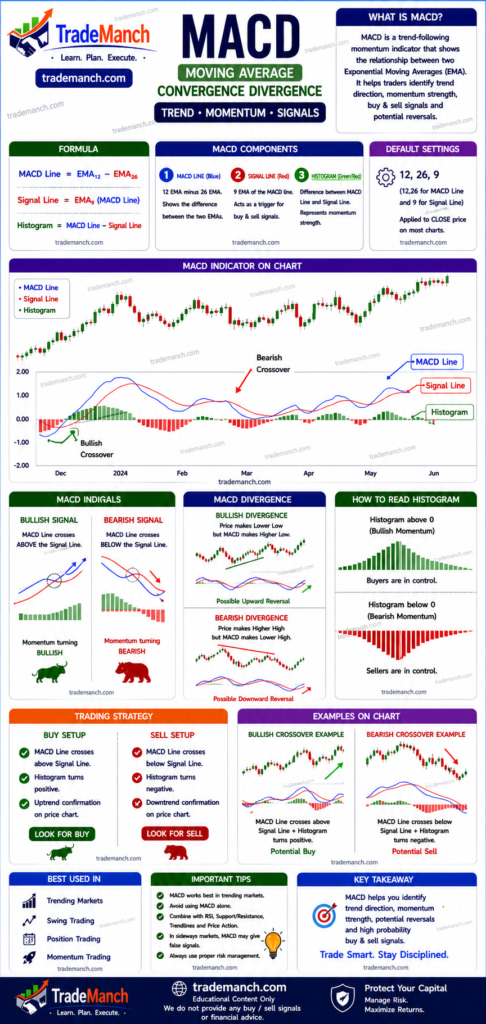
This complete beginner-friendly guide explains everything about MACD, including formulas, strategies, crossovers, advantages, limitations, and professional trading usage.
What Is MACD?
MACD stands for:
- Moving Average Convergence Divergence
It is a trend-following momentum indicator created by:
- Gerald Appel
MACD helps traders identify:
- Market trend
- Momentum changes
- Potential reversals
Simple Definition of MACD
MACD is a technical indicator that shows trend direction and momentum using moving averages.
Components of MACD
MACD consists of three main parts:
- MACD Line
- Signal Line
- Histogram
MACD Line
The MACD line is calculated by subtracting:
- 26 EMA from 12 EMA
Formula:
MACD=12EMA−26EMA
Signal Line
The signal line is:
- 9 EMA of the MACD line
It helps generate:
- Buy signals
- Sell signals
Histogram
The histogram shows:
- Difference between MACD line and signal line
It helps measure:
- Momentum strength
How MACD Works
MACD compares short-term and long-term momentum.
Bullish Momentum
When short-term momentum becomes stronger:
- MACD rises
Bearish Momentum
When short-term momentum weakens:
- MACD falls
MACD Crossover Signals
Crossovers are the most common MACD trading signals.
Bullish MACD Crossover
Occurs when:
- MACD line crosses above signal line
This may indicate:
- Bullish momentum
- Potential buying opportunity
Bearish MACD Crossover
Occurs when:
- MACD line crosses below signal line
This may indicate:
- Bearish momentum
- Potential selling opportunity
MACD Zero Line
The zero line is important in trend analysis.
MACD Above Zero
Indicates:
- Bullish trend
Short-term EMA is above long-term EMA.
MACD Below Zero
Indicates:
- Bearish trend
Short-term EMA is below long-term EMA.
MACD Histogram Explained
The histogram measures:
- Momentum strength
Expanding Histogram
Indicates:
- Increasing momentum
Shrinking Histogram
Indicates:
- Weakening momentum
Standard MACD Settings
Default MACD settings:
- 12 EMA
- 26 EMA
- 9 Signal Line
These are the most commonly used settings.
MACD Trading Strategies
1. MACD Crossover Strategy
Buy Signal
- MACD crosses above signal line
Sell Signal
- MACD crosses below signal line
This is the most basic MACD strategy.
2. MACD Zero Line Strategy
Bullish Signal
- MACD moves above zero line
Bearish Signal
- MACD moves below zero line
This helps identify major trend shifts.
3. MACD Divergence Strategy
Divergence occurs when:
- Price and MACD move differently
Bullish Divergence
Price:
- Makes lower low
MACD:
- Makes higher low
Possible signal:
- Bullish reversal
Bearish Divergence
Price:
- Makes higher high
MACD:
- Makes lower high
Possible signal:
- Bearish reversal
4. MACD + Moving Average Strategy
Popular setup:
- MACD confirms momentum
- Moving average confirms trend
Example Setup
Buy Conditions
- Price above 50 EMA
- MACD bullish crossover
This confirms:
- Uptrend momentum
MACD in Intraday Trading
Intraday traders use MACD for:
- Momentum trading
- Scalping
- Trend confirmation
Popular timeframes:
- 5-minute chart
- 15-minute chart
MACD in Swing Trading
Swing traders use MACD on:
- 1-hour chart
- Daily chart
to identify:
- Trend continuation
- Medium-term reversals
MACD in Cryptocurrency Trading
MACD is popular in crypto trading because of high volatility.
Popular cryptocurrencies:
- Bitcoin
- Ethereum
MACD in Stock Trading
Popular Indian stocks where traders use MACD:
- Reliance Industries
- Infosys
- HDFC Bank
Advantages of MACD
Easy to Understand
Suitable for beginners.
Trend Identification
Helps identify market direction.
Momentum Analysis
Measures strength of trends.
Useful in Multiple Markets
Works in:
- Stocks
- Forex
- Crypto
- Commodities
Limitations of MACD
Lagging Indicator
MACD uses past price data.
Signals may come late.
False Signals in Sideways Markets
MACD performs poorly in:
- Choppy markets
- Low-trend conditions
Not Accurate Alone
MACD should be combined with:
- Price action
- Support and resistance
- Risk management
Common Beginner Mistakes With MACD
Blindly Following Crossovers
Not all crossovers are reliable.
Ignoring Market Trend
Trend direction is very important.
Trading During Sideways Market
MACD works best in trending markets.
Using MACD Alone
Combine MACD with:
- Volume
- RSI
- Trend analysis
Best MACD Combination Indicators
Popular combinations:
- MACD + RSI
- MACD + Moving Average
- MACD + Volume Analysis
- MACD + Price Action
MACD vs RSI
| MACD | RSI |
|---|---|
| Trend-following indicator | Momentum indicator |
| Good for trend direction | Good for overbought/oversold |
| Slightly slower signals | Faster signals |
Many traders combine both indicators.
MACD vs Moving Average
| MACD | Moving Average |
|---|---|
| Combines momentum and trend | Mainly trend-following |
| More dynamic | Simpler structure |
Best Timeframe for MACD Beginners
Beginners often prefer:
- 15-minute chart
- 1-hour chart
- Daily chart
These provide cleaner signals.
Risk Management While Using MACD
Always use:
- Stop loss
- Position sizing
- Risk-reward ratio
Example of Risk-Reward Ratio
Suppose:
- Risk = ₹20
- Target = ₹60
Risk-reward ratio:
2060=3:1
Can MACD Guarantee Profits?
No indicator guarantees profits.
MACD improves:
- Trade analysis
- Momentum understanding
- Trend confirmation
Successful trading still requires:
- Discipline
- Risk management
- Patience
How Beginners Should Learn MACD
Step 1: Learn MACD Basics
Understand:
- Crossovers
- Histogram
- Trend direction
Step 2: Practice on Charts
Analyze historical MACD setups.
Step 3: Combine With Trend Analysis
Avoid isolated signals.
Step 4: Use Demo Trading
Practice before using real money.
Best Market Conditions for MACD
MACD works best in:
- Trending markets
- Strong momentum conditions
It performs poorly during:
- Sideways consolidation
MACD is one of the most powerful and beginner-friendly trend-following indicators in technical analysis. It helps traders identify momentum, trend direction, and possible reversals using moving averages.
However, MACD should not be used alone. Successful traders combine MACD with:
- Trend analysis
- RSI
- Price action
- Support and resistance
- Risk management
With proper practice and discipline, MACD can become an effective tool for trading stocks, forex, crypto, and other financial markets.
Frequently Asked Questions (FAQs)
1. What is MACD in trading?
MACD is a trend-following momentum indicator using moving averages.
2. Who created MACD?
MACD was created by Gerald Appel.
3. What is MACD crossover?
It occurs when MACD line crosses signal line.
4. What does MACD above zero mean?
It usually indicates bullish trend strength.
5. Is MACD good for beginners?
Yes, MACD is widely used by beginners and professionals.
6. Can MACD be used for intraday trading?
Yes, MACD is commonly used in intraday trading.
7. What is MACD divergence?
When price and MACD move differently, signaling possible reversal.
8. Is MACD better than RSI?
Both serve different purposes and are often used together.
9. Does MACD work in crypto trading?
Yes, MACD is popular in crypto markets.
10. Can MACD guarantee profits?
No, all indicators only improve probability and not certainty.