
A Stop-Loss is one of the most important risk management tools in trading and investing. Whether you trade stocks, commodities, forex, cryptocurrencies, or options, using a stop-loss can help protect your capital and prevent small losses from becoming large ones.
Many beginner traders focus on finding the perfect entry point, but professional traders understand that managing risk is far more important than finding the perfect trade. A well-placed stop-loss helps traders survive losing trades and stay in the market for the long term.
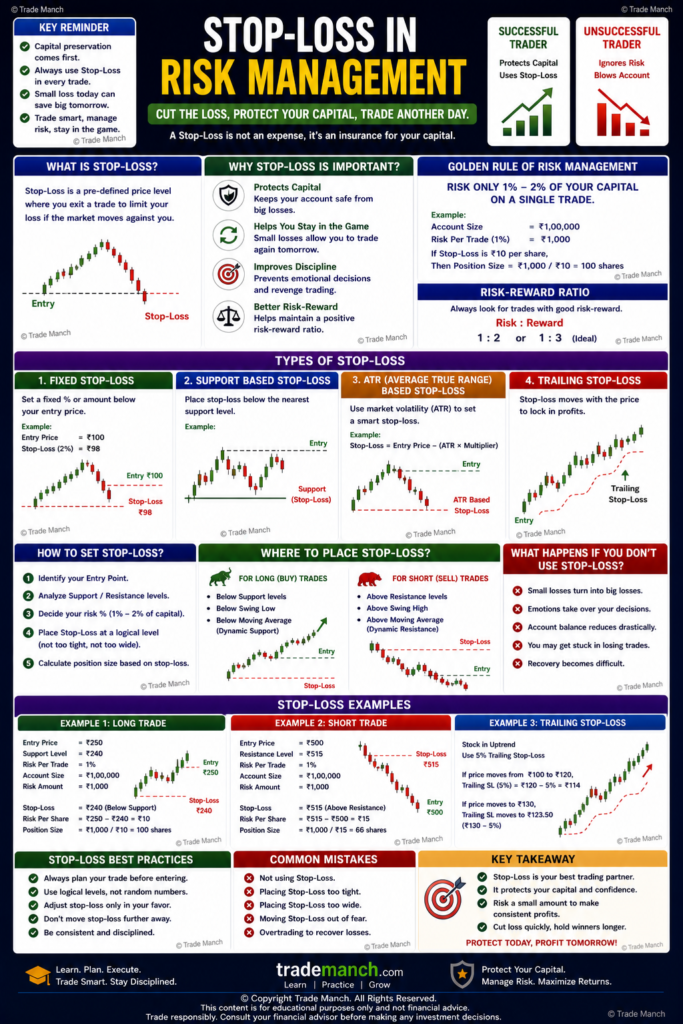
In this complete guide, you will learn everything about stop-loss orders, how they work, different types of stop-losses, advantages, disadvantages, and best practices for using them effectively.
What Is a Stop-Loss?
A stop-loss is a predefined price level at which a trader exits a position to limit potential losses.
It acts as a safety mechanism that automatically closes a trade if the market moves against the trader.
Simple Definition of Stop-Loss
A stop-loss is an order that automatically sells or exits a trade when the price reaches a specified level to prevent excessive losses.
Why Is Stop-Loss Important?
Stop-loss helps traders:
- Protect trading capital
- Limit losses
- Control emotions
- Improve discipline
- Manage risk effectively
Without a stop-loss, a single bad trade can significantly damage a trading account.
How Does a Stop-Loss Work?
Suppose you buy a stock at:
₹500
You decide that you are willing to risk only ₹20 per share.
Stop-loss level:
500−20=480
If the stock falls to ₹480:
- The trade is automatically exited.
- Your loss is limited.
Example of Stop-Loss in Trading
Trade Setup
Entry Price = ₹1,000
Stop-Loss = ₹950
Risk:
1000−950=50
Maximum loss per share = ₹50
This prevents unlimited losses if the stock continues falling.
Why Professional Traders Always Use Stop-Loss
Successful traders know that:
- Not every trade will be profitable.
- Losses are part of trading.
- Risk control is essential.
Stop-loss allows traders to survive losing trades and remain in the market.
Types of Stop-Loss Orders
There are several ways to place a stop-loss.
Fixed Stop-Loss
A fixed stop-loss is placed at a specific price level.
Example:
Entry = ₹500
Stop-Loss = ₹480
Risk = ₹20 per share
Percentage Stop-Loss
Based on a percentage of the stock price.
Example:
Entry = ₹1,000
Stop-Loss = 5%
Calculation:
1000×5%=50
Stop-loss:
1000−50=950
Technical Stop-Loss
Based on chart analysis.
Examples:
- Support levels
- Trendlines
- Moving averages
- Swing lows
Many professional traders prefer technical stop-loss placement.
Trailing Stop-Loss
A trailing stop-loss moves with the price as the trade becomes profitable.
Example:
Entry = ₹500
Trailing Stop = ₹20
If stock rises to ₹550:
New stop-loss:
550−20=530
This helps lock in profits.
Stop-Loss in Different Trading Styles
Intraday Trading
Intraday traders use tight stop-losses because trades are short-term.
Swing Trading
Swing traders often place stop-losses below key support levels.
Positional Trading
Positional traders generally use wider stop-losses due to longer holding periods.
Long-Term Investing
Investors may use fundamental or percentage-based stop-losses depending on strategy.
How to Calculate Position Size Using Stop-Loss
Proper position sizing is crucial.
Suppose:
Trading Capital = ₹1,00,000
Maximum Risk = 1%
Risk Amount:
100000×1%=1000
Maximum risk = ₹1,000
Trade:
Entry = ₹500
Stop-Loss = ₹490
Risk per share:
500−490=10
Position Size:
101000=100
Maximum quantity = 100 shares
Stop-Loss and Risk-Reward Ratio
Every trade should have a favorable risk-reward ratio.
Example:
Risk = ₹500
Target = ₹1,500
Risk-Reward Ratio:
5001500=3:1
Many professional traders seek at least a 1:2 or 1:3 ratio.
Advantages of Using Stop-Loss
Protects Capital
Limits losses on losing trades.
Removes Emotional Decisions
The exit is predefined.
Improves Discipline
Encourages consistent trading behavior.
Supports Long-Term Survival
Protecting capital is essential for long-term success.
Enables Better Risk Management
Every trade has a known risk.
Disadvantages of Stop-Loss
Premature Exits
Price may hit the stop-loss and then reverse.
Market Volatility
Temporary fluctuations can trigger stops.
Gap Risk
Stocks can open below the stop-loss after major news events.
Common Stop-Loss Mistakes
No Stop-Loss
One of the biggest mistakes beginners make.
Moving the Stop-Loss Farther Away
Many traders increase risk when trades move against them.
Placing Stop-Loss Too Tight
Normal market noise can trigger exits.
Ignoring Market Structure
Always consider support and resistance levels.
Risking Too Much Capital
Avoid risking large portions of your account on a single trade.
Best Stop-Loss Strategies
Support and Resistance Method
Place stop-loss below support in long trades.
Moving Average Method
Use key moving averages such as:
- 20 EMA
- 50 EMA
- 200 EMA
ATR-Based Stop-Loss
Use the Average True Range (ATR) indicator to adjust stop-loss according to volatility.
Swing High/Swing Low Method
Place stop-loss beyond recent swing levels.
Stop-Loss in the Indian Stock Market
Whether trading stocks listed on:
- National Stock Exchange of India
- Bombay Stock Exchange
stop-loss remains a critical part of risk management.
Popular stocks such as:
- Reliance Industries
- Infosys
- HDFC Bank
can experience significant price movements, making stop-loss essential.
Stop-Loss vs Trailing Stop-Loss
| Feature | Stop-Loss | Trailing Stop-Loss |
|---|---|---|
| Fixed Level | Yes | No |
| Moves with Price | No | Yes |
| Locks Profit | No | Yes |
| Risk Protection | Yes | Yes |
How Beginners Should Use Stop-Loss
Step 1
Determine maximum risk per trade.
Step 2
Identify logical stop-loss level.
Step 3
Calculate position size.
Step 4
Enter trade only if risk-reward ratio is favorable.
Step 5
Never move stop-loss farther away.
Can Stop-Loss Guarantee Protection?
No.
Stop-loss reduces risk but cannot eliminate it completely.
Events such as:
- Market gaps
- Flash crashes
- Extreme volatility
may result in execution at different prices.
A stop-loss is one of the most important tools in trading and investing. It helps protect capital, control risk, improve discipline, and remove emotional decision-making.
Successful traders understand that losses are inevitable, but large losses are avoidable. By using proper stop-loss techniques, position sizing, and risk management, traders can improve consistency and increase their chances of long-term success.
Remember: the goal of a stop-loss is not to avoid every loss—it is to prevent small losses from becoming devastating ones.
Frequently Asked Questions (FAQs)
1. What is a stop-loss?
A stop-loss is an order that automatically exits a trade when a specified price is reached.
2. Why is stop-loss important?
It helps limit losses and protect trading capital.
3. Should every trade have a stop-loss?
Most professional traders use a stop-loss on every trade.
4. What is a trailing stop-loss?
A stop-loss that moves with the price as the trade becomes profitable.
5. What is the best stop-loss method?
It depends on the strategy. Common methods include support/resistance and ATR-based stops.
6. Can stop-loss guarantee protection?
No. It reduces risk but cannot eliminate all market risks.
7. What is a good risk percentage per trade?
Many professional traders risk only 1% to 2% of their capital per trade.
8. What happens if I don’t use a stop-loss?
A single large loss can significantly damage your trading account.
9. Is stop-loss useful for investors?
Yes, depending on investment strategy and risk tolerance.
10. Can a stop-loss be triggered by market volatility?
Yes. Short-term price fluctuations can sometimes trigger stop-loss orders.