
Position sizing is one of the most important concepts in trading and investing. Many beginner traders focus on finding the perfect stock, indicator, or strategy, but professional traders know that risk management and position sizing are the real keys to long-term success.
Even a profitable trading strategy can fail if position sizes are too large. On the other hand, proper position sizing can help protect your capital and keep you in the market during losing streaks.
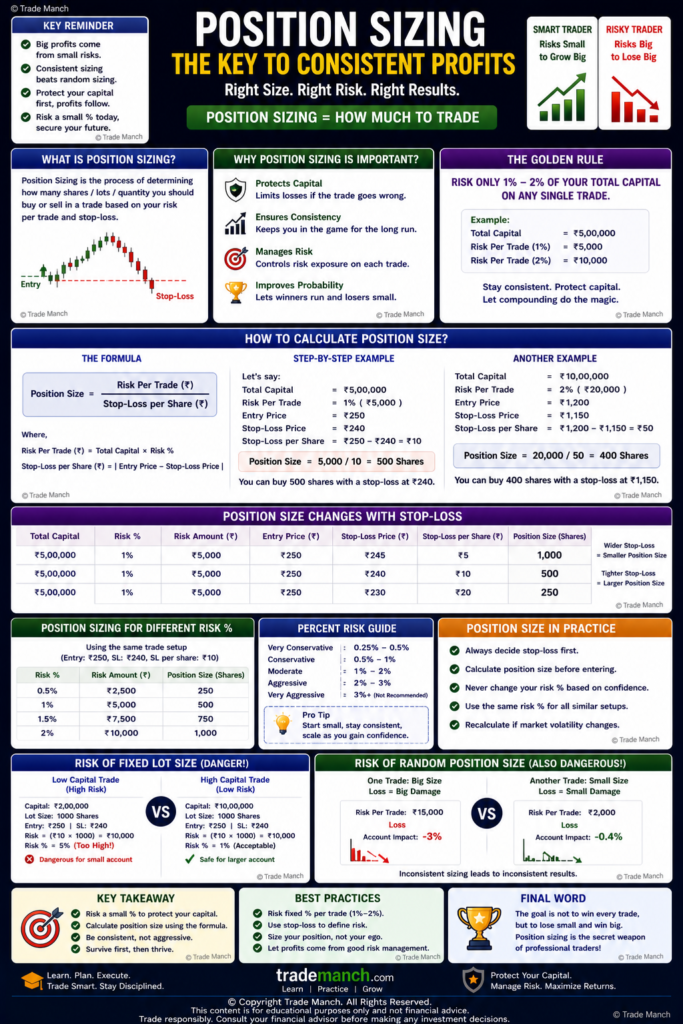
This complete guide explains everything about position sizing, including calculations, formulas, examples, strategies, and risk management techniques.
What Is Position Sizing?
Position sizing refers to determining how many shares, lots, or units you should buy or sell in a trade based on your trading capital and risk tolerance.
It helps traders control risk and avoid excessive losses.
Simple Definition of Position Sizing
Position sizing is the process of deciding how much money to allocate to a trade while keeping risk under control.
Why Is Position Sizing Important?
Position sizing helps traders:
- Protect trading capital
- Control risk
- Prevent large losses
- Improve consistency
- Reduce emotional trading
- Survive losing streaks
Without proper position sizing, even a few losing trades can wipe out a trading account.
How Position Sizing Works
Position sizing is based on:
- Account size
- Risk percentage
- Stop-loss distance
Before entering a trade, traders calculate how much they are willing to lose if the trade goes wrong.
The Golden Rule of Position Sizing
Most professional traders risk:
- 1% to 2% of total trading capital per trade
This helps prevent large drawdowns.
Example
Trading Capital:
₹1,00,000
Risk per Trade:
1%
Risk Amount:
100000×1%=1000
Maximum loss allowed = ₹1,000
Position Sizing Formula
The most common formula is:
Position Size=Risk Per ShareAccount Risk
Where:
- Account Risk = Maximum amount willing to lose
- Risk Per Share = Entry Price − Stop Loss
Example 1: Stock Trading
Suppose:
Trading Capital = ₹1,00,000
Risk = 1%
Entry Price = ₹500
Stop Loss = ₹490
Risk Per Share:
500−490=10
Maximum Risk:
₹1,000
Position Size:
101000=100
Maximum quantity = 100 shares
Example 2: Higher Stop-Loss Distance
Entry Price = ₹500
Stop Loss = ₹480
Risk Per Share:
500−480=20
Position Size:
201000=50
Maximum quantity = 50 shares
Notice:
- Larger stop-loss distance
- Smaller position size
Why Position Sizing Matters More Than Winning Rate
Many traders focus only on winning trades.
However:
- Good position sizing protects capital.
- Poor position sizing can destroy accounts.
Even traders with a 40% win rate can be profitable if risk management is strong.
Position Sizing and Risk Management
Position sizing is a major part of risk management.
The goal is:
- Protect capital first
- Generate profits second
Professional traders focus on survival before growth.
Position Sizing and Risk-Reward Ratio
Example:
Risk = ₹1,000
Target = ₹3,000
Risk-Reward Ratio:
10003000=3:1
A favorable risk-reward ratio improves long-term profitability.
Common Position Sizing Methods
Fixed Percentage Method
Most popular approach.
Risk:
- 1%
- 2%
of total capital per trade.
Fixed Rupee Method
Risk the same amount on every trade.
Example:
- ₹500 per trade
- ₹1,000 per trade
Regardless of account size.
Volatility-Based Position Sizing
Position size depends on market volatility.
More volatile stocks:
- Smaller positions
Less volatile stocks:
- Larger positions
ATR-Based Position Sizing
Uses the Average True Range (ATR) indicator.
Benefits:
- Adjusts position size according to volatility.
- Popular among professional traders.
Position Sizing in Different Trading Styles
Intraday Trading
Typically:
- Smaller stop-loss
- Larger position size
Swing Trading
Typically:
- Moderate stop-loss
- Moderate position size
Positional Trading
Typically:
- Wider stop-loss
- Smaller position size
Long-Term Investing
Position sizing often depends on:
- Portfolio allocation
- Diversification
Position Sizing for Beginners
A simple rule:
Never risk more than:
- 1% of capital
on a single trade.
This helps protect beginners from major losses.
Position Sizing Example for Beginners
Capital:
₹50,000
Risk:
1%
Maximum Risk:
50000×1%=500
Entry:
₹200
Stop Loss:
₹190
Risk Per Share:
200−190=10
Position Size:
10500=50
Maximum quantity = 50 shares
Position Sizing in the Indian Stock Market
Position sizing is important whether trading:
- Stocks
- Futures
- Options
- Commodities
Popular stocks such as:
- Reliance Industries
- Infosys
- HDFC Bank
can experience significant volatility, making proper position sizing essential.
Benefits of Proper Position Sizing
Capital Protection
Reduces risk of major losses.
Emotional Stability
Traders feel less pressure.
Consistency
Improves long-term performance.
Better Risk Control
Each trade has predefined risk.
Survival During Losing Streaks
Allows traders to withstand multiple losses.
Common Position Sizing Mistakes
Risking Too Much
Many beginners risk:
- 10%
- 20%
or more on one trade.
This is dangerous.
Ignoring Stop-Loss
Position sizing depends on stop-loss placement.
Using Full Capital on Every Trade
Never invest all capital in one position.
Increasing Size After Losses
This often leads to emotional trading.
Overconfidence After Winning Streaks
Maintain consistent risk regardless of recent results.
Portfolio Position Sizing
Long-term investors should also manage allocation.
Example Portfolio:
- 40% Large Cap Stocks
- 25% Mid Cap Stocks
- 15% Small Cap Stocks
- 10% Gold
- 10% Cash
Diversification reduces risk.
Position Sizing vs Leverage
Leverage allows traders to control larger positions.
Example:
Capital = ₹50,000
Leverage = 5x
Trading Value:
50000×5=250000
Position sizing becomes even more important when using leverage.
Can Position Sizing Improve Profitability?
Yes.
Position sizing helps:
- Reduce losses
- Improve consistency
- Protect capital
While it cannot guarantee profits, it can significantly improve long-term trading performance.
How Beginners Should Learn Position Sizing
Step 1
Understand risk management.
Step 2
Learn stop-loss placement.
Step 3
Use the 1% risk rule.
Step 4
Practice calculations.
Step 5
Track performance in a trading journal.
Position sizing is one of the most important skills every trader and investor should master. It helps determine how much capital to allocate to a trade while controlling risk and protecting your account from large losses.
Successful traders understand that preserving capital is the foundation of long-term profitability. By combining proper position sizing, stop-loss placement, and disciplined risk management, traders can improve consistency and increase their chances of long-term success in the financial markets.
Frequently Asked Questions (FAQs)
1. What is position sizing?
Position sizing is the process of determining how much capital to allocate to a trade.
2. Why is position sizing important?
It helps manage risk and protect trading capital.
3. How much should I risk per trade?
Many professional traders risk only 1% to 2% of their capital.
4. What is the position sizing formula?
Position Size=Risk Per ShareAccount Risk
5. Does position sizing guarantee profits?
No, but it helps reduce losses and improve consistency.
6. What is risk per share?
Risk per share is the difference between entry price and stop-loss price.
7. Can position sizing be used in intraday trading?
Yes, it is essential for all trading styles.
8. Is position sizing important for investors?
Yes, proper portfolio allocation is a form of position sizing.
9. What is the 1% rule?
It means risking no more than 1% of total capital on a single trade.
10. Can poor position sizing cause losses?
Yes. Even a good strategy can fail if position sizes are too large.