
The Indian stock market does not operate in isolation. In today’s interconnected world, events occurring in major economies such as the United States, China, Europe, Japan, and the Middle East can significantly influence Indian markets.
Many investors wonder why Indian markets sometimes fall even when there is no major domestic news. The answer often lies in global market movements, international economic data, geopolitical developments, and foreign investor behavior.
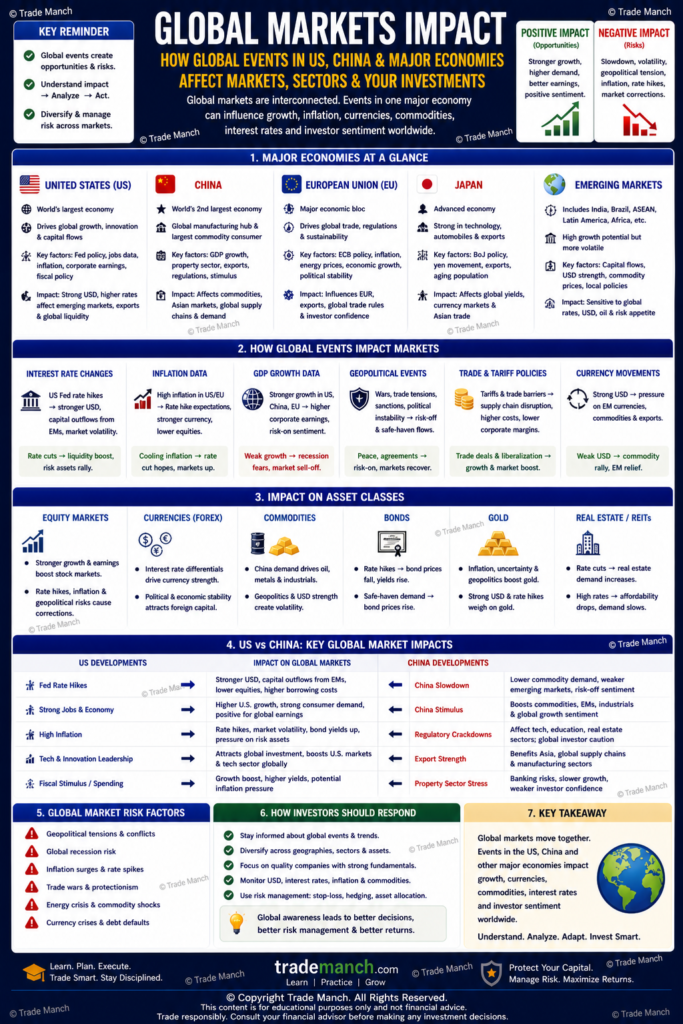
Understanding how global markets affect India can help traders and investors make better decisions and prepare for market volatility.
What Are Global Markets?
Global markets refer to financial markets around the world where stocks, bonds, commodities, currencies, and other financial instruments are traded.
Major global markets include:
- United States
- China
- Japan
- Germany
- United Kingdom
Movements in these markets often impact the Indian stock market.
Simple Definition of Global Markets
Global markets are international financial markets whose economic and market activities can influence stock prices worldwide.
Why Global Markets Affect India
India is connected to the global economy through:
- International trade
- Foreign investments
- Currency markets
- Commodity imports
- Global supply chains
As a result, major global events often affect Indian businesses and investors.
How Global Markets Influence Indian Stocks
Global developments can impact:
- Investor sentiment
- Foreign Institutional Investment (FII) flows
- Corporate earnings
- Commodity prices
- Currency exchange rates
These factors directly affect Indian stock prices.
Impact of the US Market on India
The United States is the world’s largest economy and has a significant influence on global financial markets.
Major US indices include:
- S&P 500
- Dow Jones Industrial Average
- NASDAQ Composite
Why the US Market Matters
The US influences:
- Global economic growth
- Interest rates
- Technology sector performance
- Investment flows
When US markets rise strongly, investor confidence often improves globally.
US Federal Reserve and Indian Markets
The US central bank, the:
- Federal Reserve System
plays a major role in global markets.
Interest Rate Hikes
When the Federal Reserve increases interest rates:
- US investments become more attractive
- Foreign investors may withdraw money from emerging markets
This can create pressure on Indian stocks.
Interest Rate Cuts
Lower US interest rates often encourage investors to seek higher returns in countries like India.
This can increase foreign investment inflows.
Impact of US Technology Stocks
Major technology companies influence global sentiment.
Examples include:
- Apple Inc.
- Microsoft Corporation
- NVIDIA Corporation
Strong performance in global technology stocks often benefits Indian IT companies.
Impact of China on Indian Markets
China is the world’s second-largest economy and a major manufacturing hub.
Why China Matters
China affects:
- Global trade
- Commodity demand
- Manufacturing supply chains
Economic slowdowns in China can influence global growth expectations.
Chinese Economic Growth
Strong Chinese growth often supports:
- Commodity prices
- Global demand
- Emerging markets
Weak growth may create market uncertainty.
Impact on Indian Sectors
Chinese developments often affect:
Metal Companies
Demand for metals depends heavily on Chinese industrial activity.
Chemical Companies
Supply chain changes can influence pricing.
Manufacturing Businesses
Global manufacturing trends impact Indian exports.
Impact of Crude Oil Prices
India imports a large portion of its crude oil requirements.
Crude oil prices significantly affect:
- Inflation
- Corporate costs
- Economic growth
Rising Oil Prices
Higher oil prices can:
- Increase inflation
- Raise transportation costs
- Pressure corporate margins
This may negatively impact the stock market.
Falling Oil Prices
Lower oil prices often benefit India by:
- Reducing import costs
- Lowering inflation pressure
- Supporting economic growth
Impact of Currency Markets
The exchange rate between the:
- Indian Rupee
- United States Dollar
is closely monitored by investors.
Weak Rupee
Benefits:
- Export-oriented companies
- IT sector
- Pharmaceutical exporters
Strong Rupee
Benefits:
- Import-heavy industries
- Companies dependent on foreign raw materials
Impact of Foreign Institutional Investors (FIIs)
Foreign investors play a major role in Indian markets.
Examples include:
- Global mutual funds
- Pension funds
- Hedge funds
FII Buying
When FIIs invest heavily in India:
- Market liquidity increases
- Stock prices often rise
FII Selling
Large withdrawals can create downward pressure on markets.
Impact of European Markets
Major European economies influence global sentiment.
Examples include:
- Germany
- France
- United Kingdom
European economic weakness can impact global trade and Indian exports.
Impact of Japan on Indian Markets
Japan remains a major investor in India.
Japanese economic conditions affect:
- Global liquidity
- Investment flows
- Infrastructure investments
Impact of Geopolitical Events
Global political events can significantly affect markets.
Examples:
- Wars
- Trade disputes
- Sanctions
- Political instability
These events often increase volatility.
Example: Global Conflict Impact
Major conflicts can lead to:
- Rising oil prices
- Supply chain disruptions
- Increased uncertainty
Markets generally react negatively to such developments.
Impact of Global Inflation
Global inflation affects:
- Interest rates
- Commodity prices
- Consumer spending
High inflation often leads central banks worldwide to tighten monetary policy.
Global Recession Impact on India
A global recession can affect:
- Exports
- Corporate earnings
- Foreign investments
However, domestic demand can sometimes help cushion the impact.
Which Indian Sectors Are Most Sensitive to Global Markets?
Information Technology (IT)
Companies such as:
- Infosys
- Tata Consultancy Services
depend heavily on global clients.
Pharmaceuticals
Export-oriented pharma companies are influenced by global demand.
Metals
Commodity prices affect profitability.
Oil & Gas
Highly sensitive to crude oil prices.
Banking
Indirectly affected through economic growth and investment flows.
How Traders Use Global Market Information
Professional traders monitor:
- US market closing performance
- Asian market openings
- Commodity prices
- Currency movements
- Global economic news
These factors help assess market sentiment.
How Long-Term Investors Should View Global Events
Long-term investors should:
- Focus on fundamentals
- Avoid emotional reactions
- Understand long-term implications
Short-term global volatility is often temporary.
Common Beginner Mistakes
Following Every Global Headline
Not all news has a lasting market impact.
Panic Selling
Temporary market declines are common.
Ignoring Domestic Fundamentals
Indian markets are also driven by domestic growth.
Overreacting to FII Activity
Short-term flows do not always determine long-term market direction.
How Investors Should Monitor Global Markets
Daily Checklist
- US market performance
- Asian market trends
- Crude oil prices
- Dollar index
- FII activity
- Major economic announcements
This provides a broader understanding of market conditions.
Global Markets vs Indian Markets
| Factor | Global Impact | Indian Impact |
|---|---|---|
| US Interest Rates | Very High | High |
| China Growth | High | Moderate to High |
| Oil Prices | High | Very High |
| Currency Movements | High | High |
| Geopolitical Events | High | Moderate to High |
| Domestic Policies | Low | Very High |
Global markets play a crucial role in shaping the direction of the Indian stock market. Developments in the United States, China, Europe, Japan, and global commodity markets can influence investor sentiment, foreign investment flows, corporate earnings, and economic growth.
Successful investors understand that market movements are driven by both domestic and international factors. By monitoring global trends while staying focused on long-term fundamentals, investors can better navigate market volatility and identify valuable investment opportunities.
Remember: India is part of a global financial ecosystem, and understanding global market influences is essential for becoming a well-informed investor.
Frequently Asked Questions (FAQs)
1. Why do US markets affect Indian markets?
The US is the world’s largest economy and influences global investment flows and market sentiment.
2. How does the Federal Reserve impact India?
US interest rate decisions affect foreign investment and global liquidity.
3. Why is China important for Indian markets?
China influences global trade, commodities, and manufacturing demand.
4. How do oil prices affect India?
India imports large quantities of crude oil, making oil prices important for inflation and growth.
5. What are FIIs?
Foreign Institutional Investors are overseas institutions that invest in Indian markets.
6. Can global recessions affect Indian stocks?
Yes. They can impact exports, investments, and corporate earnings.
7. Why do traders monitor US markets daily?
US market performance often influences the next trading session in India.
8. How does a weak rupee affect stocks?
It can benefit exporters and IT companies.
9. Should long-term investors worry about global volatility?
Long-term investors should focus more on fundamentals than short-term fluctuations.
10. Which global factor affects India the most?
US interest rates and crude oil prices are among the most influential global factors.