
Investing in the stock market is one of the best ways to build long-term wealth and achieve financial freedom. Many beginners want to start investing but often feel confused because of technical terms, risks, and market fluctuations.
The good news is that anyone can start investing in the stock market with proper knowledge and discipline. In this complete beginner-friendly guide, you will learn step-by-step how to start investing in the stock market in India.
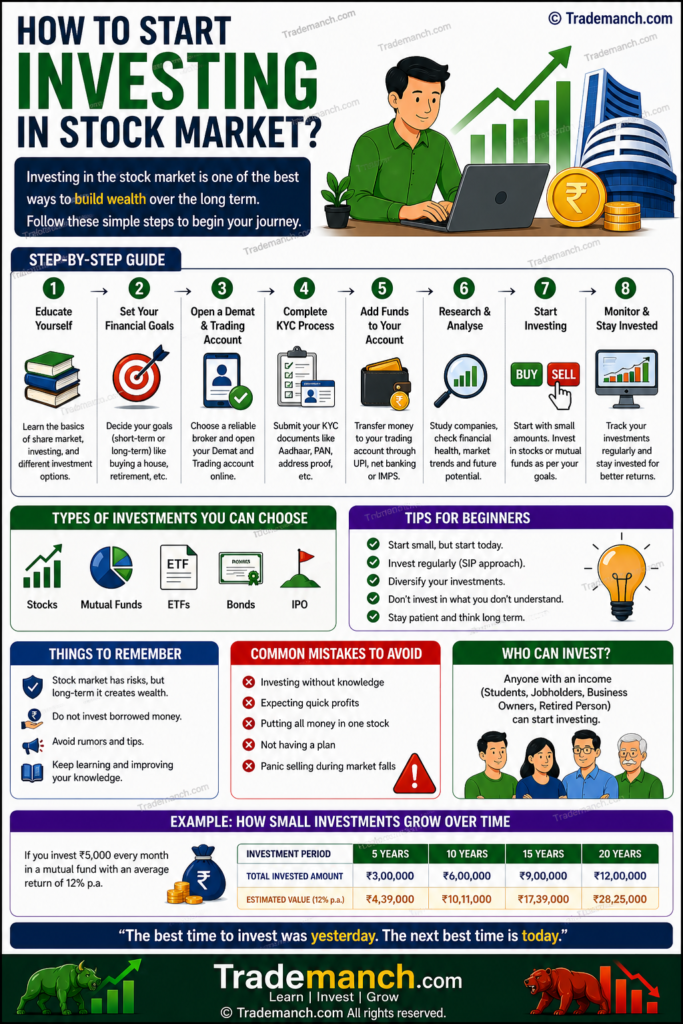
What Is Stock Market Investing?
Stock market investing means buying shares of companies to grow your money over time.
When you buy shares of a company, you become a part-owner of that business. If the company grows, the value of your investment may increase.
Examples of popular Indian companies:
- Reliance Industries
- Infosys
- Tata Consultancy Services
Why Should You Invest in the Stock Market?
Investing helps:
- Build long-term wealth
- Beat inflation
- Create passive income
- Achieve financial goals
- Grow savings faster than traditional methods
Historically, stock markets have provided better long-term returns than savings accounts or fixed deposits.
Step 1: Learn Stock Market Basics
Before investing money, understand basic concepts like:
- Shares
- Stock market
- IPO
- Dividend
- Bull and bear market
- Risk management
- Demat account
Knowledge reduces investment mistakes.
Step 2: Set Financial Goals
Decide why you want to invest.
Examples:
- Retirement planning
- Buying a house
- Child education
- Wealth creation
- Passive income
Clear goals help choose the right investment strategy.
Step 3: Understand Your Risk Tolerance
Every investor has different risk capacity.
Conservative Investors
Prefer lower-risk investments.
Moderate Investors
Balance risk and returns.
Aggressive Investors
Take higher risks for higher returns.
Beginners should usually start with moderate or lower-risk investments.
Step 4: Open a Demat and Trading Account
To invest in the Indian stock market, you need:
Demat Account
Stores shares electronically.
Trading Account
Used to buy and sell shares.
Popular brokers include:
- Zerodha
- Groww
- Upstox
- Angel One
Documents Required to Open an Account
You generally need:
- PAN Card
- Aadhaar Card
- Mobile Number
- Email ID
- Bank Account
Most brokers allow paperless online account opening.
Step 5: Start With a Small Amount
Beginners should avoid investing large amounts initially.
You can start with:
- ₹500
- ₹1,000
- ₹5,000
Small investments help you learn without taking huge risks.
Step 6: Choose the Right Investment Option
There are different ways to invest in the stock market.
1. Direct Stocks
Buy shares of individual companies.
Suitable for:
- Investors willing to research companies.
2. Mutual Funds
Professionally managed investment funds.
Suitable for:
- Beginners
- Long-term investors
3. Index Funds
Funds that track indices like:
- Nifty 50
- Sensex
These are low-cost and beginner-friendly.
4. ETFs (Exchange Traded Funds)
Trade like stocks but track market indices or sectors.
Step 7: Research Before Investing
Never invest blindly.
Study:
- Company profits
- Revenue growth
- Debt levels
- Business model
- Industry growth
Good research reduces investment risk.
Step 8: Diversify Your Portfolio
Do not invest all money in one stock or sector.
Diversification means spreading investments across:
- Different industries
- Multiple companies
- Different asset types
This reduces overall risk.
Step 9: Invest Regularly
Regular investing builds wealth over time.
Many investors use:
- SIPs (Systematic Investment Plans)
SIPs help:
- Reduce market timing risk
- Create investment discipline
Step 10: Think Long Term
The stock market may fluctuate in the short term.
Long-term investing usually gives better results because of:
- Compounding
- Business growth
- Economic growth
Patience is very important.
Difference Between Investing and Trading
| Investing | Trading |
|---|---|
| Long-term wealth creation | Short-term profit focus |
| Lower risk | Higher risk |
| Requires patience | Requires constant monitoring |
| Suitable for beginners | More suitable for experienced traders |
Beginners should focus more on investing than trading.
What Is Compounding?
Compounding means earning returns on previous returns.
Example:
- Invest ₹10,000
- Earn 10% return
- Your money grows over time exponentially
Compounding is one of the biggest advantages of long-term investing.
Common Mistakes Beginners Make
Investing Without Knowledge
Always learn before investing.
Following Tips Blindly
Avoid random social media advice.
Panic Selling
Short-term market falls are normal.
Lack of Diversification
Never put all money in one stock.
Trying to Get Rich Quickly
Stock market wealth takes time and discipline.
Best Investment Options for Beginners
Beginners may start with:
- Index funds
- Mutual funds
- Blue-chip stocks
- SIP investments
Examples of stable companies:
- HDFC Bank
- Infosys
- ITC
What Is SIP Investing?
SIP (Systematic Investment Plan) allows investors to invest fixed amounts regularly.
Benefits:
- Disciplined investing
- Rupee cost averaging
- Long-term wealth creation
Importance of Risk Management
All investments carry risk.
To manage risk:
- Diversify investments
- Invest according to financial goals
- Avoid emotional decisions
- Focus on long-term growth
How Much Money Should Beginners Invest?
Invest only money you do not need immediately.
A common suggestion:
- Start with 10–20% of monthly savings
Gradually increase investments with experience.
Is Stock Market Investing Safe?
The stock market involves risk, but disciplined long-term investing in strong companies is generally safer than short-term speculation.
Risk can be reduced through:
- Research
- Diversification
- Patience
- Proper financial planning
Best Time to Start Investing
The best time to start investing is as early as possible.
Starting early gives:
- More compounding benefits
- Better wealth creation opportunities
How Beginners Can Track Investments
You can track investments using:
- Trading apps
- Portfolio trackers
- Financial news
- Company reports
Regular monitoring helps improve decisions.
Psychological Discipline in Investing
Successful investors avoid:
- Fear
- Greed
- Overtrading
- Emotional investing
Patience and discipline are key to long-term success.
Starting stock market investing is easier today than ever before. With proper learning, disciplined investing, and long-term thinking, beginners can gradually build wealth and achieve financial goals.
Start small, focus on learning, diversify investments, and stay patient during market fluctuations. The stock market rewards disciplined and informed investors over time.
Frequently Asked Questions (FAQs)
1. How can beginners start investing in the stock market?
Beginners can start by opening a Demat and trading account and learning market basics.
2. How much money is needed to start investing?
You can start with even ₹500 or ₹1,000.
3. Is stock market investing risky?
Yes, all investments involve risk, but proper research reduces risk.
4. Which app is best for beginners in India?
Popular apps include Groww, Zerodha, and Upstox.
5. What is the safest investment for beginners?
Index funds and large-cap stocks are relatively safer.
6. Should beginners do trading or investing?
Beginners should focus more on long-term investing.
7. What is SIP investing?
SIP allows regular investment of fixed amounts in mutual funds.
8. Can I lose money in the stock market?
Yes, stock prices fluctuate and losses are possible.
9. How long should I invest in stocks?
Long-term investing generally provides better results.
10. Is stock market investing better than saving money in banks?
Historically, stock markets have provided higher long-term returns than traditional savings accounts.