
Risk is one of the most important concepts in the stock market. Every investor and trader faces some level of risk while investing money in stocks, mutual funds, IPOs, or other financial instruments.
Understanding stock market risk is essential because it helps investors make smarter decisions, protect their capital, and manage losses effectively.
In this complete beginner-friendly guide, you will learn what risk in the stock market means, types of risks, causes, examples, and methods to reduce investment risk.
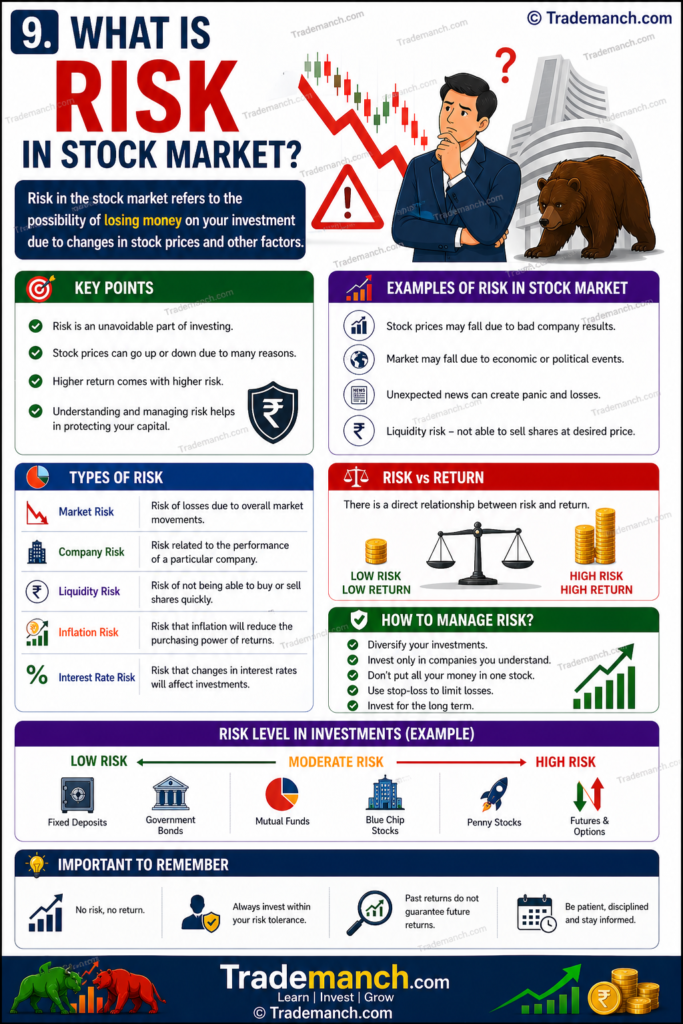
What Is Risk in the Stock Market?
Stock market risk refers to the possibility of losing money or earning lower-than-expected returns due to changes in market conditions, company performance, economic events, or other factors.
In simple words:
- Risk means the chance of financial loss in investments.
Simple Definition of Risk
Risk is the uncertainty of returns in the stock market.
There is no guarantee that stock prices will always rise. Prices may increase or decrease depending on market conditions.
Example of Stock Market Risk
Suppose:
- You buy shares at ₹1,000.
- Due to poor market conditions, the price falls to ₹800.
Loss:
1000−800=200
You lose ₹200 per share.
This possibility of loss is called stock market risk.
Why Is There Risk in the Stock Market?
The stock market is affected by many changing factors such as:
- Company profits
- Economic conditions
- Inflation
- Interest rates
- Government policies
- Global events
- Investor emotions
Because these factors constantly change, the market is uncertain and risky.
Types of Risk in the Stock Market
There are several types of risks investors should understand.
1. Market Risk
Market risk is the risk of losses caused by overall market decline.
Even good companies can fall during weak market conditions.
Example:
- Economic recession
- Market crash
- Global crisis
2. Company Risk
Company risk occurs when a particular company performs poorly.
Reasons include:
- Low profits
- High debt
- Bad management
- Weak sales
Example:
If a company reports heavy losses, its share price may fall sharply.
3. Volatility Risk
Volatility means rapid price fluctuations.
Highly volatile stocks can move sharply up or down within a short period.
This increases uncertainty and trading risk.
4. Liquidity Risk
Liquidity risk happens when investors cannot easily buy or sell shares.
Low-volume stocks may:
- Have fewer buyers
- Cause difficulty during selling
5. Inflation Risk
Inflation reduces purchasing power.
If investment returns are lower than inflation:
- Real wealth decreases.
6. Interest Rate Risk
Higher interest rates often negatively affect stock markets because:
- Borrowing becomes expensive
- Business growth slows down
7. Political and Economic Risk
Government policies, elections, wars, or global tensions can affect stock prices.
Example:
- Policy changes
- Tax increases
- International conflicts
8. Currency Risk
Currency fluctuations affect companies involved in exports and imports.
Example:
- Weak rupee may impact certain industries.
9. Emotional Risk
Fear and greed often lead to poor investment decisions.
Examples:
- Panic selling during market falls
- Buying stocks due to hype
Difference Between Risk and Return
In the stock market:
- Higher risk usually offers higher return potential.
- Lower risk generally offers lower returns.
This relationship is called the risk-return tradeoff.
Why Is Risk Important in Investing?
Understanding risk helps investors:
- Protect capital
- Make informed decisions
- Reduce losses
- Choose suitable investments
- Build long-term wealth safely
Can Risk Be Completely Removed?
No, stock market risk cannot be completely eliminated.
However, it can be reduced through:
- Diversification
- Proper research
- Long-term investing
- Risk management
What Is Risk Management?
Risk management means controlling and reducing potential losses in investments.
Good investors always focus on protecting capital before earning profits.
How to Reduce Risk in the Stock Market
1. Diversification
Do not invest all money in one stock.
Spread investments across:
- Different sectors
- Multiple companies
- Various asset classes
Diversification reduces overall portfolio risk.
2. Invest for Long Term
Long-term investing usually reduces short-term market volatility.
Historically, long-term investors often recover from market declines.
3. Research Before Investing
Study:
- Company financials
- Business model
- Industry growth
- Management quality
Proper research reduces company risk.
4. Avoid Emotional Decisions
Do not invest based on fear, greed, or social media hype.
Stay disciplined and follow strategy.
5. Use Stop Loss
Stop loss helps limit losses in trading.
Example:
- Buy stock at ₹500
- Stop loss at ₹480
If price falls to ₹480:
- Trade exits automatically.
6. Invest According to Risk Capacity
Choose investments based on:
- Income
- Financial goals
- Age
- Experience
Beginners should avoid excessive risk.
Risk in Trading vs Investing
| Trading | Investing |
|---|---|
| Higher short-term risk | Lower long-term risk |
| Frequent buying and selling | Long holding periods |
| High volatility exposure | More stability over time |
High-Risk vs Low-Risk Investments
| High Risk | Low Risk |
|---|---|
| Small-cap stocks | Large-cap stocks |
| Intraday trading | Index funds |
| Options trading | Government bonds |
| Penny stocks | Blue-chip companies |
What Is Risk Appetite?
Risk appetite means the level of risk an investor is comfortable taking.
Conservative Investors
Prefer lower risk.
Moderate Investors
Balance risk and returns.
Aggressive Investors
Take higher risks for higher returns.
What Is a Market Crash?
A market crash is a sudden and sharp decline in stock prices.
Examples include:
- Financial crises
- Global pandemics
- Economic recessions
Market crashes increase investment risk significantly.
Psychological Impact of Risk
Risk affects investor emotions.
Common emotional mistakes:
- Panic selling
- Revenge trading
- Overconfidence
- Fear of missing out (FOMO)
Successful investors control emotions during market volatility.
Is Stock Market Risky for Beginners?
Yes, the stock market can be risky for beginners without proper knowledge.
Beginners should:
- Start small
- Learn market basics
- Avoid leverage
- Focus on long-term investing
Safe Investment Practices for Beginners
Learn Before Investing
Education reduces mistakes.
Start With Large Companies
Blue-chip stocks are relatively safer.
Use SIP Investments
Regular investing reduces timing risk.
Avoid Quick Profit Schemes
Stay away from unrealistic promises.
Examples of Safer Investment Options
Beginners may consider:
- Index funds
- ETFs
- Large-cap stocks
- Dividend-paying companies
Examples:
- Reliance Industries
- Infosys
- Tata Consultancy Services
Risk in the stock market refers to the possibility of financial loss due to market fluctuations, economic conditions, company performance, and investor behavior. While risk cannot be completely removed, proper research, diversification, long-term investing, and disciplined risk management can significantly reduce losses.
Every investor should understand risk before investing money in the stock market. Smart investing is not about avoiding risk completely, but about managing it wisely.
Frequently Asked Questions (FAQs)
1. What is risk in the stock market?
Risk is the possibility of losing money in investments due to market changes.
2. Can stock market risk be avoided completely?
No, risk cannot be fully eliminated, but it can be reduced.
3. What is market risk?
Market risk is the risk caused by overall market decline.
4. Why are stocks risky?
Stock prices fluctuate due to economic, company, and market factors.
5. What is risk management?
Risk management means reducing potential investment losses.
6. How can beginners reduce stock market risk?
Beginners should diversify, invest long term, and research properly.
7. Is trading riskier than investing?
Yes, short-term trading is generally riskier than long-term investing.
8. What is diversification?
Diversification means spreading investments across different assets.
9. What is volatility risk?
Volatility risk refers to rapid price fluctuations in stocks.
10. Which investments are safer for beginners?
Index funds, ETFs, and large-cap stocks are relatively safer options.