
Intraday trading is one of the most popular forms of stock market trading. Every day, thousands of traders buy and sell stocks within a single trading session to earn profits from short-term price movements.
While intraday trading offers opportunities for quick profits, it also involves significant risks. Success in intraday trading requires proper knowledge, discipline, risk management, and a well-defined trading strategy.
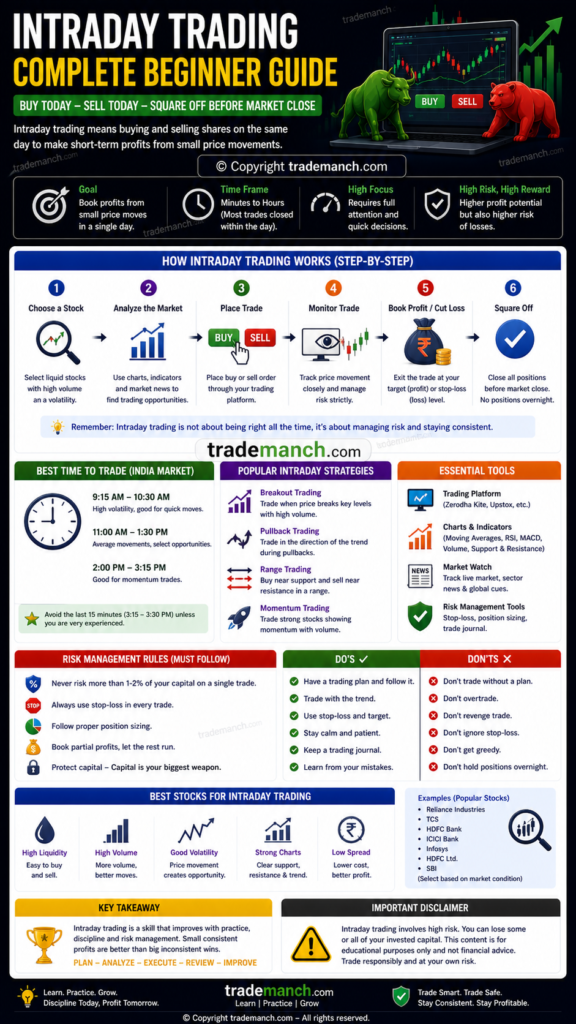
This complete beginner guide will help you understand everything about intraday trading, including how it works, strategies, advantages, risks, and common mistakes to avoid.
What Is Intraday Trading?
Intraday trading refers to buying and selling financial securities within the same trading day.
In intraday trading:
- Positions are opened and closed on the same day.
- No shares are carried overnight.
- Traders aim to profit from short-term price movements.
For example:
- Buy a stock at ₹500 in the morning.
- Sell it at ₹510 before market close.
Profit:
510−500=10
Profit per share = ₹10
Simple Definition of Intraday Trading
Intraday trading is the practice of buying and selling stocks, commodities, currencies, or other financial instruments within the same trading session.
How Intraday Trading Works
The process is simple:
- Identify a trading opportunity.
- Buy or sell a stock.
- Monitor price movement.
- Exit the trade before market closing.
Any open intraday position is generally squared off automatically by brokers if not closed manually.
Intraday Trading Timing in India
Indian stock market trading hours:
- Market Opens: 9:15 AM
- Market Closes: 3:30 PM
Most intraday traders focus on:
- Morning Session (9:15 AM – 11:00 AM)
- Afternoon Session (1:30 PM – 3:00 PM)
These periods often provide higher volatility and trading opportunities.
Who Can Do Intraday Trading?
Anyone with:
- Demat Account
- Trading Account
- Trading Capital
- Market Knowledge
can participate in intraday trading.
Popular brokers include:
- Zerodha
- Groww
- Angel One
- Upstox
Intraday Trading vs Delivery Trading
| Feature | Intraday Trading | Delivery Trading |
|---|---|---|
| Holding Period | Same Day | Multiple Days/Years |
| Objective | Quick Profit | Long-Term Wealth Creation |
| Risk | Higher | Lower |
| Capital Requirement | Lower (Leverage Available) | Higher |
| Time Commitment | High | Moderate |
Why Do People Choose Intraday Trading?
Many traders prefer intraday trading because:
- Quick profit opportunities
- No overnight risk
- Higher liquidity
- Frequent trading opportunities
- Ability to use leverage
Advantages of Intraday Trading
No Overnight Risk
Positions are closed before market close.
Global events after market hours do not affect your trade.
Multiple Trading Opportunities
Daily price movements create regular opportunities.
Leverage Benefits
Many brokers offer margin facilities.
Example:
Capital = ₹10,000
Leverage = 5x
Trading Power:
10000×5=50000
Trading capital becomes ₹50,000.
Potential for Daily Income
Experienced traders may generate regular profits.
Risks of Intraday Trading
High Volatility
Prices can change rapidly.
Emotional Pressure
Fast decisions may lead to mistakes.
Leverage Risk
Losses can increase significantly when using margin.
Market Uncertainty
Unexpected news can impact trades instantly.
Essential Requirements for Intraday Trading
Successful intraday traders need:
- Trading plan
- Risk management
- Trading journal
- Reliable internet connection
- Quality charting platform
Best Timeframes for Intraday Trading
Popular chart timeframes include:
| Trading Style | Timeframe |
|---|---|
| Scalping | 1-Minute |
| Fast Trading | 3-Minute |
| Intraday Trading | 5-Minute |
| Trend Trading | 15-Minute |
Most beginners start with:
- 5-minute chart
- 15-minute chart
Important Intraday Trading Indicators
Many traders use:
Moving Average (EMA)
Identifies trend direction.
RSI (Relative Strength Index)
Measures momentum.
VWAP (Volume Weighted Average Price)
Popular among professional traders.
MACD
Helps identify trend changes.
Supertrend
Provides buy and sell signals.
Popular Intraday Trading Strategies
1. Trend Following Strategy
Trade in the direction of the market trend.
Buy Example
- Price above 50 EMA
- Strong bullish momentum
Sell Example
- Price below 50 EMA
- Strong bearish momentum
2. Breakout Trading Strategy
Trade when price breaks important levels.
Examples:
- Resistance breakout
- Support breakdown
3. VWAP Strategy
Buy Setup
- Price above VWAP
Sell Setup
- Price below VWAP
Many institutional traders use VWAP.
4. Opening Range Breakout (ORB)
The first 15–30 minutes often create key levels.
Trade when price breaks:
- Opening High
- Opening Low
Intraday Trading Risk Management
Risk management is the most important part of trading.
Never Risk Too Much
Many professionals risk only:
- 1% of capital per trade
Example:
Capital = ₹1,00,000
Risk:
1%×100000=1000
Maximum risk = ₹1,000
Use Stop Loss
A stop loss automatically exits losing trades.
Example:
Entry = ₹500
Stop Loss = ₹490
Maximum loss:
500−490=10
Loss per share = ₹10
Maintain Risk-Reward Ratio
Good traders seek favorable risk-reward setups.
Example:
Risk = ₹500
Target = ₹1500
Ratio:
5001500=3:1
Common Intraday Trading Mistakes
Overtrading
Taking too many trades.
No Stop Loss
One large loss can destroy profits.
Trading Without a Plan
Random trades usually lead to losses.
Revenge Trading
Trying to recover losses emotionally.
Using Excessive Leverage
Can magnify losses.
Best Stocks for Intraday Trading
Look for stocks with:
- High liquidity
- Good volume
- Strong volatility
Examples:
- Reliance Industries
- HDFC Bank
- ICICI Bank
- Infosys
- Tata Consultancy Services
How Much Money Is Needed for Intraday Trading?
There is no fixed amount.
Many beginners start with:
- ₹5,000
- ₹10,000
- ₹25,000
However, focus on learning before increasing capital.
Can Intraday Trading Be a Full-Time Career?
Yes.
Many professional traders trade full-time.
However, it requires:
- Experience
- Discipline
- Risk management
- Consistent profitability
Beginners should avoid relying on trading as their only income source initially.
How Beginners Should Start Intraday Trading
Step 1
Learn market basics.
Step 2
Open a trading account.
Step 3
Practice using a demo account.
Step 4
Learn one trading strategy.
Step 5
Focus on risk management.
Step 6
Maintain a trading journal.
Can Intraday Trading Guarantee Profits?
No.
No trading strategy guarantees profits.
Successful traders focus on:
- Probability
- Risk management
- Consistency
- Discipline
rather than trying to win every trade.
Intraday trading offers exciting opportunities to profit from short-term market movements. However, it also carries significant risks and requires proper education, discipline, and risk management.
Beginners should focus on learning market structure, technical analysis, position sizing, and emotional control before risking substantial capital. With the right approach and continuous practice, intraday trading can become a valuable skill and potentially a profitable activity.
Frequently Asked Questions (FAQs)
1. What is intraday trading?
Intraday trading involves buying and selling securities within the same trading day.
2. Is intraday trading suitable for beginners?
Yes, but beginners should start with proper education and small capital.
3. What is the best timeframe for intraday trading?
Most beginners use 5-minute and 15-minute charts.
4. Do I need a Demat account for intraday trading?
Yes, along with a trading account.
5. What is leverage in intraday trading?
Leverage allows traders to control larger positions using smaller capital.
6. Which indicators are useful for intraday trading?
EMA, RSI, VWAP, MACD, and Supertrend.
7. What is a stop loss?
A stop loss limits losses by automatically exiting a trade at a specified price.
8. How much capital do I need to start?
Many beginners start with ₹5,000 to ₹25,000.
9. Can intraday trading provide regular income?
Possibly, but consistent profitability requires experience and discipline.
10. Can intraday trading guarantee profits?
No. Trading always involves risk, and profits are never guaranteed.