
The Risk-Reward Ratio (RRR) is one of the most important concepts in trading and investing. Successful traders understand that profitability is not just about winning trades—it is about managing risk and ensuring that potential rewards outweigh potential losses.
Many beginner traders focus only on finding winning trades, but professional traders focus on the relationship between risk and reward before entering any trade.
In this complete guide, you will learn what the Risk-Reward Ratio is, how it works, how to calculate it, its importance, and how to use it effectively in trading.
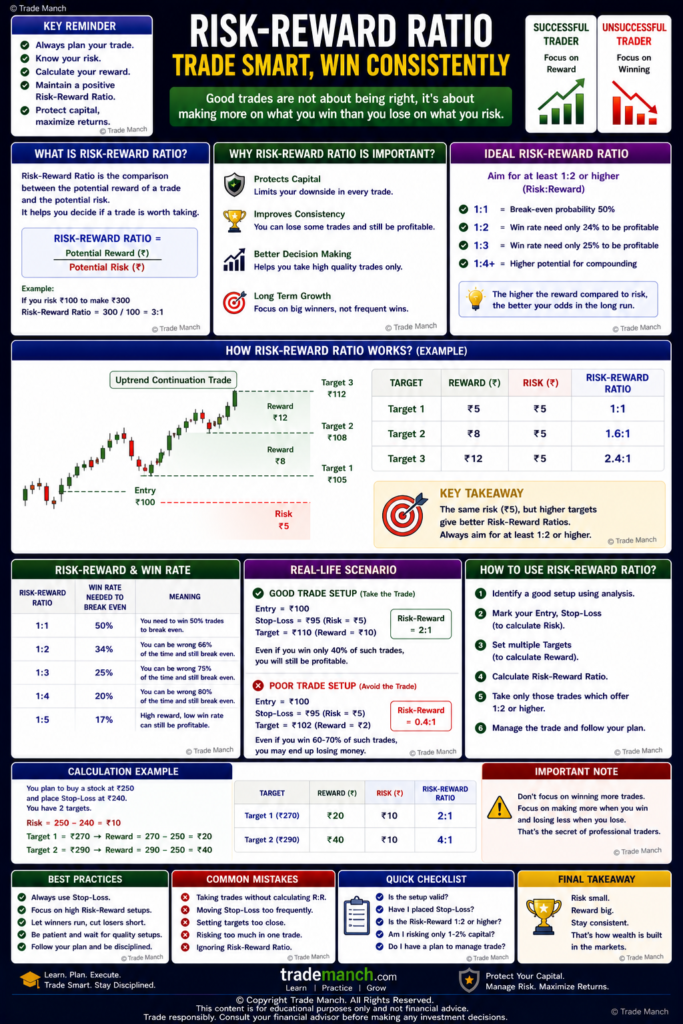
What Is Risk-Reward Ratio?
The Risk-Reward Ratio measures the amount of money a trader is willing to risk compared to the potential profit they expect to earn from a trade.
It helps traders determine whether a trade is worth taking.
Simple Definition of Risk-Reward Ratio
The Risk-Reward Ratio compares potential loss (risk) to potential profit (reward) in a trade.
Why Is Risk-Reward Ratio Important?
The Risk-Reward Ratio helps traders:
- Manage risk effectively
- Improve long-term profitability
- Maintain trading discipline
- Reduce emotional decision-making
- Evaluate trading opportunities
Even traders with a low win rate can be profitable if they maintain a favorable risk-reward ratio.
Risk-Reward Ratio Formula
The formula is:
Risk−Reward Ratio=Potential RiskPotential Reward
Where:
- Potential Reward = Target Price − Entry Price
- Potential Risk = Entry Price − Stop-Loss Price
Example 1: Basic Risk-Reward Calculation
Suppose:
- Entry Price = ₹500
- Stop-Loss = ₹490
- Target = ₹530
Risk:
500−490=10
Reward:
530−500=30
Risk-Reward Ratio:
1030=3:1
This means:
- Risk = ₹10
- Potential Reward = ₹30
Understanding Common Risk-Reward Ratios
| Risk-Reward Ratio | Meaning |
|---|---|
| 1:1 | Risk ₹1 to make ₹1 |
| 1:2 | Risk ₹1 to make ₹2 |
| 1:3 | Risk ₹1 to make ₹3 |
| 1:4 | Risk ₹1 to make ₹4 |
Higher reward relative to risk generally improves long-term profitability.
Why Professional Traders Use Risk-Reward Ratio
Professional traders understand that:
- Not every trade will win.
- Losses are inevitable.
- Good risk management creates consistency.
A favorable risk-reward ratio allows traders to remain profitable even with some losing trades.
Example of Profitability Using Risk-Reward Ratio
Suppose:
- 10 trades
- Win Rate = 40%
- Risk-Reward Ratio = 1:3
Wins:
4 trades × ₹3,000 = ₹12,000
Losses:
6 trades × ₹1,000 = ₹6,000
Net Profit:
12000−6000=6000
Profit = ₹6,000
Even though the trader lost more trades than won, the overall result is profitable.
Best Risk-Reward Ratio for Trading
Many professional traders prefer:
Minimum 1:2
Risk ₹1 to earn ₹2.
Preferred 1:3
Risk ₹1 to earn ₹3.
Higher Than 1:3
Can provide greater profitability but may reduce winning frequency.
Risk-Reward Ratio in Different Trading Styles
Intraday Trading
Common ratios:
- 1:1.5
- 1:2
- 1:3
Swing Trading
Common ratios:
- 1:2
- 1:3
- 1:4
Positional Trading
Often seeks:
- 1:3
- 1:5
- 1:10
because larger trends are targeted.
Long-Term Investing
Investors focus less on fixed ratios and more on long-term return potential.
How to Identify a Good Risk-Reward Setup
Before entering a trade:
Step 1
Identify entry price.
Step 2
Determine stop-loss.
Step 3
Estimate realistic target.
Step 4
Calculate risk-reward ratio.
Step 5
Only enter if the ratio is favorable.
Example 2: Poor Risk-Reward Setup
Entry = ₹500
Stop-Loss = ₹490
Target = ₹505
Risk:
₹10
Reward:
₹5
Risk-Reward Ratio:
105=0.5:1
This is generally considered unattractive because the reward is smaller than the risk.
Risk-Reward Ratio and Stop-Loss
The stop-loss determines:
- Maximum risk
The target determines:
- Potential reward
Together, they create the risk-reward ratio.
Without a stop-loss, calculating proper risk-reward becomes difficult.
Risk-Reward Ratio and Position Sizing
Position sizing and risk-reward ratio work together.
Example:
Trading Capital = ₹1,00,000
Maximum Risk = 1%
Risk Amount:
100000×1%=1000
Maximum loss = ₹1,000
Proper position sizing ensures risk remains controlled.
Advantages of Using Risk-Reward Ratio
Improves Decision Making
Helps identify high-quality setups.
Controls Risk
Encourages disciplined trading.
Improves Profitability
Favorable ratios can offset losing trades.
Reduces Emotional Trading
Creates a structured approach.
Supports Long-Term Success
Professional traders consistently use risk-reward analysis.
Common Risk-Reward Ratio Mistakes
Ignoring Stop-Loss
Risk cannot be measured without a stop-loss.
Unrealistic Targets
Targets should be based on market structure.
Chasing Trades
Entering after a large move often reduces reward potential.
Taking Poor Ratios
Avoid trades where reward is smaller than risk.
Ignoring Probability
A high risk-reward ratio alone does not guarantee success.
Risk-Reward Ratio vs Win Rate
Many beginners think:
Higher Win Rate = More Profit
This is not always true.
Example:
Trader A
- Win Rate = 80%
- Risk-Reward = 1:0.5
Trader B
- Win Rate = 40%
- Risk-Reward = 1:3
Trader B may earn more despite winning fewer trades.
Risk-Reward Ratio in the Indian Stock Market
Whether trading:
- Stocks
- Futures
- Options
- Commodities
Risk-reward analysis remains essential.
Popular stocks such as:
- Reliance Industries
- Infosys
- HDFC Bank
often provide opportunities with favorable risk-reward setups.
How Beginners Should Use Risk-Reward Ratio
Step 1
Always define a stop-loss.
Step 2
Identify realistic targets.
Step 3
Calculate the ratio before entering.
Step 4
Prefer setups with at least 1:2 ratio.
Step 5
Follow your trading plan consistently.
Can Risk-Reward Ratio Guarantee Profits?
No.
Risk-reward ratio improves probability and consistency, but it cannot guarantee profitable trades.
Market conditions, execution, and discipline also play major roles.
The Risk-Reward Ratio is one of the most powerful tools in trading and investing. It helps traders evaluate opportunities, manage risk, and improve long-term profitability.
Successful traders understand that protecting capital is more important than chasing every trade. By combining favorable risk-reward ratios, proper stop-loss placement, position sizing, and disciplined execution, traders can significantly improve their chances of long-term success.
Remember: the goal is not to win every trade. The goal is to make more money from winning trades than you lose from losing trades.
Frequently Asked Questions (FAQs)
1. What is Risk-Reward Ratio?
The Risk-Reward Ratio compares potential profit to potential loss in a trade.
2. Why is Risk-Reward Ratio important?
It helps traders manage risk and evaluate trading opportunities.
3. What is a good Risk-Reward Ratio?
Many professional traders prefer at least 1:2 or 1:3.
4. Can I be profitable with a low win rate?
Yes, if your risk-reward ratio is favorable.
5. How do I calculate Risk-Reward Ratio?
Divide potential reward by potential risk.
6. Is stop-loss necessary for Risk-Reward calculations?
Yes, because stop-loss defines the risk portion.
7. What is better: high win rate or high Risk-Reward Ratio?
Both matter, but a favorable risk-reward ratio can compensate for a lower win rate.
8. Does Risk-Reward Ratio guarantee success?
No. It improves consistency but cannot eliminate risk.
9. Should beginners use Risk-Reward analysis?
Yes, it is one of the most important trading skills.
10. What is the minimum ratio beginners should target?
Many traders recommend at least a 1:2 Risk-Reward Ratio.