
The stock market is one of the most important parts of the global economy. It helps companies raise money and gives people an opportunity to grow their wealth through investments. Whether you are a student, a working professional, or someone interested in financial freedom, understanding the stock market is the first step toward smart investing.
What Is the Stock Market?
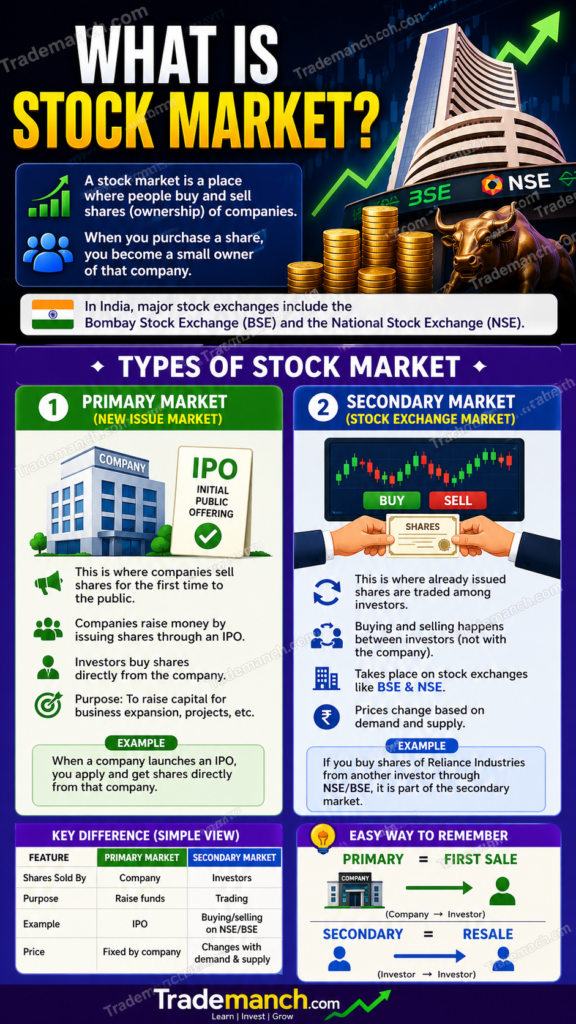
The stock market is a place where shares of companies are bought and sold. A share represents ownership in a company. When you buy shares of a company, you become a small owner of that company.
For example, if you buy shares of a company like Reliance Industries or Tata Consultancy Services, you own a small part of that company.
The stock market allows companies to collect money from the public to expand their business, and investors get a chance to earn profits through rising share prices and dividends.
Definition of Stock Market
The stock market is a financial marketplace where investors trade stocks, bonds, and other securities. It connects buyers and sellers through stock exchanges.
In India, the two major stock exchanges are:
- Bombay Stock Exchange (BSE)
- National Stock Exchange (NSE)
These exchanges regulate and manage stock trading activities.
How Does the Stock Market Work?
The stock market works through a network of buyers and sellers. Here is a simple explanation of the process:
1. Companies Issue Shares
When a company needs money, it offers shares to the public through an IPO (Initial Public Offering).
2. Investors Buy Shares
People purchase shares using trading platforms or brokers.
3. Share Prices Change
Stock prices rise or fall based on demand and supply, company performance, news, and market conditions.
4. Investors Earn Profit or Loss
If share prices increase, investors make profits. If prices fall, they may face losses.
What Is a Share?
A share is a unit of ownership in a company. Owning shares means you own a portion of that company.
For example:
- If a company has 1 lakh shares and you own 100 shares, you own a small percentage of the company.
Types of Stock Markets
There are mainly two types of stock markets:
1. Primary Market
This is where companies issue shares for the first time through IPOs.
2. Secondary Market
This is where investors buy and sell shares among themselves after the IPO.
Most daily trading happens in the secondary market.
Importance of the Stock Market
The stock market plays a major role in economic growth. Here are some reasons why it is important:
Helps Companies Raise Capital
Businesses collect funds for expansion and development.
Creates Wealth
Investors can grow their money over time.
Encourages Savings and Investment
People invest their savings instead of keeping money idle.
Supports the Economy
A strong stock market reflects economic growth and investor confidence.
Benefits of Investing in the Stock Market
1. Wealth Creation
Long-term investing can generate significant returns.
2. Passive Income
Some companies pay dividends regularly.
3. Liquidity
You can easily buy or sell shares during market hours.
4. Ownership in Companies
You become a shareholder in successful businesses.
5. Inflation Protection
Stock market returns often beat inflation over the long term.
Risks of the Stock Market
While the stock market offers opportunities, it also carries risks.
Market Risk
Prices can fall due to economic or political events.
Company Risk
Poor company performance may reduce stock value.
Volatility
Stock prices can change rapidly.
Emotional Trading
Fear and greed often lead to poor decisions.
Who Can Invest in the Stock Market?
Anyone above 18 years can invest in the stock market. In India, you need:
- PAN Card
- Aadhaar Card
- Bank Account
- Demat Account
- Trading Account
Popular stock brokers include:
- Zerodha
- Groww
- Upstox
What Is a Demat Account?
A Demat account stores your shares digitally. It works like a bank account, but instead of money, it holds stocks and securities.
Without a Demat account, you cannot invest in the stock market in India.
What Causes Stock Prices to Rise or Fall?
Several factors affect stock prices:
- Company profits
- Economic conditions
- Interest rates
- Government policies
- Global news
- Investor sentiment
- Demand and supply
For example, positive earnings reports usually increase stock prices.
Difference Between Trading and Investing
| Trading | Investing |
|---|---|
| Short-term activity | Long-term activity |
| Frequent buying and selling | Holding stocks for years |
| Higher risk | Relatively lower risk |
| Requires technical analysis | Requires fundamental analysis |
What Is Sensex and Nifty?
Sensex
The Sensex is an index of 30 major companies listed on BSE.
Nifty 50
The Nifty 50 is an index of 50 top companies listed on NSE.
These indices indicate overall market performance.
Basic Terms Every Beginner Should Know
Bull Market
A market where prices are rising.
Bear Market
A market where prices are falling.
Dividend
A portion of company profits shared with investors.
Portfolio
A collection of investments.
IPO
Initial Public Offering of shares.
Market Capitalization
The total value of a company’s shares.
Tips for Beginners in the Stock Market
Start With Learning
Understand market basics before investing.
Invest for Long Term
Long-term investing usually gives better returns.
Diversify Your Portfolio
Do not invest all money in one stock.
Avoid Emotional Decisions
Do not panic during market fluctuations.
Research Before Investing
Study company performance and financials.
Start Small
Begin with a small amount and gain experience.
Is the Stock Market Gambling?
No, the stock market is not gambling when done with proper knowledge and strategy. Gambling depends mostly on luck, while stock investing involves research, analysis, and long-term planning.
However, careless trading without knowledge can become risky.
How Beginners Can Start Investing
Here are simple steps:
- Open a Demat and trading account.
- Learn stock market basics.
- Choose fundamentally strong companies.
- Start SIPs or small investments.
- Monitor and review investments regularly.
Future of the Stock Market in India
India’s stock market is growing rapidly due to:
- Increasing digital awareness
- Rising retail investors
- Strong economic growth
- Easy mobile trading apps
More young people are now investing in stocks for wealth creation.
The stock market is a platform where investors buy and sell shares of companies. It helps businesses raise money and allows individuals to build wealth over time. While the stock market carries risks, proper knowledge, patience, and disciplined investing can help investors achieve financial goals.
If you are a beginner, start learning gradually, invest wisely, and focus on long-term growth instead of quick profits.
Frequently Asked Questions (FAQs)
1. What is the stock market in simple words?
The stock market is a place where people buy and sell shares of companies.
2. How does the stock market work?
The stock market works through buyers and sellers trading shares on stock exchanges like NSE and BSE.
3. Is the stock market safe?
The stock market involves risks, but long-term investing in good companies can be relatively safe.
4. Can beginners invest in the stock market?
Yes, beginners can invest after opening a Demat and trading account.
5. What is the minimum amount needed to invest?
You can start investing with even ₹100 depending on the stock price.
6. What is the difference between trading and investing?
Trading is short-term buying and selling, while investing focuses on long-term wealth creation.
7. What is an IPO?
IPO stands for Initial Public Offering, where a company offers shares to the public for the first time.
8. What are Sensex and Nifty?
They are stock market indices that represent the performance of top companies in India.
9. Can I lose money in the stock market?
Yes, stock prices can fall, which may lead to losses.
10. Which is the best app for stock market investing in India?
Popular apps include Zerodha, Groww, and Upstox.