
A share is one of the most important concepts in the stock market. If you want to start investing or learn about the share market, understanding what a share is should be your first step. Shares help companies raise money and allow investors to become part-owners of businesses.
In this detailed guide, you will learn what a share is, how shares work, types of shares, benefits, risks, and many other important concepts related to shares in simple language.
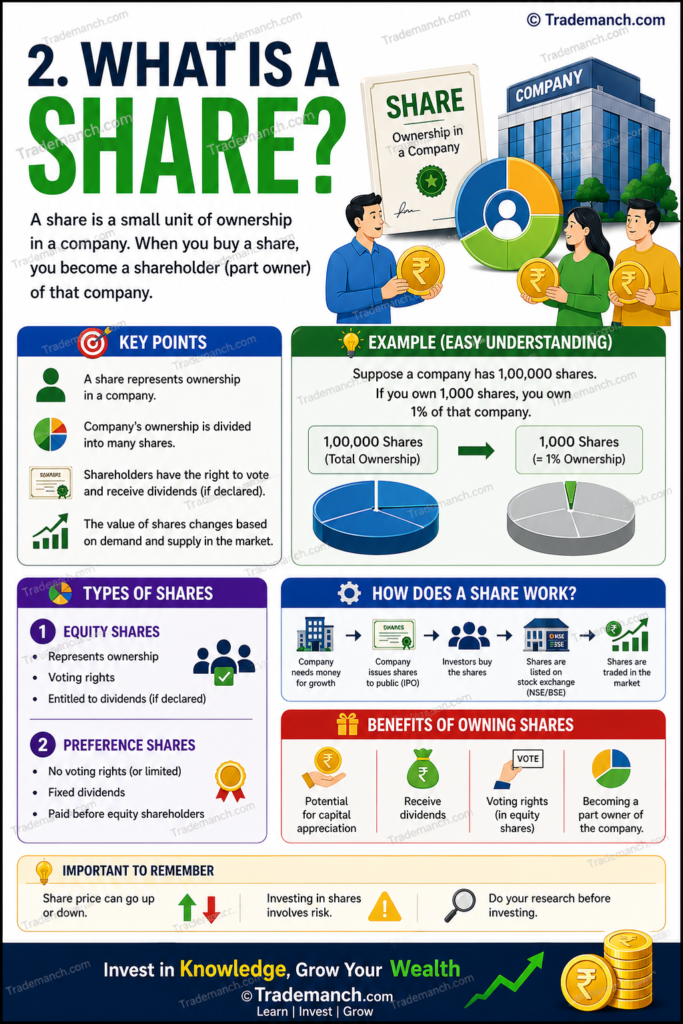
What Is a Share?
A share is a small unit of ownership in a company. When you buy shares of a company, you become a shareholder, which means you own a small portion of that company.
For example, if you buy shares of Reliance Industries or Infosys, you become one of the owners of that company according to the number of shares you own.
Companies divide their ownership into many small units called shares so that investors can buy them easily.
Simple Definition of Share
A share represents ownership in a company and gives investors a right to a part of the company’s profits and assets.
In simple words:
- Buying a share means buying a small part of a company.
Example of a Share
Let’s understand with a simple example.
Suppose a company has:
- Total Shares = 1,00,000
- You Buy = 100 Shares
This means you own a small percentage of that company.
If the company grows and its profits increase, the value of your shares may also increase.
Why Do Companies Issue Shares?
Companies need money to:
- Expand their business
- Launch new products
- Open new branches
- Purchase machinery
- Reduce debt
Instead of taking loans from banks, companies often raise money by selling shares to the public through the stock market.
This process is called an IPO (Initial Public Offering).
What Happens When You Buy Shares?
When you buy shares:
- You become a shareholder
- You may receive dividends
- You can benefit from rising share prices
- You may get voting rights in company decisions
Your profit depends on how well the company performs in the future.
How Shares Work in the Stock Market
Shares are bought and sold on stock exchanges like:
- National Stock Exchange (NSE)
- Bombay Stock Exchange (BSE)
Investors use trading apps and brokers to buy or sell shares online.
Popular stock brokers in India include:
- Zerodha
- Groww
- Angel One
Types of Shares
There are mainly two types of shares.
1. Equity Shares
Equity shares are the most common type of shares. These shares provide ownership rights in a company.
Features of Equity Shares
- Voting rights
- Dividend benefits
- Higher risk and higher return
- Profit depends on company performance
Most investors buy equity shares in the stock market.
2. Preference Shares
Preference shareholders receive dividends before equity shareholders.
Features of Preference Shares
- Fixed dividend
- Lower risk
- Limited voting rights
- Priority during company liquidation
What Is Share Price?
The share price is the current market value of a company’s share.
For example:
- If one share of a company costs ₹500, then ₹500 is its share price.
Share prices continuously change during market hours.
Factors Affecting Share Prices
Many factors influence share prices.
Company Performance
If a company earns good profits, its share price may rise.
Demand and Supply
Higher demand increases share prices.
Economic Conditions
Inflation, interest rates, and GDP growth affect markets.
Government Policies
Tax rules and regulations impact stock prices.
Global News
International events also influence markets.
Investor Sentiment
Fear and greed play a major role in stock movements.
Benefits of Investing in Shares
Investing in shares offers many advantages.
1. Wealth Creation
Shares can generate strong long-term returns.
Many successful investors create wealth through stock market investments.
2. Dividend Income
Some companies share profits with investors through dividends.
This creates passive income for shareholders.
3. Ownership in Companies
Shareholders become part-owners of businesses.
4. High Liquidity
Shares can be easily bought and sold in the stock market.
5. Protection Against Inflation
Long-term stock market returns often beat inflation.
Risks of Investing in Shares
While shares offer good returns, they also involve risks.
Market Risk
Share prices may fall due to market conditions.
Company Risk
Poor company performance can reduce share value.
Volatility
Stock prices can change rapidly in a short period.
Emotional Investing
Fear and greed often lead to bad investment decisions.
Difference Between Shares and Stocks
Many people use the words “shares” and “stocks” interchangeably, but there is a slight difference.
| Shares | Stocks |
|---|---|
| Ownership in one company | Ownership in multiple companies |
| Specific term | General term |
What Is a Shareholder?
A shareholder is a person who owns shares in a company.
There are two types of shareholders:
- Equity shareholders
- Preference shareholders
What Is Dividend?
A dividend is a portion of company profits distributed to shareholders.
For example:
If a company announces a ₹10 dividend per share and you own 100 shares, you receive ₹1,000.
What Is a Demat Account?
A Demat account stores your shares electronically.
Without a Demat account, you cannot buy or sell shares in India.
Popular platforms offering Demat accounts:
- Upstox
- Groww
- Zerodha
How Beginners Can Start Buying Shares
Here are the basic steps:
Step 1: Open a Demat and Trading Account
Choose a trusted broker.
Step 2: Complete KYC
Submit PAN card, Aadhaar card, and bank details.
Step 3: Add Money
Transfer funds into your trading account.
Step 4: Research Companies
Study company fundamentals before investing.
Step 5: Buy Shares
Place a buy order through your trading app.
Difference Between Trading and Investing
| Trading | Investing |
|---|---|
| Short-term activity | Long-term activity |
| Quick profits | Wealth creation |
| Higher risk | Relatively safer |
| Requires technical analysis | Requires fundamental analysis |
Important Terms Related to Shares
Bull Market
A market where share prices rise continuously.
Bear Market
A market where share prices fall.
Portfolio
A collection of investments owned by an investor.
Market Capitalization
The total value of a company’s shares.
IPO
The first public issue of shares by a company.
Tips for Beginners Investing in Shares
Start Small
Do not invest large amounts initially.
Invest for Long Term
Long-term investing often gives better returns.
Diversify Investments
Do not invest all money in one company.
Learn Before Investing
Understand stock market basics.
Avoid Emotional Decisions
Stay calm during market ups and downs.
Are Shares Safe?
Shares can provide excellent returns, but they are not completely risk-free.
Investing in fundamentally strong companies for the long term generally reduces risk.
Future of Share Market Investing in India
India is witnessing rapid growth in stock market participation due to:
- Digital trading apps
- Financial awareness
- Easy internet access
- Rising young investors
Millions of Indians are now investing in shares to build wealth.
A share is a unit of ownership in a company. By buying shares, investors become part-owners of businesses and can benefit from company growth through capital appreciation and dividends.
Shares are an important part of the stock market and one of the best long-term wealth creation tools when used wisely. Beginners should start with proper learning, research, and disciplined investing to achieve financial success.
Frequently Asked Questions (FAQs)
1. What is a share in simple words?
A share is a small ownership unit of a company.
2. How do shares make money?
Shares generate returns through price increases and dividends.
3. Can beginners invest in shares?
Yes, beginners can invest after opening a Demat and trading account.
4. Are shares risky?
Yes, share prices can rise or fall depending on market conditions.
5. What is the minimum amount needed to buy shares?
You can start with even a few hundred rupees depending on the share price.
6. What is the difference between shares and stocks?
Shares represent ownership in one company, while stocks is a broader term.
7. What is an equity share?
An equity share gives ownership rights in a company.
8. What is a dividend?
A dividend is a portion of company profits distributed to shareholders.
9. Can I lose money in shares?
Yes, losses can happen if share prices fall.
10. Which app is best for buying shares in India?
Popular apps include Zerodha, Groww, and Angel One.