
Industry Analysis is one of the most important parts of stock market investing. Even the best company may struggle if the industry itself is facing challenges. Similarly, an average company can perform exceptionally well when its industry is experiencing rapid growth.
Successful investors don’t just analyze a company’s financial statements—they also study the industry in which the company operates. Industry analysis helps investors identify future growth opportunities, understand risks, and make better investment decisions.
This guide explains Industry Analysis in simple language, making it easy for beginners to understand.
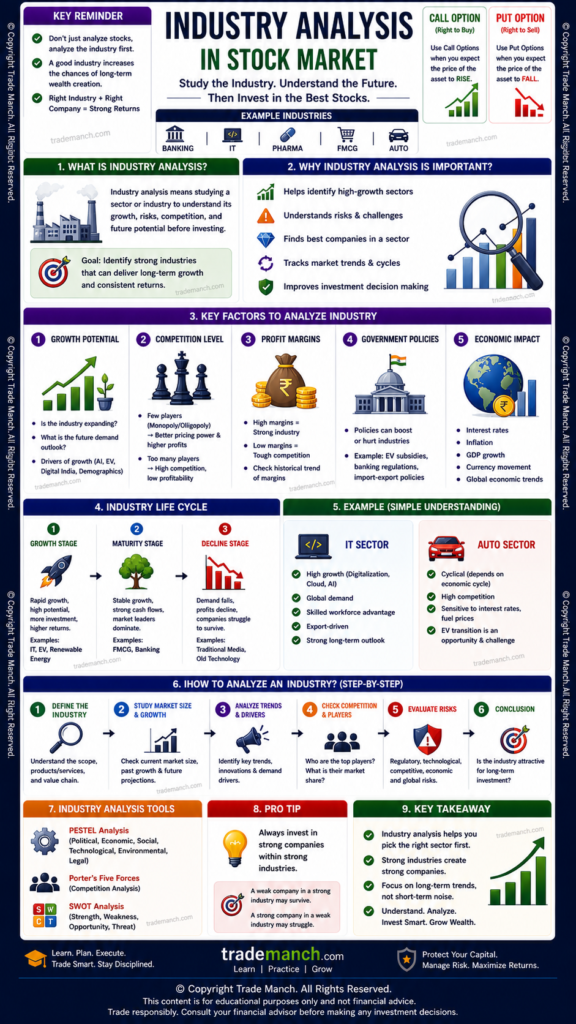
What Is Industry Analysis?
Industry Analysis is the process of evaluating a specific industry to understand its growth potential, competitive environment, opportunities, and risks.
It helps investors determine whether an industry is likely to grow, remain stable, or decline in the future.
Simple Definition of Industry Analysis
Industry Analysis is the study of an industry’s current condition, future prospects, competition, and profitability.
Why Is Industry Analysis Important?
Before investing in any company, investors should understand:
- Industry growth potential
- Market demand
- Competition
- Government regulations
- Future opportunities
A strong industry often creates favorable conditions for companies operating within it.
Industry Analysis vs Company Analysis
| Feature | Industry Analysis | Company Analysis |
|---|---|---|
| Focus | Entire Industry | Individual Company |
| Objective | Understand Sector Potential | Evaluate Business Performance |
| Scope | Broad | Specific |
| Importance | Growth Opportunities | Stock Selection |
Both analyses are essential for successful investing.
What Is an Industry?
An industry is a group of companies that offer similar products or services.
Examples:
Banking Industry
Includes banks and financial institutions.
Information Technology (IT) Industry
Provides software and technology services.
Automobile Industry
Manufactures vehicles and automotive components.
Pharmaceutical Industry
Produces medicines and healthcare products.
Major Industries in India
Banking & Financial Services
Examples:
- HDFC Bank
- ICICI Bank
Information Technology
Examples:
- Infosys
- Tata Consultancy Services
Automobile Sector
Examples:
- Maruti Suzuki India
- Tata Motors
Pharmaceutical Sector
Examples:
- Sun Pharmaceutical Industries
- Dr. Reddy’s Laboratories
FMCG Sector
Examples:
- Hindustan Unilever
- ITC Limited
Key Factors to Analyze in an Industry
Industry Growth Rate
The first step is understanding how fast the industry is growing.
Questions to Ask
- Is demand increasing?
- Is the market expanding?
- What are future growth projections?
Growing industries often provide better investment opportunities.
Market Size
Market size indicates the potential revenue opportunity.
Large Market Size
Usually provides greater growth potential.
Small Market Size
May limit future expansion.
Industry Life Cycle
Every industry passes through different stages.
Introduction Stage
New industries emerge.
Examples:
- Artificial Intelligence
- Electric Vehicles
Growth is usually rapid but uncertain.
Growth Stage
Demand increases significantly.
Companies expand operations.
Investors often find strong opportunities in this stage.
Maturity Stage
Growth slows but remains stable.
Examples:
- FMCG
- Banking
Companies often generate consistent profits.
Decline Stage
Demand decreases.
Industries may face disruption from new technologies.
Competitive Analysis
Understanding competition is crucial.
Number of Competitors
Few Competitors
Often leads to stronger profitability.
Many Competitors
Can reduce profit margins.
Market Leaders
Identify dominant companies.
Examples:
IT Sector
- Infosys
- Tata Consultancy Services
Banking Sector
- HDFC Bank
- ICICI Bank
Market leaders often have competitive advantages.
Government Policies and Regulations
Many industries depend on government support.
Positive Policies
Can boost growth.
Examples:
- Infrastructure spending
- Tax incentives
- Production-linked incentives (PLI)
Strict Regulations
Can increase costs and reduce profitability.
Demand and Supply Analysis
Understanding demand and supply is essential.
Rising Demand
Usually supports revenue growth.
Oversupply
Can reduce prices and profits.
Technological Changes
Technology can transform industries rapidly.
Beneficial Technologies
Improve efficiency and profitability.
Disruptive Technologies
Can threaten existing businesses.
Example:
Electric Vehicles impacting traditional automobile manufacturers.
Economic Factors
Industries respond differently to economic conditions.
Interest Rates
Highly important for banking and real estate sectors.
Inflation
Can affect costs and profitability.
GDP Growth
Generally supports business expansion.
Industry Profitability
Some industries are naturally more profitable than others.
High-Profit Industries
Examples:
- Software
- Pharmaceuticals
Lower-Profit Industries
Examples:
- Airlines
- Commodity businesses
Industry Trends
Investors should identify long-term trends.
Renewable Energy
Growing rapidly worldwide.
Artificial Intelligence
Creating new business opportunities.
Digital Payments
Expanding due to technology adoption.
Industry Risks
Every industry has risks.
Regulatory Risk
Government policy changes.
Technological Risk
Industry disruption.
Competition Risk
Increasing rivalry.
Economic Risk
Slowdowns affecting demand.
Porter’s Five Forces Analysis
Many professional investors use this framework.
Competitive Rivalry
How intense is competition?
Threat of New Entrants
How easy is it to enter the industry?
Supplier Power
Do suppliers have pricing power?
Buyer Power
Can customers negotiate prices?
Threat of Substitutes
Are alternative products available?
How to Select the Best Industry
Look for industries with:
Strong Growth
Growing demand and opportunities.
Favorable Government Policies
Supportive regulations.
High Profitability
Healthy margins.
Competitive Advantages
Barriers to entry.
Long-Term Trends
Future relevance.
Industry Analysis Example
Suppose you are evaluating the Electric Vehicle (EV) industry.
Growth Rate
High.
Government Support
Strong incentives.
Market Potential
Large.
Competition
Increasing.
Long-Term Outlook
Positive.
This may indicate a promising industry for further research.
Common Beginner Mistakes
Investing Without Industry Analysis
Strong companies still depend on industry health.
Following Popular Trends Blindly
Always verify growth potential.
Ignoring Competition
Competition affects profitability.
Focusing Only on Short-Term News
Industry trends often develop over years.
Best Sources for Industry Research
Investors often use:
- Moneycontrol
- Screener.in
- NSE India
- Company Annual Reports
- Industry Research Reports
How Professionals Perform Industry Analysis
Professional investors usually:
Study Industry Growth
Analyze future demand.
Compare Competitors
Identify market leaders.
Evaluate Risks
Assess threats and opportunities.
Monitor Industry Trends
Track technological and regulatory changes.
Industry Analysis is a critical step in successful investing. It helps investors understand growth opportunities, competition, risks, and long-term prospects before selecting individual stocks. By analyzing industry trends, government policies, profitability, and market dynamics, investors can identify sectors with the highest potential for future growth.
Remember: A great company in a weak industry may struggle, while a good company in a growing industry can deliver exceptional returns. Smart investors analyze both the company and the industry before investing.
Frequently Asked Questions (FAQs)
What is Industry Analysis?
Industry Analysis is the study of an industry’s growth, competition, opportunities, and risks.
Why is Industry Analysis important?
It helps investors identify promising sectors and avoid weak industries.
What factors should be analyzed in an industry?
Growth rate, competition, profitability, regulations, and future trends.
What is an industry life cycle?
The stages through which an industry evolves: introduction, growth, maturity, and decline.
Why are government policies important?
Policies can significantly impact industry growth and profitability.
What is competitive analysis?
Studying competitors and market structure within an industry.
Which industries are growing rapidly in India?
Technology, renewable energy, digital payments, and electric vehicles are notable examples.
Can a strong company fail in a weak industry?
Yes. Industry conditions often affect company performance.
What is Porter’s Five Forces Analysis?
A framework for evaluating industry competitiveness and profitability.
Should investors analyze industries before stocks?
Yes. Industry analysis is often the first step before selecting individual companies.