
Intraday trading is one of the most popular types of trading in the stock market. Many traders prefer intraday trading because it offers opportunities to earn profits from short-term price movements within a single trading day.
However, intraday trading also carries high risk and requires proper knowledge, discipline, and strategy. In this complete beginner-friendly guide, you will learn what intraday trading is, how it works, its advantages, risks, strategies, and important tips for beginners.
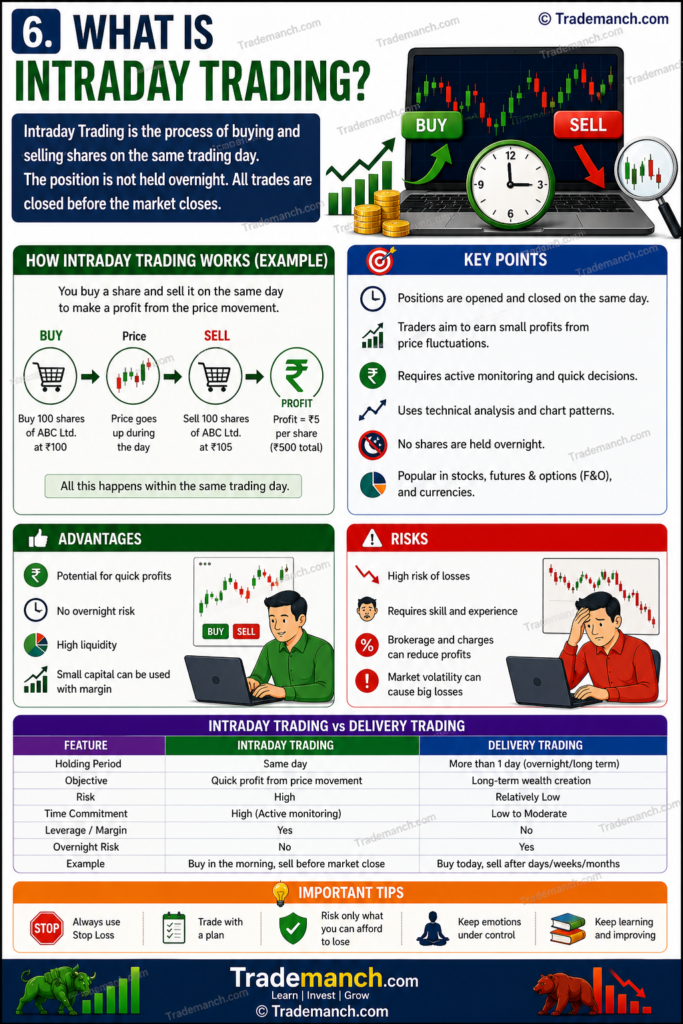
What Is Intraday Trading?
Intraday trading means buying and selling stocks on the same day during market hours.
In intraday trading:
- Traders do not hold positions overnight.
- All trades are closed before the market closes.
The main goal is to earn profits from small price movements during the day.
Simple Definition of Intraday Trading
Intraday trading is the process of buying and selling shares within the same trading day to earn short-term profits.
Example of Intraday Trading
Suppose:
- You buy 100 shares at ₹500 in the morning.
- The price rises to ₹510 during the day.
- You sell the shares before market closing.
Profit:
- ₹10 profit per share
- Total Profit = ₹1,000
This is called intraday trading.
How Intraday Trading Works
Intraday traders take advantage of market volatility and price fluctuations.
They:
- Buy at lower prices
- Sell at higher prices
or
- Sell first and buy later in falling markets (short selling)
All positions must be squared off before the market closes.
Intraday Trading Timing in India
The stock market in India operates from:
- 9:15 AM to 3:30 PM
Intraday traders usually trade during these hours on:
- National Stock Exchange
- Bombay Stock Exchange
Features of Intraday Trading
Same-Day Trading
Positions are opened and closed on the same day.
Short-Term Focus
Traders focus on quick price movements.
High Risk and Reward
Profits and losses can happen quickly.
Use of Margin
Brokers often provide leverage or margin.
What Is Margin in Intraday Trading?
Margin means borrowed money provided by brokers to trade larger quantities.
For example:
- With ₹10,000, a broker may allow trading worth ₹50,000.
While margin increases profit potential, it also increases risk.
Popular brokers include:
- Zerodha
- Groww
- Angel One
Advantages of Intraday Trading
1. Quick Profit Opportunities
Traders can earn profits within a single day.
2. No Overnight Risk
Positions are closed before market closing.
3. Margin Benefits
Leverage increases buying power.
4. Opportunities in Both Rising and Falling Markets
Traders can profit from market movements in either direction.
Risks of Intraday Trading
Intraday trading is highly risky, especially for beginners.
High Volatility
Prices can change rapidly.
Emotional Stress
Fear and greed affect decisions.
Leverage Risk
Margin can increase losses significantly.
Need for Constant Monitoring
Traders must watch the market continuously.
Losses Can Occur Quickly
Improper risk management may lead to heavy losses.
Difference Between Intraday Trading and Investing
| Intraday Trading | Investing |
|---|---|
| Short-term activity | Long-term activity |
| Positions closed same day | Holdings for months or years |
| High risk | Relatively lower risk |
| Requires technical analysis | Requires fundamental analysis |
| Fast profits/losses | Long-term wealth creation |
What Is Short Selling in Intraday Trading?
Short selling means:
- Selling shares first
- Buying them later at lower prices
Example:
- Sell at ₹500
- Buy back at ₹480
- Profit = ₹20 per share
Short selling helps traders profit in falling markets.
Best Stocks for Intraday Trading
Good intraday stocks usually have:
- High liquidity
- Strong volume
- Volatility
- Narrow bid-ask spread
Popular intraday stocks often include:
- Reliance Industries
- HDFC Bank
- Infosys
Intraday Trading Strategies
1. Momentum Trading
Buying stocks moving strongly in one direction.
2. Breakout Trading
Trading when prices cross important levels.
3. Scalping
Making small profits from tiny price changes.
4. Reversal Trading
Trading after trend reversals.
Importance of Stop Loss in Intraday Trading
A stop loss limits potential losses.
Example:
- Buy stock at ₹500
- Stop loss at ₹490
If price falls to ₹490:
- Trade automatically exits.
Stop loss is very important for risk management.
Technical Analysis in Intraday Trading
Intraday traders mainly use technical analysis.
Common tools include:
- Candlestick charts
- Moving averages
- RSI
- MACD
- Volume analysis
- Support and resistance
Best Time for Intraday Trading
Many traders prefer:
- First hour after market opening
- Last hour before market closing
These periods usually have higher volatility and volume.
Common Mistakes Beginners Make
Overtrading
Taking too many trades.
Trading Without Stop Loss
Increases risk.
Emotional Decisions
Fear and greed cause mistakes.
Lack of Strategy
Random trading leads to losses.
Using Excessive Leverage
High margin increases risk.
Tips for Beginners in Intraday Trading
Learn Before Trading
Understand market basics and strategies.
Start Small
Begin with small quantities.
Use Stop Loss
Always manage risk.
Follow Discipline
Avoid emotional trading.
Focus on Liquid Stocks
Trade stocks with high volume.
Practice First
Use demo accounts or paper trading.
Is Intraday Trading Safe?
Intraday trading is risky and not suitable for everyone.
Beginners should:
- Learn technical analysis
- Understand risk management
- Avoid unrealistic profit expectations
Long-term investing is generally safer than intraday trading.
Intraday Trading vs Delivery Trading
| Intraday Trading | Delivery Trading |
|---|---|
| Same-day buying and selling | Stocks held overnight |
| Short-term profits | Long-term investment |
| High risk | Lower risk |
| Uses leverage | No compulsory leverage |
Psychological Discipline in Intraday Trading
Successful traders control:
- Fear
- Greed
- Revenge trading
- Overconfidence
Emotional discipline is as important as technical knowledge.
Intraday trading involves buying and selling shares within the same day to earn profits from short-term market movements. While intraday trading can provide quick profit opportunities, it also carries high risk and requires proper knowledge, discipline, and risk management.
Beginners should start slowly, learn technical analysis, use stop losses, and avoid emotional trading decisions. Proper education and disciplined strategies are essential for long-term success in intraday trading.
Frequently Asked Questions (FAQs)
1. What is intraday trading in simple words?
Intraday trading means buying and selling shares on the same day.
2. Is intraday trading profitable?
Yes, intraday trading can be profitable, but it is highly risky.
3. Can beginners do intraday trading?
Yes, but beginners should learn proper strategies and risk management first.
4. What is the best time for intraday trading?
Many traders prefer the first and last trading hours due to higher volatility.
5. What is stop loss in intraday trading?
Stop loss automatically limits losses if prices move against the trade.
6. Is intraday trading gambling?
No, disciplined trading based on analysis is different from gambling.
7. Which app is best for intraday trading in India?
Popular apps include Zerodha, Groww, and Angel One.
8. Can I lose money in intraday trading?
Yes, losses can occur due to market volatility and poor risk management.
9. What is leverage in intraday trading?
Leverage allows traders to trade larger amounts using margin provided by brokers.
10. Is intraday trading better than investing?
Intraday trading is riskier, while long-term investing is generally safer for beginners.