
A Demat account is one of the most important requirements for investing in the stock market. If you want to buy shares, invest in IPOs, mutual funds, ETFs, or trade in the stock market, you need a Demat account.
In this complete beginner-friendly guide, you will learn what a Demat account is, how it works, its benefits, types, charges, and how to open a Demat account in India.
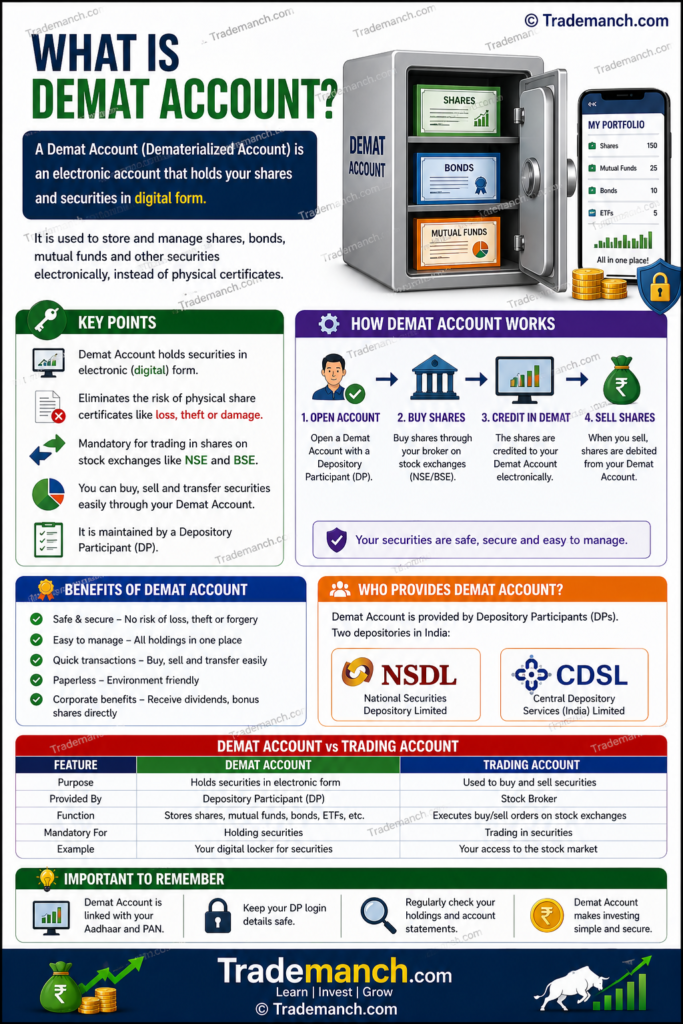
What Is a Demat Account?
A Demat account is an account used to store shares and securities in electronic form.
The word “Demat” stands for:
- Dematerialization
It means converting physical share certificates into digital form.
Today, almost all stock market investments in India are stored electronically through Demat accounts.
Simple Definition of Demat Account
A Demat account is a digital account that safely stores your shares, bonds, ETFs, mutual funds, and other securities electronically.
Why Is a Demat Account Needed?
A Demat account is necessary because:
- Physical share certificates are no longer commonly used.
- Electronic storage is safer and faster.
- Buying and selling shares becomes easier.
Without a Demat account, you cannot invest in stocks in India.
Example of a Demat Account
Suppose you buy:
- 10 shares of Reliance Industries
- 5 shares of Infosys
These shares are automatically stored in your Demat account electronically.
How Does a Demat Account Work?
A Demat account works like a bank account, but instead of storing money, it stores securities.
Process:
- You buy shares through a trading account.
- Shares are credited to your Demat account.
- When you sell shares, they are debited from the account.
Difference Between Demat Account and Trading Account
Many beginners confuse these two accounts.
| Demat Account | Trading Account |
|---|---|
| Stores shares electronically | Used for buying and selling shares |
| Acts like a digital locker | Acts like a transaction platform |
| Holds securities | Connects investors to stock exchanges |
Both accounts work together for stock market investing.
Types of Demat Accounts
There are mainly three types of Demat accounts in India.
1. Regular Demat Account
Used by Indian residents for stock market investing.
2. Repatriable Demat Account
Used by NRIs to transfer funds abroad.
3. Non-Repatriable Demat Account
Used by NRIs who do not want to transfer funds outside India.
Benefits of a Demat Account
1. Safe and Secure
Electronic storage reduces risks of:
- Theft
- Damage
- Loss of physical certificates
2. Easy Access
Investors can access holdings online anytime.
3. Faster Transactions
Buying and selling shares becomes quick and simple.
4. Reduced Paperwork
No need to maintain physical share certificates.
5. Automatic Updates
Bonus shares, dividends, and stock splits are updated automatically.
Features of a Demat Account
Electronic Holding of Securities
Stores shares digitally.
Easy Transfer of Shares
Quick transfer during buying and selling.
Online Portfolio Tracking
Investors can monitor holdings easily.
Multiple Investment Options
Can hold:
- Shares
- Bonds
- ETFs
- Mutual funds
- Government securities
Documents Required to Open a Demat Account
You generally need:
- PAN Card
- Aadhaar Card
- Mobile Number
- Email ID
- Bank Account
- Passport-size Photograph
- Signature
How to Open a Demat Account in India
Step 1: Choose a Broker
Popular brokers include:
- Zerodha
- Groww
- Angel One
Step 2: Fill Online Application
Submit personal details.
Step 3: Complete KYC
Upload documents for verification.
Step 4: In-Person Verification
Some brokers complete verification online through video KYC.
Step 5: Account Activation
After approval, your Demat account becomes active.
What Can Be Stored in a Demat Account?
A Demat account can hold:
- Equity shares
- Mutual funds
- Bonds
- ETFs
- Government securities
- IPO allotments
What Are Demat Account Charges?
Different brokers may charge:
- Account opening fee
- Annual maintenance charges (AMC)
- Brokerage charges
- Transaction charges
Some brokers offer free account opening.
What Is NSDL and CDSL?
Demat accounts in India are maintained through two depositories:
- National Securities Depository Limited (NSDL)
- Central Depository Services Limited (CDSL)
These organizations safely store securities electronically.
Is a Demat Account Safe?
Yes, Demat accounts are generally very secure because:
- They are regulated by Securities and Exchange Board of India (SEBI).
- Shares are stored electronically.
- Online security systems protect accounts.
However, investors should:
- Keep passwords secure
- Avoid sharing OTPs
- Use trusted brokers
Can Beginners Open a Demat Account?
Yes, beginners can easily open Demat accounts online within minutes.
Most brokers now provide:
- Simple mobile apps
- Paperless account opening
- Easy KYC verification
Difference Between Physical Shares and Demat Shares
| Physical Shares | Demat Shares |
|---|---|
| Paper certificates | Electronic format |
| Risk of loss or damage | Safe digital storage |
| Slow transactions | Fast transactions |
| More paperwork | Less paperwork |
What Is a Depository Participant (DP)?
A Depository Participant is an agent that provides Demat account services to investors.
Stock brokers usually act as DPs.
Advantages of Online Demat Accounts
Easy Mobile Access
Invest anytime from anywhere.
Real-Time Portfolio Tracking
Track investments instantly.
Quick IPO Applications
Apply for IPOs online.
Faster Transactions
Shares are transferred quickly.
Things to Check Before Opening a Demat Account
Brokerage Charges
Compare transaction fees.
AMC Charges
Check annual maintenance fees.
Trading Platform
Choose a user-friendly app.
Customer Support
Good support is important for beginners.
Research Tools
Some brokers provide learning tools and analysis.
Best Demat Account Providers in India
Popular Demat account providers include:
- Zerodha
- Groww
- Upstox
- Angel One
Tips for Beginners
Start With Learning
Understand stock market basics first.
Use Trusted Brokers
Choose SEBI-registered brokers.
Keep Long-Term Focus
Avoid emotional trading.
Monitor Portfolio Regularly
Track investments carefully.
A Demat account is a digital account used to store shares and securities electronically. It is essential for investing and trading in the stock market in India. Demat accounts make investing safe, fast, and convenient by eliminating physical paperwork and simplifying transactions.
Beginners can easily open a Demat account online and start their investment journey with proper learning and disciplined investing.
Frequently Asked Questions (FAQs)
1. What is a Demat account in simple words?
A Demat account stores shares and securities electronically.
2. Is a Demat account necessary for stock market investing?
Yes, a Demat account is required to buy and hold shares in India.
3. Can beginners open a Demat account?
Yes, beginners can easily open Demat accounts online.
4. What documents are needed for a Demat account?
PAN card, Aadhaar card, bank account, mobile number, and email ID.
5. Is a Demat account free?
Some brokers offer free account opening, but annual charges may apply.
6. What is the difference between Demat and trading account?
Demat stores shares, while trading accounts are used for buying and selling.
7. Can I have multiple Demat accounts?
Yes, investors can open multiple Demat accounts.
8. Is a Demat account safe?
Yes, Demat accounts are secure and regulated by SEBI.
9. Which is the best Demat account in India?
Popular options include Zerodha, Groww, and Upstox.
10. Can mutual funds be stored in a Demat account?
Yes, mutual funds and many other securities can be held in a Demat account.