
The terms Bull Market and Bear Market are very common in the stock market. These terms describe the overall direction of the market and investor sentiment. Understanding bull and bear markets is important for every beginner because they affect stock prices, investment strategies, and market behavior.
In this detailed guide, you will learn what bull and bear markets are, their characteristics, causes, examples, and how investors should behave during different market conditions.
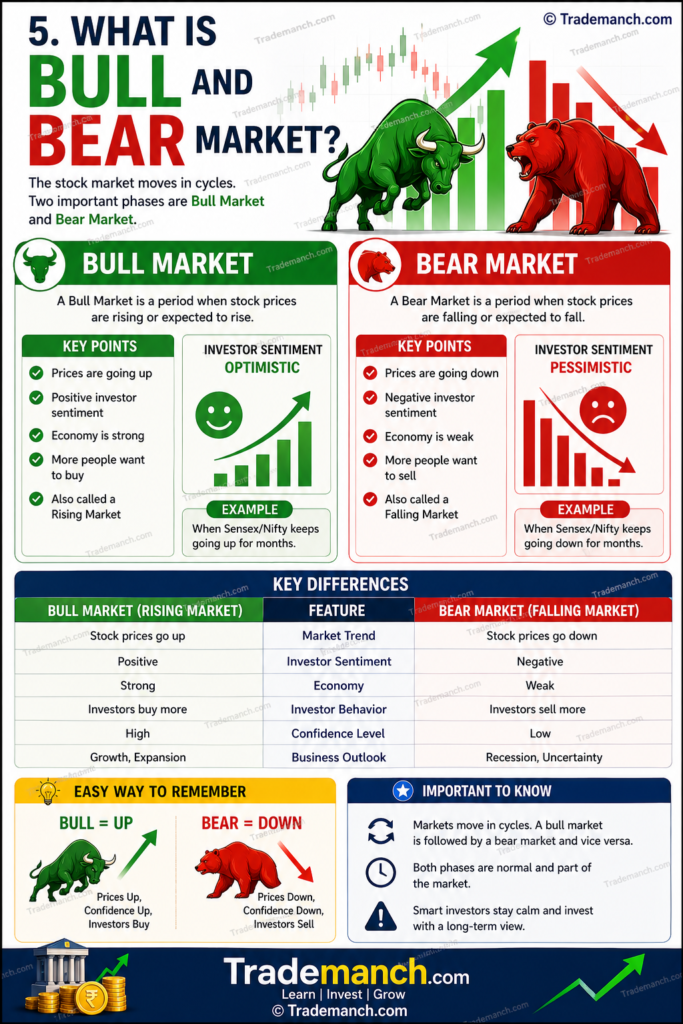
What Is a Bull Market?
A Bull Market is a market condition where stock prices are rising continuously over a period of time.
In a bull market:
- Investors are optimistic
- Market confidence is strong
- Share prices generally move upward
- Economic conditions are positive
A bull market reflects strong investor sentiment and economic growth.
Simple Definition of Bull Market
A bull market is a situation where the stock market rises and investors expect prices to continue increasing.
Why Is It Called a Bull Market?
The term “bull” comes from the attacking style of a bull.
A bull attacks by pushing its horns upward, symbolizing rising stock prices.
Characteristics of a Bull Market
Rising Share Prices
Stock prices increase steadily.
Strong Investor Confidence
Investors feel positive about the market.
Economic Growth
GDP growth and business activity improve.
Higher Investment Activity
More people invest in stocks.
Positive News Flow
Companies report better earnings and profits.
Example of a Bull Market
Suppose:
- National Stock Exchange Nifty rises continuously for several months.
- Most company shares gain value.
- Investors make profits.
This situation is called a bull market.
What Is a Bear Market?
A Bear Market is a market condition where stock prices fall continuously over a period of time.
In a bear market:
- Investors become fearful
- Market sentiment turns negative
- Share prices decline
- Economic growth slows down
Bear markets are associated with uncertainty and lower investor confidence.
Simple Definition of Bear Market
A bear market is a situation where stock prices fall and investors expect further decline.
Why Is It Called a Bear Market?
The term “bear” comes from the attacking style of a bear.
A bear attacks by swiping its paws downward, symbolizing falling stock prices.
Characteristics of a Bear Market
Falling Stock Prices
Share prices decline consistently.
Fear and Panic
Investors become cautious.
Weak Economy
Economic slowdown may occur.
Lower Investment Activity
People avoid investing.
Negative News
Poor company earnings and bad economic news affect sentiment.
Example of a Bear Market
Suppose:
- Bombay Stock Exchange Sensex falls sharply for several months.
- Most stocks lose value.
- Investors panic and sell shares.
This is called a bear market.
Difference Between Bull and Bear Market
| Bull Market | Bear Market |
|---|---|
| Prices rise | Prices fall |
| Investors are optimistic | Investors are fearful |
| Strong economy | Weak economy |
| Higher buying activity | Higher selling activity |
| Positive market sentiment | Negative market sentiment |
Causes of a Bull Market
Several factors can create a bull market.
Economic Growth
Strong GDP growth supports markets.
Low Interest Rates
Cheap borrowing increases investments.
Higher Corporate Profits
Good company earnings boost stock prices.
Political Stability
Stable government policies improve investor confidence.
Increased Foreign Investments
More money flows into the market.
Causes of a Bear Market
Bear markets can occur due to many reasons.
Economic Recession
Slow economic growth affects companies.
High Inflation
Rising prices reduce consumer spending.
Global Crises
Wars, pandemics, or financial crises hurt markets.
Rising Interest Rates
Higher rates reduce business growth.
Investor Fear
Panic selling causes markets to fall further.
How Long Do Bull and Bear Markets Last?
There is no fixed duration.
- Bull markets may last for years.
- Bear markets may last for months or longer.
Market conditions depend on economic and global factors.
How Investors Behave in Bull Markets
During a bull market:
- Investors buy more stocks.
- Risk-taking increases.
- Trading activity rises.
- New investors enter the market.
Many people make profits during bullish trends.
How Investors Behave in Bear Markets
During a bear market:
- Investors become cautious.
- Many sell shares to avoid losses.
- Market volatility increases.
- Fear dominates trading decisions.
Experienced investors often look for good buying opportunities during bear markets.
Investment Strategies in Bull Markets
Buy Growth Stocks
Growth companies often perform well.
Hold Investments
Long-term holding may generate strong profits.
Use SIP Investments
Regular investing benefits from rising markets.
Investment Strategies in Bear Markets
Focus on Strong Companies
Invest in fundamentally strong businesses.
Avoid Panic Selling
Emotional decisions may increase losses.
Diversify Portfolio
Spread investments across sectors.
Invest Gradually
Bear markets can create long-term buying opportunities.
What Is Market Sentiment?
Market sentiment refers to the overall mood of investors.
- Positive sentiment creates bullish markets.
- Negative sentiment creates bearish markets.
What Is a Market Correction?
A market correction is a temporary fall in stock prices, usually around 10%.
Corrections are normal and may happen during long bull markets.
What Is a Market Crash?
A market crash is a sudden and sharp decline in stock prices.
Crashes are often caused by:
- Economic crises
- Panic selling
- Global uncertainty
Are Bull and Bear Markets Normal?
Yes, bull and bear markets are natural parts of the stock market cycle.
Markets do not move upward forever. Periods of growth and decline are normal.
Which Market Is Better for Investors?
Both markets offer opportunities.
Bull Market
- Easier for beginners to make profits.
Bear Market
- Opportunity to buy quality stocks at lower prices.
Long-term investors often benefit from both phases.
Tips for Beginners
Learn Market Basics
Understand how stock markets work.
Stay Patient
Avoid emotional decisions.
Think Long Term
Long-term investing usually reduces risk.
Diversify Investments
Never invest all money in one stock.
Avoid Following Crowd
Research before investing.
Bull and bear markets are important concepts in the stock market. A bull market represents rising prices and positive investor sentiment, while a bear market represents falling prices and fear in the market.
Understanding these market conditions helps investors make smarter investment decisions and manage risk effectively. Beginners should focus on long-term investing, proper research, and disciplined financial planning during both bullish and bearish phases.
Frequently Asked Questions (FAQs)
1. What is a bull market in simple words?
A bull market is a market where stock prices rise continuously.
2. What is a bear market?
A bear market is a market where stock prices fall continuously.
3. Why is it called a bull market?
It is named after the upward attack movement of a bull.
4. Why is it called a bear market?
It is named after the downward attack movement of a bear.
5. Which market is better for investing?
Both markets offer opportunities depending on investment strategy.
6. Can beginners invest during a bear market?
Yes, bear markets may provide opportunities to buy good stocks at lower prices.
7. What causes a bull market?
Economic growth, positive sentiment, and strong company earnings.
8. What causes a bear market?
Economic slowdown, fear, inflation, and negative global events.
9. How long does a bull market last?
Bull markets can last for months or even years.
10. How should beginners invest during market fluctuations?
Beginners should focus on long-term investing and avoid emotional trading.