
When a company wants to raise money from investors, it issues shares. By purchasing shares, investors become partial owners of the company. However, not all shares are the same. Shares are mainly classified into two categories:
- Equity Shares
- Preference Shares
Understanding the different types of shares is essential for investors because each type offers different rights, benefits, risks, and returns.
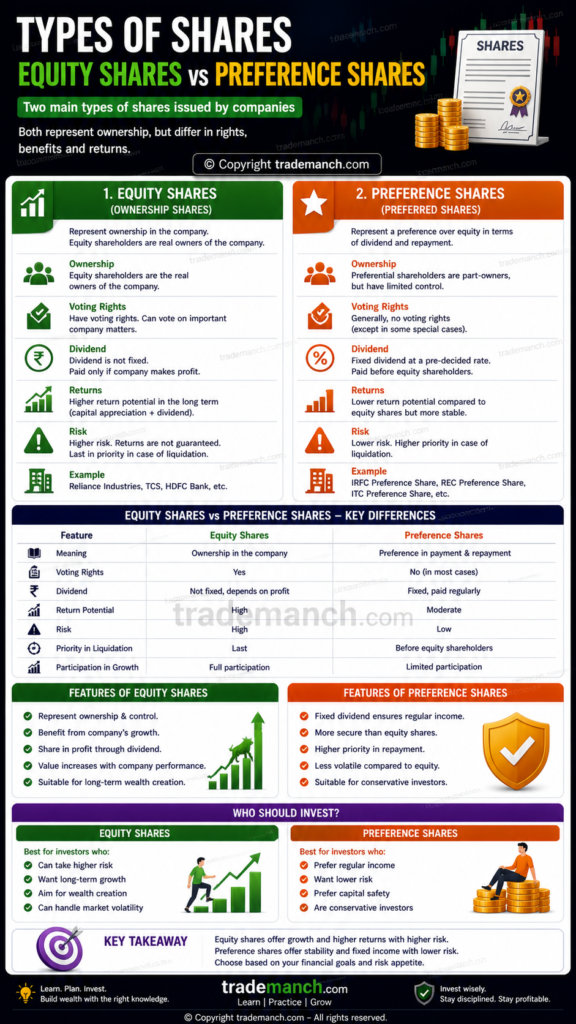
In this complete beginner-friendly guide, you will learn everything about Equity Shares and Preference Shares, their features, advantages, disadvantages, and key differences.
What Are Shares?
Shares represent ownership in a company.
When you buy shares:
- You become a shareholder.
- You own a portion of the company.
- You may receive dividends.
- You can benefit from stock price appreciation.
Companies issue shares to raise capital for business expansion and operations.
Simple Definition of Shares
A share is a unit of ownership in a company that gives investors a claim on the company’s assets and profits.
Main Types of Shares
There are two major types of shares:
1. Equity Shares
2. Preference Shares
These are the most common categories of shares issued by companies.
Equity Shares
What Are Equity Shares?
Equity shares, also called ordinary shares or common shares, represent ownership in a company.
Equity shareholders are the real owners of the company.
They enjoy:
- Voting rights
- Dividend rights
- Capital appreciation benefits
Most shares traded on stock exchanges are equity shares.
Simple Definition of Equity Shares
Equity shares are shares that provide ownership rights and voting power in a company.
Features of Equity Shares
Ownership Rights
Equity shareholders become part-owners of the company.
Voting Rights
Equity shareholders can vote on important company matters such as:
- Director appointments
- Mergers and acquisitions
- Corporate decisions
Dividend Benefits
Equity shareholders may receive dividends if the company earns profits.
However:
- Dividends are not guaranteed.
Capital Appreciation
If the company grows successfully:
- Share prices may increase significantly.
This can generate substantial wealth.
Residual Claim
If a company is liquidated:
- Equity shareholders receive remaining assets after all obligations are paid.
This makes equity shares riskier.
Advantages of Equity Shares
High Return Potential
Successful companies can generate significant returns.
Ownership Participation
Investors participate in company growth.
Voting Rights
Shareholders can influence important corporate decisions.
Liquidity
Most equity shares are easily traded on stock exchanges.
Disadvantages of Equity Shares
Higher Risk
Prices can fluctuate significantly.
No Guaranteed Dividend
Companies may skip dividends during difficult periods.
Last Priority in Liquidation
Equity shareholders are paid after creditors and preference shareholders.
Types of Equity Shares
Ordinary Equity Shares
Most common type of share.
Provides:
- Voting rights
- Dividend eligibility
Bonus Shares
Free shares issued to existing shareholders.
Example:
1:1 Bonus Issue
Means:
- One additional share for every existing share.
Rights Shares
Offered to existing shareholders at a discounted price.
Sweat Equity Shares
Issued to employees and directors as compensation.
Preference Shares
What Are Preference Shares?
Preference shares provide investors with preferential rights over equity shareholders.
Preference shareholders receive:
- Fixed dividends
- Priority during liquidation
However:
- They generally do not have voting rights.
Simple Definition of Preference Shares
Preference shares are shares that provide fixed dividend payments and priority over equity shareholders.
Features of Preference Shares
Fixed Dividend
Preference shareholders usually receive a fixed dividend rate.
Example:
- 8% Preference Shares
- 10% Preference Shares
Priority in Dividend Payment
Preference shareholders receive dividends before equity shareholders.
Priority During Liquidation
In case of company closure:
- Preference shareholders are paid before equity shareholders.
Limited Voting Rights
Preference shareholders generally cannot vote on routine company matters.
Advantages of Preference Shares
Stable Income
Provides predictable dividend income.
Lower Risk
Less risky than equity shares.
Priority Rights
Higher claim on profits and assets.
Disadvantages of Preference Shares
Limited Capital Appreciation
Price growth is generally lower than equity shares.
Limited Voting Power
Few or no voting rights.
Dividend May Still Be Delayed
Depending on share type and company conditions.
Types of Preference Shares
Cumulative Preference Shares
Unpaid dividends accumulate.
If the company skips dividends:
- They must be paid later.
Non-Cumulative Preference Shares
Missed dividends do not accumulate.
Redeemable Preference Shares
Company can repurchase shares after a specified period.
Irredeemable Preference Shares
Cannot be redeemed during the company’s lifetime.
(Note: These are generally restricted in many jurisdictions.)
Convertible Preference Shares
Can be converted into equity shares later.
Non-Convertible Preference Shares
Cannot be converted into equity shares.
Participating Preference Shares
May receive additional profits beyond fixed dividends.
Non-Participating Preference Shares
Receive only fixed dividends.
Difference Between Equity Shares and Preference Shares
| Feature | Equity Shares | Preference Shares |
|---|---|---|
| Ownership | Yes | Limited |
| Voting Rights | Yes | Usually No |
| Dividend | Variable | Fixed |
| Risk | Higher | Lower |
| Return Potential | High | Moderate |
| Priority in Dividend | After Preference Shares | Before Equity Shares |
| Priority in Liquidation | Last | Higher Priority |
| Capital Appreciation | High | Limited |
Example of Equity Share Investment
Suppose:
You buy shares of:
- Reliance Industries
If the stock price rises:
- You benefit from capital gains.
If the company declares dividends:
- You may receive dividend income.
Example of Preference Share Investment
Suppose:
You purchase:
- 10% Preference Shares
Investment:
₹1,00,000
Annual Dividend:
100000×10%=10000
Annual dividend = ₹10,000
Which Type of Share Is Better?
The answer depends on your investment goals.
Choose Equity Shares If:
- You want long-term wealth creation.
- You seek higher returns.
- You can tolerate market volatility.
Choose Preference Shares If:
- You want stable income.
- You prefer lower risk.
- You need dividend priority.
Equity Shares in the Indian Stock Market
Most stocks traded on:
- National Stock Exchange of India
- Bombay Stock Exchange
are equity shares.
Popular examples include:
- Reliance Industries
- Infosys
- HDFC Bank
- ICICI Bank
Risks Associated With Shares
Market Risk
Stock prices can fluctuate.
Business Risk
Poor company performance can affect returns.
Economic Risk
Economic downturns can impact share prices.
Liquidity Risk
Some shares may be difficult to sell quickly.
How Beginners Should Invest in Shares
Step 1
Open a Demat Account.
Step 2
Open a Trading Account.
Step 3
Research companies carefully.
Step 4
Understand the type of shares being purchased.
Step 5
Invest according to your financial goals and risk tolerance.
Shares are one of the most important investment instruments in the stock market. The two major types of shares are Equity Shares and Preference Shares.
Equity shares provide ownership, voting rights, and high growth potential but come with higher risk. Preference shares offer fixed dividends, priority rights, and lower risk but usually have limited growth opportunities.
Understanding these differences helps investors choose the right type of share based on their financial objectives, risk appetite, and investment strategy.
Frequently Asked Questions (FAQs)
1. What are shares?
Shares represent ownership in a company.
2. What are the main types of shares?
The two main types are Equity Shares and Preference Shares.
3. What are equity shares?
Equity shares provide ownership and voting rights in a company.
4. What are preference shares?
Preference shares provide fixed dividends and priority over equity shareholders.
5. Which shares have voting rights?
Equity shares generally provide voting rights.
6. Which shares receive dividends first?
Preference shareholders receive dividends before equity shareholders.
7. Which type of share is riskier?
Equity shares are generally riskier.
8. Which type offers higher returns?
Equity shares typically offer higher long-term return potential.
9. Can preference shares be converted into equity shares?
Some preference shares are convertible, depending on their terms.
10. Which type of share is best for beginners?
It depends on the investor’s goals. Growth-oriented investors often prefer equity shares, while income-focused investors may prefer preference shares.