
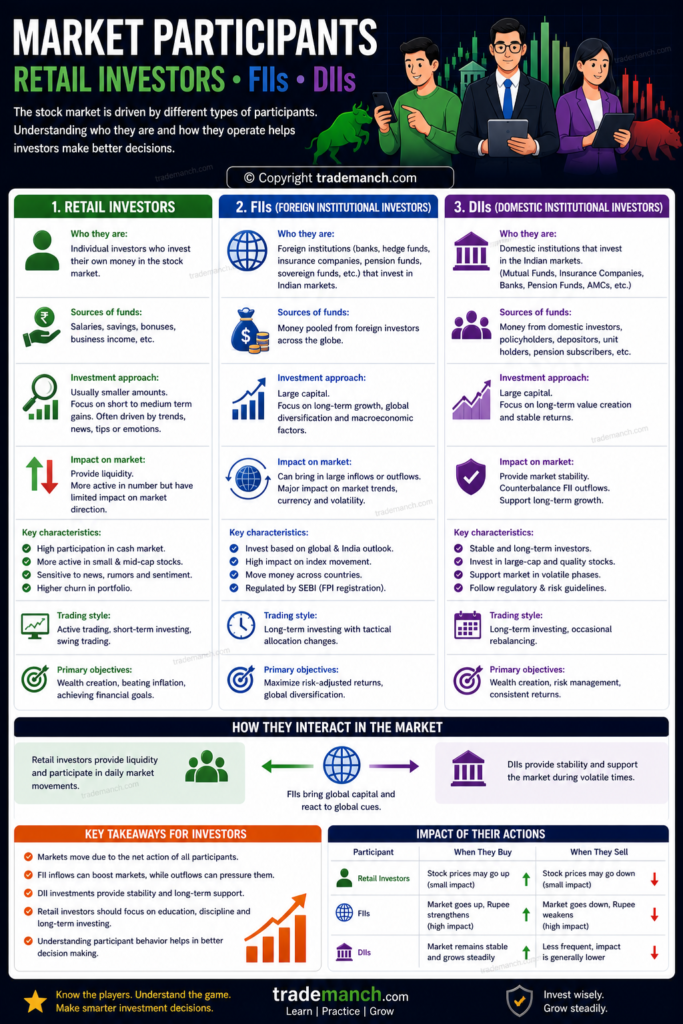
The stock market is made up of various participants who buy and sell securities every day. These participants play a crucial role in determining market liquidity, price movements, and overall market sentiment.
The three major categories of market participants are:
- Retail Investors
- Foreign Institutional Investors (FIIs)
- Domestic Institutional Investors (DIIs)
Understanding how these participants operate can help investors better analyze market trends and make informed investment decisions.
What Are Market Participants?
Market participants are individuals or organizations that buy and sell financial securities in the stock market.
These participants include:
- Individual investors
- Mutual funds
- Insurance companies
- Banks
- Foreign institutions
- Pension funds
- Hedge funds
Every transaction in the stock market involves one or more market participants.
Why Are Market Participants Important?
Market participants help:
- Provide liquidity
- Improve price discovery
- Increase market efficiency
- Support capital formation
- Influence market trends
Their buying and selling activities directly affect stock prices.
Retail Investors
Who Are Retail Investors?
Retail investors are individual investors who buy and sell securities using their personal funds.
Examples:
- Salaried employees
- Business owners
- Students
- Professionals
- Retired individuals
Retail investors typically invest through stockbrokers and trading platforms.
Characteristics of Retail Investors
Retail investors generally:
- Invest smaller amounts
- Trade independently
- Use personal savings
- Focus on wealth creation
They form a significant portion of daily trading activity.
How Retail Investors Invest
Retail investors usually invest through:
- Demat Accounts
- Trading Accounts
- Mutual Funds
- SIPs (Systematic Investment Plans)
Popular brokerage platforms include:
- Zerodha
- Groww
- Angel One
- Upstox
Advantages of Retail Investors
Flexibility
Retail investors can make quick decisions.
Long-Term Investing
Many retail investors focus on wealth creation.
No Large Regulatory Restrictions
They can buy and sell securities freely within market regulations.
Challenges Faced by Retail Investors
Limited Capital
Investment capacity is often smaller than institutions.
Emotional Trading
Fear and greed can influence decisions.
Limited Research Resources
Many retail investors depend on public information.
Foreign Institutional Investors (FIIs)
Who Are FIIs?
FIIs (Foreign Institutional Investors) are organizations or institutions based outside India that invest in Indian financial markets.
Examples include:
- Foreign mutual funds
- Pension funds
- Hedge funds
- Insurance companies
- Sovereign wealth funds
FIIs invest large amounts of money in Indian equities and debt markets.
Why FIIs Are Important
FIIs bring:
- Foreign capital
- Market liquidity
- Global investment expertise
Their investment decisions significantly impact stock market trends.
Examples of FIIs
Some common FII categories include:
- Global Mutual Funds
- Foreign Pension Funds
- International Asset Managers
- Foreign Banks
How FIIs Influence the Market
When FIIs buy heavily:
- Market sentiment improves
- Stock prices may rise
- Liquidity increases
When FIIs sell heavily:
- Market may decline
- Volatility may increase
Factors Affecting FII Investment
FIIs consider:
- Economic growth
- Interest rates
- Inflation
- Government policies
- Currency exchange rates
Advantages of FII Participation
Increased Liquidity
More buying and selling activity.
Market Development
Improves market efficiency.
Global Confidence
Shows international trust in the economy.
Risks of FII Dependence
Sudden Capital Outflows
FIIs can withdraw funds quickly.
Increased Volatility
Large transactions may create sharp price movements.
Domestic Institutional Investors (DIIs)
Who Are DIIs?
DIIs (Domestic Institutional Investors) are Indian institutions that invest in the Indian stock market.
Examples include:
- Mutual Funds
- Insurance Companies
- Pension Funds
- Banks
- Financial Institutions
DIIs invest money collected from Indian investors.
Examples of DIIs
Popular DII categories:
- Mutual Funds
- Life Insurance Companies
- Pension Funds
- Government Financial Institutions
One major example is:
- Life Insurance Corporation of India
Role of DIIs in the Stock Market
DIIs help:
- Stabilize markets
- Support long-term investments
- Counter FII selling pressure
They often act as a balancing force.
How DIIs Influence Market Movements
When DIIs buy:
- Demand increases
- Market receives support
When DIIs sell:
- Prices may face pressure
However, DIIs generally invest with a longer-term perspective.
Advantages of DIIs
Long-Term Investment Focus
Most DIIs invest for years rather than days.
Market Stability
They reduce excessive volatility.
Support During Market Corrections
DIIs often buy when FIIs are selling.
Difference Between Retail Investors, FIIs, and DIIs
| Feature | Retail Investors | FIIs | DIIs |
|---|---|---|---|
| Source of Funds | Personal Savings | Foreign Capital | Domestic Capital |
| Investment Size | Small | Very Large | Large |
| Market Influence | Moderate | High | High |
| Investment Horizon | Varies | Medium to Long Term | Long Term |
| Research Capability | Limited | Extensive | Extensive |
| Market Impact | Low | Significant | Significant |
How FIIs and DIIs Affect Stock Prices
FII Buying
When FIIs purchase large quantities of shares:
- Demand increases
- Prices may rise
FII Selling
When FIIs sell heavily:
- Supply increases
- Prices may decline
DII Buying
DIIs often provide market support during corrections.
DII Selling
Can create downward pressure but generally occurs gradually.
Why Investors Track FII and DII Data
Many traders monitor daily FII and DII activity because it provides insight into:
- Market sentiment
- Institutional confidence
- Potential trend direction
Strong institutional buying often indicates positive market outlook.
Which Participant Has the Greatest Impact?
Generally:
- FIIs
- DIIs
- Retail Investors
FIIs often have the largest influence due to the size of their investments.
However, retail participation in India has increased significantly in recent years.
Market Participation in IPOs
All three participants can invest in IPOs:
- Retail Investors
- FIIs
- DIIs
IPO allocations are often divided among different investor categories.
Importance of Institutional Investors
Institutional investors:
- Improve market efficiency
- Enhance liquidity
- Support price discovery
- Increase investor confidence
Their research and analysis contribute to better market functioning.
How Beginners Should Use FII and DII Data
Don’t Follow Blindly
Institutional buying is useful information but should not be the sole reason for investing.
Combine With Research
Use:
- Fundamental Analysis
- Technical Analysis
- Company Research
before making decisions.
Focus on Long-Term Trends
One day of buying or selling does not always indicate a long-term trend.
Market participants are the backbone of the stock market. Retail Investors, FIIs, and DIIs each play a unique role in maintaining liquidity, supporting price discovery, and driving market movements.
Retail investors contribute through personal investments, FIIs bring foreign capital and global expertise, while DIIs provide stability and long-term support. Understanding the behavior of these participants can help investors better interpret market trends and make more informed investment decisions.
Frequently Asked Questions (FAQs)
1. Who are market participants?
Market participants are individuals and institutions that buy and sell securities in the stock market.
2. Who are retail investors?
Retail investors are individual investors who use their own money to invest in financial markets.
3. What are FIIs?
Foreign Institutional Investors (FIIs) are foreign organizations that invest in Indian financial markets.
4. What are DIIs?
Domestic Institutional Investors (DIIs) are Indian institutions that invest in Indian securities.
5. Why are FIIs important?
FIIs bring foreign capital, improve liquidity, and influence market sentiment.
6. Why are DIIs important?
DIIs help stabilize markets and support long-term investment growth.
7. Who has the biggest impact on the stock market?
FIIs generally have the largest impact because of their large investment size.
8. Can retail investors influence the market?
Yes, especially when large numbers of retail investors participate together.
9. Why do traders track FII and DII activity?
To understand institutional sentiment and possible market trends.
10. Should beginners follow FII and DII data?
Yes, but it should be combined with proper research and analysis before making investment decisions.