
The stock market is where investors buy and sell shares of companies. However, these transactions do not happen directly between buyers and sellers. Instead, they take place through organized platforms known as stock exchanges.
In India, the two major stock exchanges are:
- National Stock Exchange of India
- Bombay Stock Exchange
These exchanges play a crucial role in the Indian financial system by providing a transparent and regulated marketplace for trading securities.
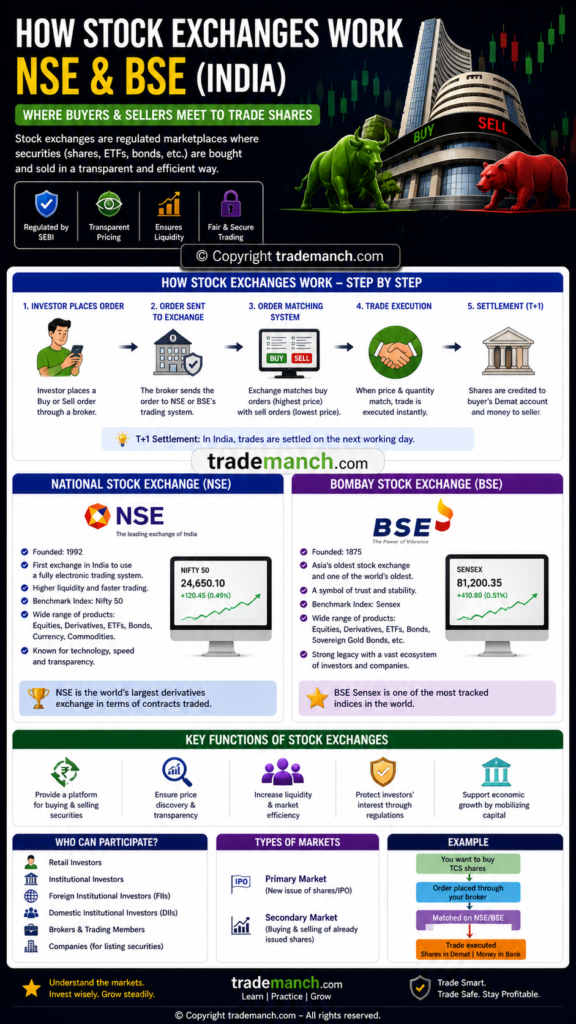
This beginner-friendly guide explains how stock exchanges work, the differences between NSE and BSE, their functions, advantages, and their importance in the Indian economy.
What Is a Stock Exchange?
A stock exchange is a regulated marketplace where investors can:
- Buy shares
- Sell shares
- Trade bonds
- Trade ETFs
- Trade derivatives
A stock exchange ensures:
- Fair pricing
- Transparency
- Liquidity
- Investor protection
Without stock exchanges, buying and selling shares would be extremely difficult.
Simple Definition of Stock Exchange
A stock exchange is an organized marketplace where securities such as stocks and bonds are traded electronically.
Why Are Stock Exchanges Important?
Stock exchanges help:
Companies
- Raise capital from investors
Investors
- Buy ownership in companies
Economy
- Promote business growth
- Generate employment
- Increase investments
How Does a Stock Exchange Work?
The stock exchange acts as a platform that connects:
- Buyers
- Sellers
When an investor places an order:
- Order is sent through a broker.
- Exchange receives the order.
- Matching system finds a buyer or seller.
- Trade is executed.
- Shares and money are transferred.
The entire process takes only seconds.
Example of a Stock Market Transaction
Suppose:
- Investor A wants to buy 100 shares of a company.
- Investor B wants to sell 100 shares.
The exchange matches both orders and completes the trade.
This process is called:
- Order Matching
Major Stock Exchanges in India
India has two primary stock exchanges:
1. National Stock Exchange (NSE)
2. Bombay Stock Exchange (BSE)
Both are regulated by:
- Securities and Exchange Board of India
What Is NSE?
The National Stock Exchange (NSE) was established in 1992.
It introduced:
- Electronic trading
- Modern trading systems
- Faster order execution
NSE is currently India’s largest stock exchange by trading volume.
Key Features of NSE
- Established in 1992
- Fully electronic exchange
- High liquidity
- Fast trade execution
- Popular among traders
NSE Benchmark Index
The main index of NSE is:
- NIFTY 50
Nifty 50 consists of:
- 50 major Indian companies
It represents the overall performance of the Indian stock market.
What Is BSE?
The Bombay Stock Exchange (BSE) was established in 1875.
It is:
- Asia’s oldest stock exchange
- One of the oldest exchanges in the world
BSE has thousands of listed companies.
Key Features of BSE
- Established in 1875
- Asia’s oldest stock exchange
- Large number of listed companies
- Strong investor participation
BSE Benchmark Index
The main index of BSE is:
- BSE Sensex
Sensex consists of:
- 30 major Indian companies
It reflects the performance of India’s leading businesses.
Difference Between NSE and BSE
| Feature | NSE | BSE |
|---|---|---|
| Established | 1992 | 1875 |
| Benchmark Index | Nifty 50 | Sensex |
| Trading Volume | Higher | Lower |
| Liquidity | Higher | Moderate |
| Technology | Modern Electronic | Electronic |
| Popular Among Traders | Very High | High |
How Shares Are Listed on Stock Exchanges
Before trading publicly, a company must:
- Meet listing requirements
- Obtain approvals
- Launch an IPO
- List shares on NSE or BSE
After listing, investors can buy and sell shares freely.
What Is an IPO?
IPO stands for:
- Initial Public Offering
An IPO is the process through which a private company becomes publicly listed.
After IPO:
- Shares begin trading on NSE or BSE.
Role of Brokers in Stock Exchanges
Investors cannot trade directly on stock exchanges.
They need a registered stockbroker.
Popular brokers in India include:
- Zerodha
- Angel One
- Upstox
- Groww
Brokers connect investors to exchanges.
How Orders Are Matched
Modern exchanges use:
- Electronic Order Matching Systems
Example:
Buyer places:
- Buy 100 shares at ₹500
Seller places:
- Sell 100 shares at ₹500
The exchange instantly matches both orders.
Types of Orders in Stock Exchange
Market Order
Buy or sell immediately at the current market price.
Limit Order
Buy or sell at a specific price.
Stop-Loss Order
Automatically exits a trade if price reaches a predetermined level.
What Is Market Capitalization?
Market Capitalization represents a company’s total market value.
Formula:
Market Cap=Share Price×Total Outstanding Shares
What Is Liquidity?
Liquidity refers to:
- Ease of buying and selling shares
High liquidity means:
- Faster transactions
- Smaller price fluctuations
NSE generally has higher liquidity than BSE.
What Is Clearing and Settlement?
After a trade is executed:
Clearing
Confirms buyer and seller obligations.
Settlement
Transfers:
- Shares to buyer
- Money to seller
In India, settlement is handled through regulated systems under SEBI guidelines.
Role of SEBI
The stock market regulator in India is:
- Securities and Exchange Board of India
SEBI ensures:
- Fair trading
- Investor protection
- Market transparency
- Prevention of fraud
Advantages of Stock Exchanges
Transparency
Prices are publicly visible.
Liquidity
Easy buying and selling.
Regulation
Strong investor protection.
Capital Formation
Helps businesses raise funds.
Wealth Creation
Provides investment opportunities.
Risks of Stock Market Investing
Investors should understand:
Market Risk
Prices can fluctuate.
Economic Risk
Economic slowdown may affect markets.
Company Risk
Poor company performance can reduce stock value.
Global Risk
International events can impact Indian markets.
How Beginners Can Start Trading
Step 1
Open a Demat Account.
Step 2
Open a Trading Account.
Step 3
Complete KYC.
Step 4
Deposit funds.
Step 5
Start investing in listed companies.
Popular Companies Listed on NSE and BSE
Examples include:
- Reliance Industries
- Infosys
- Tata Consultancy Services
- HDFC Bank
- ICICI Bank
NSE vs BSE: Which Is Better?
For most investors:
- Both are reliable.
For active traders:
- NSE often provides higher liquidity and tighter spreads.
For long-term investors:
- Either exchange is suitable.
Stock exchanges are the backbone of the financial market. They provide a regulated platform where investors can buy and sell securities safely and efficiently. In India, the two major exchanges are the National Stock Exchange (NSE) and the Bombay Stock Exchange (BSE).
NSE is known for its high liquidity and trading volume, while BSE is famous for being Asia’s oldest stock exchange and having a large number of listed companies.
Understanding how stock exchanges work is one of the first steps toward becoming a successful investor or trader in the Indian stock market.
Frequently Asked Questions (FAQs)
1. What is a stock exchange?
A stock exchange is a marketplace where securities like shares and bonds are traded.
2. What are the two major stock exchanges in India?
- National Stock Exchange of India
- Bombay Stock Exchange
3. What is Nifty 50?
NIFTY 50 is the benchmark index of NSE consisting of 50 major companies.
4. What is Sensex?
BSE Sensex is the benchmark index of BSE consisting of 30 major companies.
5. Who regulates stock exchanges in India?
Securities and Exchange Board of India regulates Indian stock markets.
6. Can I buy shares directly from NSE or BSE?
No, you must use a registered stockbroker.
7. Which exchange has higher trading volume?
NSE generally has higher trading volume.
8. What is liquidity in the stock market?
Liquidity refers to how easily shares can be bought or sold.
9. What is an IPO?
An IPO is the process through which a private company becomes publicly listed.
10. Is investing in NSE and BSE safe?
Both exchanges are regulated by SEBI and follow strict compliance and investor protection standards.