
Trading in the stock market can be exciting and profitable, but many beginners lose money because of common mistakes. Most new traders focus only on profits and ignore important things like:
- Risk management
- Trading psychology
- Discipline
- Proper learning
The good news is that most trading mistakes can be avoided with proper education and patience.
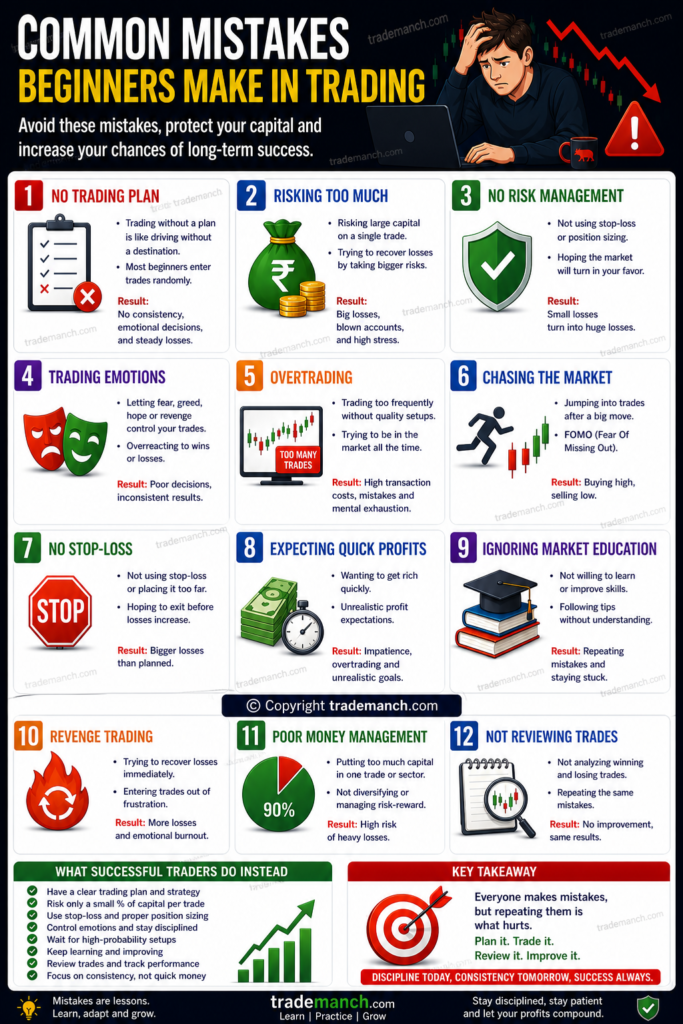
In this complete beginner-friendly guide, you will learn the most common trading mistakes beginners make and how to avoid them for long-term trading success in 2026.
Why Beginners Lose Money in Trading
Most beginners lose money because they:
- Trade emotionally
- Lack proper knowledge
- Ignore risk management
- Chase quick profits
Trading is not gambling or instant income.
Successful trading requires:
- Discipline
- Patience
- Consistency
1. Trading Without Proper Knowledge
One of the biggest mistakes is starting trading without learning market basics.
Many beginners enter markets after watching:
- Social media reels
- Telegram tips
- YouTube hype
without understanding:
- Charts
- Risk management
- Market structure
How to Avoid It
Learn:
- Technical analysis
- Trading psychology
- Risk management
- Market basics
before risking real money.
2. Ignoring Risk Management
Many beginners focus only on profits and ignore losses.
Without risk management:
- A few bad trades can destroy capital quickly.
Example
Suppose:
- Trading capital = ₹1,00,000
- Loss per trade = ₹20,000
After 5 bad trades:
20000×5=100000
Entire capital can be wiped out.
How to Avoid It
Use:
- Stop loss
- Proper position sizing
- 1–2% risk rule
3. Trading Without Stop Loss
A stop loss limits losses automatically.
Beginners often avoid stop losses hoping:
- “The market will reverse.”
This usually increases losses.
Example
Buy stock at ₹500.
Stop loss should be ₹490.
Risk:
500−490=10
Without stop loss, losses may become much larger.
4. Overtrading
Overtrading means taking too many trades unnecessarily.
Many beginners:
- Trade constantly
- Force trades
- Chase every market move
This increases:
- Emotional stress
- Brokerage costs
- Mistakes
How to Avoid It
Focus only on:
- High-quality setups
- Proper trade confirmations
Sometimes:
- No trade is the best trade.
5. Emotional Trading
Emotions destroy trading discipline.
Common emotions include:
- Fear
- Greed
- Revenge trading
- Overconfidence
Fear
Fear causes:
- Early exits
- Missed opportunities
Greed
Greed causes:
- Holding trades too long
- Taking excessive risk
Revenge Trading
After losses, beginners often trade emotionally to recover money quickly.
This usually creates more losses.
How to Avoid Emotional Trading
Follow:
- Trading plan
- Risk management
- Discipline
Professional traders think logically, not emotionally.
6. Using Too Much Leverage
Leverage allows traders to control large positions with small capital.
While leverage increases profit potential, it also increases losses.
Example
Using 10x leverage:
- ₹10,000 controls ₹1,00,000 position.
Small market moves can create huge losses.
How to Avoid It
Beginners should:
- Use low leverage
or - Avoid leverage initially.
7. Chasing Quick Profits
Many beginners expect:
- Daily guaranteed income
- Fast money
- Instant success
This mindset leads to:
- Excessive risk-taking
- Emotional decisions
Reality of Trading
Trading success takes:
- Time
- Practice
- Experience
- Discipline
8. Blindly Following Tips
Many beginners follow:
- Telegram groups
- WhatsApp tips
- Social media influencers
without proper research.
This is very risky.
How to Avoid It
Always:
- Do your own analysis
- Understand the trade before entering
9. Ignoring Trading Psychology
Trading psychology is extremely important.
Even good strategies fail if traders:
- Panic
- Become greedy
- Break discipline
Professional Traders Focus On
- Emotional control
- Patience
- Consistency
- Long-term thinking
10. Switching Strategies Frequently
Beginners often:
- Change strategies after few losses
- Search for “perfect strategy”
No strategy wins every trade.
How to Avoid It
Master:
- One or two strategies deeply
Consistency matters more than complexity.
11. Trading Without a Plan
Random trading usually leads to losses.
A trading plan should include:
- Entry rules
- Exit rules
- Stop loss
- Risk management
- Profit targets
Why Trading Plans Matter
Trading plans reduce:
- Emotional decisions
- Impulsive trades
12. Ignoring Market Trend
Trading against the trend increases risk.
Uptrend
Higher highs and higher lows.
Downtrend
Lower highs and lower lows.
How to Avoid It
Follow the trend whenever possible.
“Trend is your friend.”
13. Risking Too Much on One Trade
Some beginners risk large portions of capital in single trades.
This creates:
- Emotional pressure
- High drawdowns
Safe Risk Example
If capital = ₹1,00,000
1% risk:
100000×0.01=1000
Maximum risk per trade = ₹1,000.
14. Ignoring Position Sizing
Position sizing determines:
- How much quantity to trade
Improper sizing increases losses unnecessarily.
15. Not Maintaining a Trading Journal
Many beginners never track:
- Trades
- Mistakes
- Emotions
This slows improvement.
Benefits of Trading Journal
A journal helps traders:
- Identify mistakes
- Improve discipline
- Analyze performance
16. Trading During High Volatility Without Experience
News events and volatile markets can cause:
- Rapid price swings
- Emotional stress
Beginners should avoid highly volatile situations initially.
17. Lack of Patience
Good trading setups take time.
Many beginners:
- Force entries
- Enter trades too early
Patience is one of the most important trading skills.
18. Ignoring Fundamental Events
Major events affect markets:
- RBI policy
- US Fed decisions
- Inflation data
- Budget announcements
Traders should stay informed.
19. Trading Penny Stocks Blindly
Penny stocks are highly risky because:
- Liquidity is low
- Manipulation risk is high
Beginners should focus on quality stocks.
Examples:
- Reliance Industries
- Infosys
20. Lack of Long-Term Perspective
Many beginners focus only on:
- Daily profits
- Quick money
Professional traders focus on:
- Long-term consistency
- Capital preservation
Best Habits for Beginner Traders
Learn Continuously
Markets constantly evolve.
Start Small
Small capital reduces emotional pressure.
Focus on Risk Management
Protect capital first.
Stay Disciplined
Follow rules consistently.
Think Long Term
Trading is a marathon, not a sprint.
Difference Between Gambling and Trading
| Gambling | Professional Trading |
|---|---|
| Random decisions | Planned strategy |
| Emotional betting | Risk management |
| No discipline | Structured execution |
| High uncertainty | Probability-based approach |
Can Beginners Become Successful Traders?
Yes, but success requires:
- Learning
- Discipline
- Patience
- Emotional control
- Risk management
Most successful traders improve gradually over time.
Trading mistakes are common for beginners, but most losses can be reduced through proper education, discipline, and risk management. Emotional trading, lack of stop loss, overtrading, excessive leverage, and unrealistic expectations are among the biggest reasons why beginners fail.
Successful trading is not about finding a magic strategy. It is about:
- Protecting capital
- Managing emotions
- Staying disciplined
- Thinking long term
Beginners who focus on learning and consistency have a much better chance of long-term success in the stock market.
Frequently Asked Questions (FAQs)
1. Why do most beginners lose money in trading?
Main reasons include emotional trading, poor risk management, and lack of knowledge.
2. What is the biggest trading mistake?
Ignoring stop loss and risk management.
3. What is overtrading?
Taking too many unnecessary trades.
4. Why is emotional trading dangerous?
Fear and greed often lead to poor decisions.
5. What is leverage in trading?
Leverage allows larger trading positions using smaller capital.
6. Should beginners use leverage?
Beginners should avoid high leverage because it increases risk.
7. What is revenge trading?
Taking emotional trades after losses to recover money quickly.
8. Why is trading psychology important?
Mindset and emotional control are essential for discipline.
9. How can beginners improve trading?
Through learning, practice, discipline, and risk management.
10. Is trading easy for beginners?
No, successful trading requires time, learning, and experience.