
The stock market moves in cycles. Sometimes prices rise steadily for months or years, while at other times they decline significantly. These two major market conditions are known as the Bull Market and Bear Market.
Understanding the difference between a bull market and a bear market is one of the first steps toward becoming a successful investor or trader. These market phases influence stock prices, investor sentiment, trading strategies, and overall investment performance.
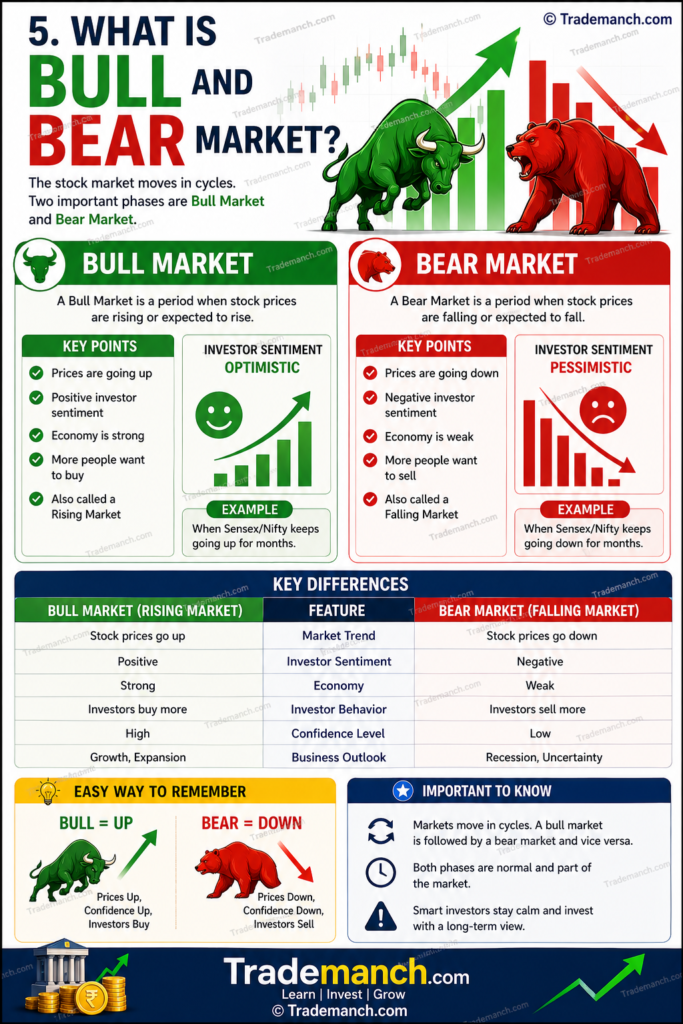
In this complete beginner guide, you will learn everything about bull and bear markets, their characteristics, causes, advantages, risks, and how to invest during each phase.
What Is a Bull Market?
A Bull Market refers to a period when stock prices are rising and investor confidence is strong.
During a bull market:
- Stock prices generally move upward.
- Investors are optimistic.
- Economic conditions are favorable.
- Corporate earnings often improve.
Bull markets can last for several months or even years.
Simple Definition of Bull Market
A bull market is a period of rising stock prices and positive investor sentiment.
Why Is It Called a Bull Market?
The term “bull” comes from the way a bull attacks.
A bull thrusts its horns upward.
This upward motion symbolizes:
- Rising stock prices
- Positive market momentum
Characteristics of a Bull Market
Rising Stock Prices
Most stocks trend upward.
Strong Economic Growth
Economic indicators improve.
High Investor Confidence
Investors feel optimistic about the future.
Increased Corporate Profits
Businesses often report higher earnings.
Higher Market Participation
More investors enter the market.
Example of a Bull Market
Suppose an index rises from:
20,000 points to 30,000 points.
Increase:
30000−20000=10000
Percentage Gain:
2000010000×100=50%
This strong upward movement may indicate a bull market.
What Is a Bear Market?
A Bear Market refers to a period when stock prices decline significantly and investor sentiment becomes negative.
During a bear market:
- Stock prices fall.
- Fear increases.
- Economic conditions weaken.
- Investor confidence declines.
Bear markets are a normal part of market cycles.
Simple Definition of Bear Market
A bear market is a period of falling stock prices and negative investor sentiment.
Why Is It Called a Bear Market?
The term “bear” comes from the way a bear attacks.
A bear strikes downward with its claws.
This downward movement symbolizes:
- Falling stock prices
- Negative market sentiment
Characteristics of a Bear Market
Falling Stock Prices
Markets trend downward.
Economic Slowdown
Growth may weaken.
Reduced Investor Confidence
Fear dominates decision-making.
Declining Corporate Earnings
Companies may report weaker results.
Lower Market Participation
Investors often become cautious.
Example of a Bear Market
Suppose an index falls from:
30,000 points to 24,000 points.
Decline:
30000−24000=6000
Percentage Loss:
300006000×100=20%
A decline of 20% or more is commonly considered a bear market.
Bull Market vs Bear Market
| Feature | Bull Market | Bear Market |
|---|---|---|
| Market Direction | Upward | Downward |
| Investor Sentiment | Optimistic | Pessimistic |
| Economic Conditions | Strong | Weak |
| Corporate Earnings | Growing | Declining |
| Investment Activity | High | Lower |
| Risk Appetite | High | Low |
Causes of a Bull Market
Several factors can trigger a bull market.
Strong Economic Growth
Increasing GDP and business activity.
Low Interest Rates
Encourage borrowing and investing.
Rising Corporate Earnings
Companies generate higher profits.
Positive Government Policies
Business-friendly policies support growth.
High Consumer Spending
Increased demand boosts company revenues.
Causes of a Bear Market
Several factors can lead to a bear market.
Economic Recession
Reduced business activity.
High Inflation
Increasing costs reduce profitability.
Rising Interest Rates
Borrowing becomes more expensive.
Global Uncertainty
Wars, pandemics, and crises can impact markets.
Weak Corporate Earnings
Lower profits reduce investor confidence.
Investor Psychology During a Bull Market
During a bull market:
- Optimism increases.
- Investors buy aggressively.
- Risk appetite grows.
Many investors believe prices will continue rising.
Investor Psychology During a Bear Market
During a bear market:
- Fear dominates.
- Investors sell holdings.
- Market participation declines.
Panic selling often occurs.
How Traders Benefit in a Bull Market
Traders often:
- Buy stocks
- Follow upward trends
- Use trend-following strategies
Bull markets generally provide more buying opportunities.
How Traders Benefit in a Bear Market
Experienced traders may:
- Short-sell stocks
- Trade bearish setups
- Focus on defensive sectors
Bear markets can also create opportunities.
Investing During a Bull Market
Focus on Growth Stocks
Growth-oriented companies often perform well.
Follow the Trend
Trend-following strategies become effective.
Avoid Excessive Risk
Even bull markets experience corrections.
Investing During a Bear Market
Focus on Quality Companies
Strong businesses often survive downturns.
Maintain Diversification
Reduce concentration risk.
Continue SIP Investments
Market declines can create attractive buying opportunities.
Keep Cash Available
Cash provides flexibility during market corrections.
Famous Bull Markets in History
Examples include:
Post-2008 Recovery
Global markets recovered strongly after the financial crisis.
Technology Boom
Technology companies experienced rapid growth.
Famous Bear Markets in History
Examples include:
Global Financial Crisis (2008)
Severe market declines occurred worldwide.
COVID-19 Market Crash (2020)
Markets experienced sharp short-term declines before recovery.
Which Is Better: Bull Market or Bear Market?
For most investors:
- Bull markets create wealth faster.
However:
- Bear markets often provide excellent buying opportunities.
Both phases are important parts of market cycles.
Common Beginner Mistakes
Buying at Market Peaks
Avoid investing solely because everyone else is buying.
Panic Selling During Bear Markets
Temporary declines do not always indicate permanent problems.
Ignoring Diversification
Maintain a balanced portfolio.
Following Emotions
Fear and greed often lead to poor decisions.
How Beginners Should Handle Market Cycles
During Bull Markets
- Stay disciplined.
- Avoid overconfidence.
- Continue risk management.
During Bear Markets
- Stay patient.
- Focus on quality investments.
- Continue long-term investing plans.
Can You Predict Bull and Bear Markets?
Accurately predicting market cycles is extremely difficult.
Most professional investors focus on:
- Asset allocation
- Diversification
- Long-term investing
rather than trying to predict every market movement.
Bull and Bear Markets in India
Indian market performance is often measured using:
- NIFTY 50
- BSE Sensex
These indices help investors understand whether the market is experiencing bullish or bearish conditions.
Bull and Bear Markets are natural phases of the stock market cycle. A Bull Market is characterized by rising prices, strong economic conditions, and positive investor sentiment, while a Bear Market involves declining prices, economic challenges, and increased fear.
Successful investors understand that both market conditions create opportunities. By maintaining discipline, diversification, proper risk management, and a long-term perspective, investors can navigate both bull and bear markets effectively.
Remember: markets move in cycles, but patience and consistency remain key to long-term investment success.
Frequently Asked Questions (FAQs)
1. What is a bull market?
A bull market is a period of rising stock prices and positive investor sentiment.
2. What is a bear market?
A bear market is a period of falling stock prices and negative investor sentiment.
3. Why is it called a bull market?
Because a bull attacks upward with its horns, symbolizing rising prices.
4. Why is it called a bear market?
Because a bear attacks downward with its claws, symbolizing falling prices.
5. How much decline defines a bear market?
A decline of 20% or more is commonly considered a bear market.
6. Which market is better for investors?
Bull markets generally generate faster wealth growth, but bear markets create buying opportunities.
7. Can traders profit in a bear market?
Yes. Experienced traders can use bearish strategies and short-selling.
8. Should beginners panic during a bear market?
No. Market declines are a normal part of investing.
9. How can investors prepare for market cycles?
Through diversification, risk management, and long-term planning.
10. Can anyone accurately predict bull and bear markets?
Predicting market cycles consistently is extremely difficult.