
The stock market is influenced by many factors, but two of the most important drivers in India are the Union Budget and the policies of the Reserve Bank of India (RBI). Every year, investors, traders, businesses, and financial institutions closely watch Budget announcements and RBI policy meetings because these decisions can significantly impact stock prices, sectors, and overall market sentiment.
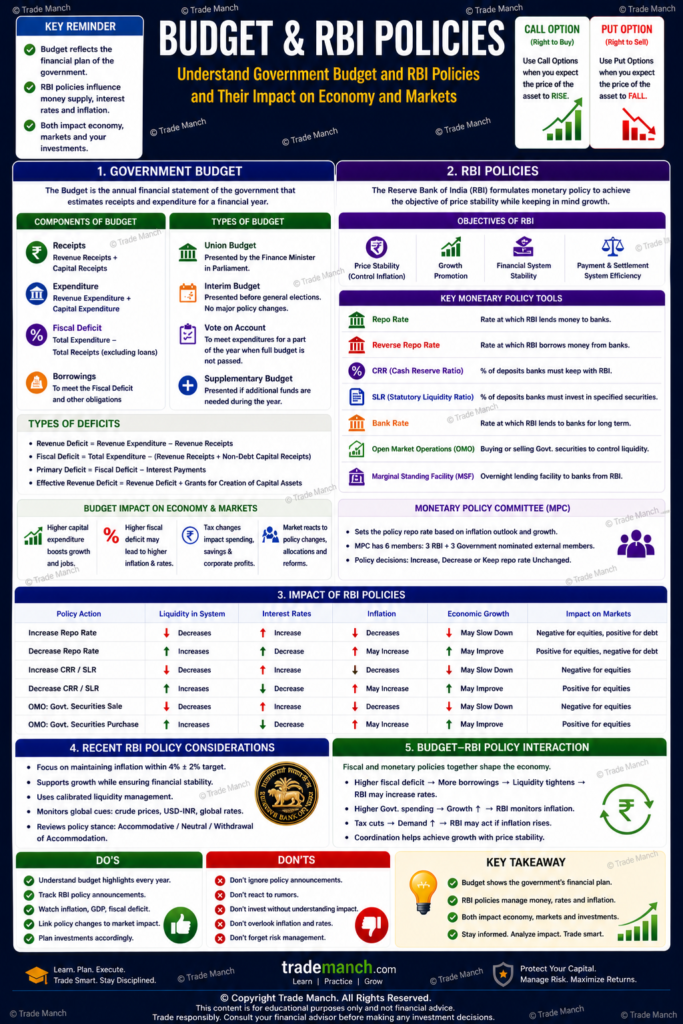
Understanding how Budget and RBI policies affect the stock market can help investors make informed decisions and identify potential opportunities.
What Is the Union Budget?
The Union Budget is the annual financial statement presented by the Government of India. It outlines:
- Government revenue
- Government expenditure
- Tax policies
- Economic priorities
- Infrastructure spending
- Fiscal deficit targets
The Budget provides a roadmap for the country’s economic development.
Simple Definition of Union Budget
The Union Budget is the government’s annual financial plan that details income, spending, and economic policies.
Why Does the Budget Affect the Stock Market?
The Budget directly impacts:
- Corporate profits
- Consumer spending
- Economic growth
- Sector performance
- Investor sentiment
Positive Budget measures often boost market confidence, while unfavorable policies may create pressure on stocks.
Key Budget Announcements That Affect Markets
Tax Changes
Changes in taxation can affect both companies and investors.
Examples:
- Corporate tax reductions
- Capital gains tax changes
- Income tax relief
Lower taxes generally support economic growth and stock prices.
Infrastructure Spending
Government spending on:
- Roads
- Railways
- Airports
- Energy projects
can benefit infrastructure-related companies.
Fiscal Deficit Targets
Fiscal deficit refers to the gap between government income and expenditure.
Lower deficits are generally viewed positively by investors.
Sector-Specific Policies
The government often introduces incentives for specific sectors such as:
- Banking
- Healthcare
- Renewable Energy
- Manufacturing
- Agriculture
These sectors may outperform following favorable announcements.
What Is RBI Monetary Policy?
The Reserve Bank of India conducts monetary policy to manage:
- Inflation
- Interest rates
- Money supply
- Economic growth
The RBI’s decisions have a major impact on financial markets.
Simple Definition of RBI Policy
RBI policy refers to decisions taken by India’s central bank to manage the economy and financial system.
Key RBI Policy Tools
Repo Rate
The repo rate is the interest rate at which banks borrow money from the RBI.
Reverse Repo Rate
The rate at which banks deposit funds with the RBI.
Cash Reserve Ratio (CRR)
The percentage of deposits banks must keep with the RBI.
Statutory Liquidity Ratio (SLR)
The portion of deposits banks must maintain in liquid assets.
How Repo Rate Affects the Stock Market
The repo rate is one of the most closely watched indicators.
Repo Rate Cut
When RBI lowers interest rates:
- Borrowing becomes cheaper
- Business expansion becomes easier
- Consumer spending increases
- Corporate profits may improve
This is generally positive for stock markets.
Repo Rate Hike
When RBI raises interest rates:
- Loans become more expensive
- Consumer spending may slow
- Business costs increase
- Economic growth may moderate
This can create pressure on stocks.
Impact of Budget on Different Sectors
Banking Sector
Positive Budget measures often support lending growth.
Major beneficiaries may include:
- HDFC Bank
- ICICI Bank
- State Bank of India
Infrastructure Sector
Government spending can benefit construction and engineering companies.
Automobile Sector
Tax incentives and economic growth can boost vehicle demand.
Healthcare Sector
Healthcare allocations may support pharmaceutical and hospital companies.
Renewable Energy Sector
Green energy initiatives can create opportunities in solar and renewable energy businesses.
Impact of RBI Policies on Different Sectors
Banking Stocks
Banks are directly affected by interest rate changes.
Lower rates may boost loan growth.
Real Estate Sector
Lower interest rates generally make home loans cheaper, supporting real estate demand.
Automobile Sector
Vehicle financing becomes more affordable when rates decline.
IT Sector
The impact is generally indirect through economic growth and currency movements.
Budget Impact on Investor Sentiment
Markets often react before, during, and after Budget announcements.
Positive sentiment may occur when:
- Tax burdens are reduced
- Growth initiatives are announced
- Fiscal discipline is maintained
Negative sentiment may occur if:
- Taxes increase
- Spending expectations are not met
- Fiscal deficits rise significantly
RBI Policy and Market Volatility
RBI policy meetings often create short-term volatility.
Traders closely watch:
- Interest rate decisions
- Inflation forecasts
- Economic growth projections
Unexpected decisions can trigger sharp market movements.
Budget and Inflation
Government spending can influence inflation.
Higher spending may:
- Stimulate growth
- Increase demand
Excessive demand can sometimes contribute to inflationary pressures.
RBI’s Role in Controlling Inflation
One of the RBI’s primary responsibilities is maintaining price stability.
If inflation rises significantly:
- RBI may increase interest rates
If inflation remains under control:
- RBI may support growth through lower rates
Budget and Long-Term Investors
Long-term investors should focus on:
- Economic growth initiatives
- Infrastructure development
- Sectoral reforms
- Fiscal sustainability
Short-term market reactions are often less important than long-term policy direction.
Budget and Traders
Traders often focus on:
- Immediate market reaction
- Sector-specific opportunities
- Increased volatility
Budget day is usually one of the most volatile trading sessions of the year.
RBI Policy and Bond Markets
Interest rate decisions significantly affect bond prices.
Generally:
- Lower interest rates = Higher bond prices
- Higher interest rates = Lower bond prices
Bond market movements often influence equities as well.
Historical Examples of Market Reactions
Markets have often reacted strongly to:
- Major tax reforms
- Infrastructure spending announcements
- Large interest rate cuts
- Inflation-related policy changes
However, long-term market direction depends on overall economic performance rather than a single event.
Common Beginner Mistakes
Trading Only Based on Headlines
Always understand the complete policy impact.
Ignoring Long-Term Effects
Short-term reactions may not reflect long-term outcomes.
Overreacting to Volatility
Budget and RBI announcements often create temporary fluctuations.
Focusing on One Sector Only
Diversification remains important.
How Investors Should Prepare for Budget and RBI Events
Before the Announcement
- Review portfolio exposure
- Understand market expectations
During the Announcement
- Avoid emotional decisions
- Focus on facts rather than rumors
After the Announcement
- Evaluate long-term implications
- Look for sector opportunities
Budget vs RBI Policy: Key Differences
| Feature | Union Budget | RBI Policy |
|---|---|---|
| Authority | Government of India | RBI |
| Focus | Fiscal Policy | Monetary Policy |
| Frequency | Annual | Multiple Times Per Year |
| Main Objective | Economic Development | Inflation & Stability |
| Market Impact | Sector-Specific & Broad | Interest Rate Sensitive |
The Union Budget and RBI policies are two of the most important factors influencing the Indian stock market. The Budget affects taxation, government spending, and economic priorities, while RBI policies influence interest rates, inflation, liquidity, and borrowing costs.
Successful investors understand that these events create both opportunities and risks. By staying informed, focusing on long-term trends, and avoiding emotional reactions, investors can better navigate market movements and make more informed investment decisions.
Frequently Asked Questions (FAQs)
1. Why does the Budget affect the stock market?
Because it influences taxes, government spending, economic growth, and corporate profitability.
2. What is RBI monetary policy?
It is the set of actions taken by the RBI to manage inflation, interest rates, and liquidity.
3. What is the repo rate?
The interest rate at which banks borrow money from the RBI.
4. How does a repo rate cut affect stocks?
Lower rates generally support economic growth and can boost stock prices.
5. How does a repo rate hike affect stocks?
Higher rates can increase borrowing costs and may pressure stock markets.
6. Which sectors benefit most from Budget announcements?
Infrastructure, banking, healthcare, manufacturing, and renewable energy sectors often benefit.
7. Does the stock market always rise after the Budget?
No. Market reactions depend on expectations and policy details.
8. Why do traders watch RBI meetings?
Interest rate decisions can create significant market volatility.
9. Should long-term investors worry about Budget-day volatility?
Generally, long-term investors should focus on policy direction rather than short-term fluctuations.
10. Which is more important for the stock market: Budget or RBI policy?
Both are important, but their impact depends on economic conditions and market expectations.