
Hedging is one of the most important uses of the Futures & Options (F&O) market. While many traders use derivatives for speculation, professional investors and institutions often use F&O contracts to protect their portfolios from potential losses.
Think of hedging as insurance for your investments. Just as you buy health insurance to protect yourself from unexpected medical expenses, hedging helps protect your investment portfolio from adverse market movements.
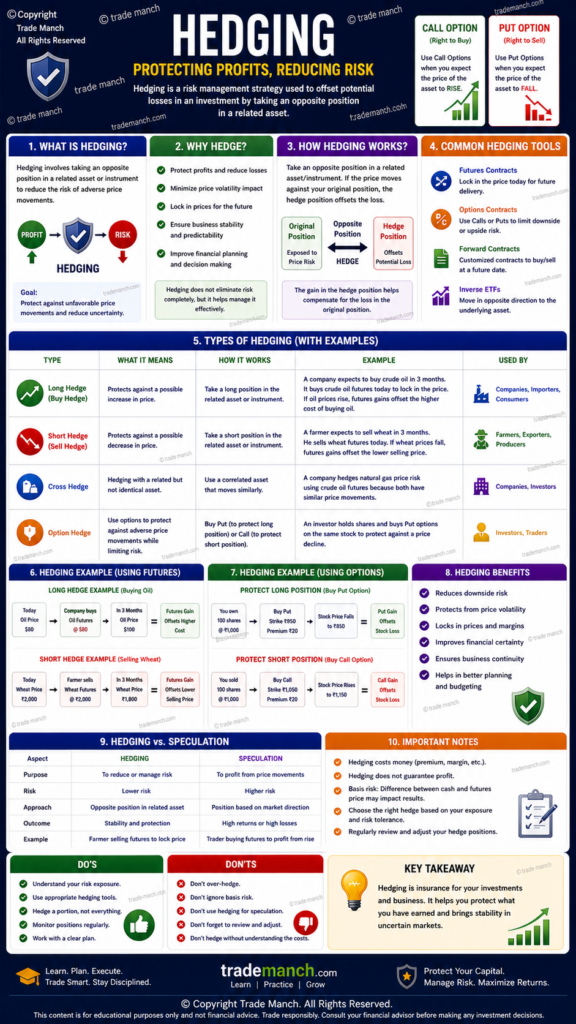
In this guide, you’ll learn what hedging is, how it works, common hedging strategies, and practical examples that beginners can easily understand.
What Is Hedging?
Hedging is a risk management technique used to reduce or offset potential losses in an investment portfolio.
It involves taking an opposite position in a related financial instrument to protect against unfavorable price movements.
Simple Definition of Hedging
Hedging is the process of protecting your investments from losses by using derivative contracts such as Futures and Options.
Why Is Hedging Important?
Markets can be unpredictable.
Even strong companies can experience short-term declines due to:
- Economic uncertainty
- Interest rate changes
- Global events
- Market corrections
- Company-specific issues
Hedging helps reduce the impact of these risks.
How Hedging Works
The basic idea is simple:
If one position loses value, the hedge gains value and helps offset the loss.
Real-Life Example of Hedging
Suppose:
You own shares worth ₹5,00,000.
You are bullish on the long-term future of the stock but worry about a short-term market decline.
Instead of selling your shares, you can hedge your position using F&O instruments.
If the market falls:
- Portfolio value declines.
- Hedge position gains value.
This reduces overall losses.
Types of Hedging in F&O
The most common methods include:
Hedging with Put Options
Hedging with Futures
Protective Put Strategy
Covered Call Strategy
Index Hedging
Hedging with Put Options
What Is a Protective Put?
A Protective Put is one of the simplest hedging strategies.
You:
- Own the stock.
- Buy a Put Option on the same stock.
Why Buy a Put Option?
A Put Option gains value when the stock price falls.
This helps offset losses in the stock position.
Example of Protective Put
Suppose:
- Stock Price = ₹1,000
- Shares Owned = 100
- Portfolio Value = ₹1,00,000
You buy:
- ₹1,000 Strike Put Option
- Premium = ₹20
Scenario 1: Stock Rises
Stock moves to ₹1,100.
Profit from stock:
1100−1000=100
Profit = ₹100 per share
The Put Option may expire worthless, but the stock gains compensate.
Scenario 2: Stock Falls
Stock moves to ₹900.
Loss from stock:
1000−900=100
Loss = ₹100 per share
However, the Put Option gains value, reducing overall losses.
Advantages of Protective Put
Downside Protection
Protects against major declines.
Unlimited Upside
Stock gains remain intact.
Peace of Mind
Reduces emotional decision-making.
Disadvantages of Protective Put
Premium Cost
Insurance is not free.
Reduced Net Returns
Premium expenses lower overall profits.
Hedging with Futures
What Is Futures Hedging?
Investors can hedge a portfolio by taking an opposite position in Futures contracts.
Example
Suppose:
Portfolio Value = ₹10,00,000
You expect short-term market weakness.
You sell Index Futures.
If Market Falls
Portfolio loses value.
Index Futures gain value.
If Market Rises
Portfolio gains value.
Futures position loses value.
Advantages of Futures Hedging
Effective Protection
Suitable for large portfolios.
No Option Premium
Unlike options, no premium is paid.
Risks of Futures Hedging
Margin Requirement
Requires maintaining margin funds.
Unlimited Risk
Futures positions can generate significant losses.
Covered Call Strategy
What Is a Covered Call?
A Covered Call involves:
- Owning shares
- Selling a Call Option
on those shares.
Objective
Generate additional income through option premium.
Example
You own:
100 shares at ₹1,000
Sell:
₹1,100 Call Option
Receive premium.
If Stock Remains Below ₹1,100
You keep:
- Shares
- Premium income
If Stock Rises Above ₹1,100
Shares may be called away.
Profit potential becomes limited.
Advantages of Covered Call
Additional Income
Earn premium regularly.
Works in Sideways Markets
Suitable when expecting limited movement.
Disadvantages of Covered Call
Limited Upside
Profit is capped.
Stock Risk Remains
Share prices can still fall.
Index Hedging
What Is Index Hedging?
Instead of hedging individual stocks, investors hedge the entire portfolio using index derivatives.
Common indices include:
- NIFTY 50
- BSE Sensex
Why Use Index Hedging?
Simplicity
One position can hedge multiple stocks.
Cost Efficiency
Often cheaper than hedging each stock separately.
Portfolio Protection
Useful during uncertain market conditions.
Hedging vs Speculation
| Feature | Hedging | Speculation |
|---|---|---|
| Objective | Reduce Risk | Generate Profit |
| Risk Level | Lower | Higher |
| Position Purpose | Protection | Market Prediction |
| Typical Users | Investors | Traders |
Who Uses Hedging?
Retail Investors
Protect investment portfolios.
Mutual Funds
Reduce market exposure.
Insurance Companies
Manage financial risks.
Institutional Investors
Protect large investments.
Benefits of Hedging
Risk Reduction
Protects against market declines.
Portfolio Stability
Reduces volatility.
Better Sleep at Night
Less worry during market uncertainty.
Long-Term Investing Support
Allows investors to remain invested.
Limitations of Hedging
Cost
Options require premium payments.
Reduced Profit
Protection often comes at a cost.
Complexity
Some strategies require advanced knowledge.
When Should Investors Hedge?
Before Major Events
Examples:
- Budget announcements
- RBI policy meetings
- Elections
- Earnings season
During High Volatility
Protection becomes more valuable.
Large Portfolio Exposure
Investors with substantial holdings often hedge regularly.
Common Beginner Mistakes
Over-Hedging
Too much protection can reduce profits.
Ignoring Costs
Premium expenses matter.
Hedging Without a Plan
Always define objectives beforehand.
Using Complex Strategies Too Early
Start with simple approaches.
Best Hedging Strategy for Beginners
The Protective Put is often considered the simplest hedging strategy.
Why?
Easy to Understand
Buy stock + buy Put Option.
Limited Risk
Losses are controlled.
Retains Upside Potential
Stock gains remain possible.
How Professionals Use Hedging
Professional investors continuously monitor:
- Market risk
- Volatility
- Interest rates
- Economic conditions
and adjust hedges accordingly.
Hedging is often viewed as a risk-management tool rather than a profit-generating strategy.
Can Hedging Eliminate Risk Completely?
No.
Hedging reduces risk but cannot eliminate it entirely.
Every hedging strategy involves:
- Costs
- Trade-offs
- Residual risks
The goal is risk reduction, not risk elimination.
Hedging is one of the most valuable applications of Futures and Options. It helps investors protect portfolios, reduce losses, and navigate uncertain market conditions. Whether using Protective Puts, Futures Hedging, Covered Calls, or Index Hedging, the primary objective is risk management rather than speculation.
For beginners, understanding hedging is essential because preserving capital is often more important than maximizing returns. A well-planned hedge can provide peace of mind and help investors stay focused on long-term goals.
Remember: successful investing is not just about making profits—it is also about protecting them.
Frequently Asked Questions (FAQs)
What is hedging in F&O?
Hedging is a strategy used to reduce investment risk using Futures and Options contracts.
Why is hedging important?
It helps protect investments from adverse market movements.
What is a Protective Put?
A strategy where an investor buys a Put Option to protect a stock position.
Can hedging eliminate losses completely?
No. Hedging reduces risk but cannot eliminate it entirely.
What is Futures Hedging?
Using Futures contracts to offset potential losses in a portfolio.
What is a Covered Call?
A strategy involving stock ownership and selling Call Options to earn premium income.
Is hedging free?
No. Many hedging strategies involve costs such as option premiums.
Who uses hedging?
Retail investors, institutions, mutual funds, and professional traders.
Which hedging strategy is easiest for beginners?
The Protective Put strategy is generally the easiest to understand.
Is hedging suitable for long-term investors?
Yes. It can help protect long-term portfolios during uncertain periods.