
Options trading is not limited to simply buying Call Options and Put Options. Professional traders often combine multiple option contracts to create strategies that can profit from different market conditions. Among the most popular options strategies are the Straddle, Strangle, and Iron Condor.
These strategies are widely used by traders to benefit from volatility, time decay, and range-bound markets. Understanding these strategies can help traders manage risk and create more structured trading plans.
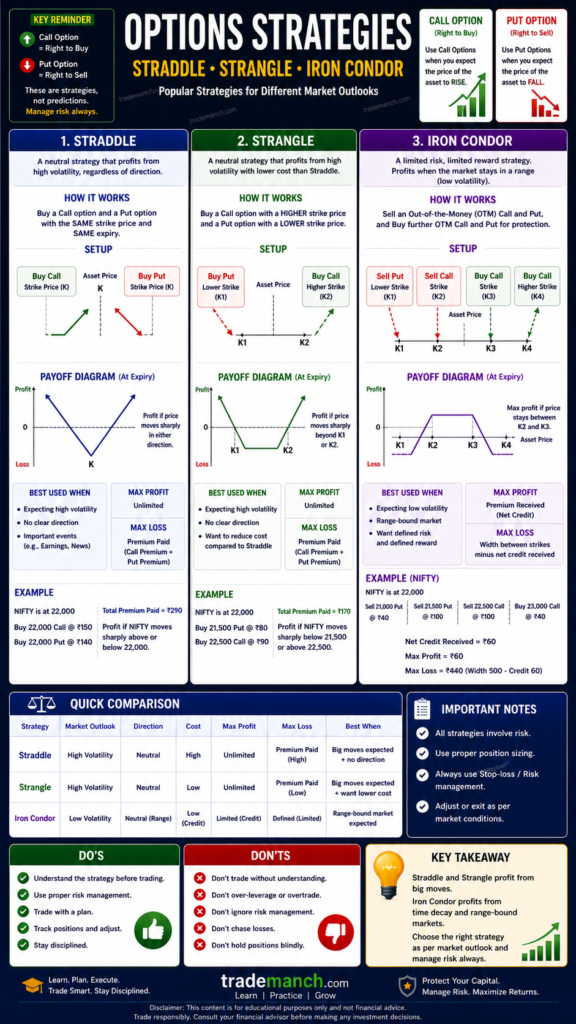
What Are Options Strategies?
Options strategies involve combining two or more option contracts to achieve a specific trading objective.
Traders use strategies to:
- Reduce risk
- Benefit from volatility
- Generate income
- Hedge portfolios
- Trade market uncertainty
Simple Definition of Options Strategies
An options strategy is a combination of option positions designed to profit from a particular market movement or condition.
Why Use Options Strategies?
Options strategies allow traders to:
Manage Risk
Control potential losses.
Trade Different Market Conditions
Profit from:
- Rising markets
- Falling markets
- Sideways markets
- Volatile markets
Improve Probability
Some strategies focus on consistent returns rather than large profits.
Straddle Strategy
What Is a Straddle?
A Straddle involves:
- Buying one Call Option
- Buying one Put Option
with:
- Same Strike Price
- Same Expiry Date
Simple Definition of Straddle
A Straddle is an options strategy used when a trader expects a large move in either direction but is unsure whether the market will rise or fall.
Structure of a Long Straddle
Buy Call Option
Same strike price.
Buy Put Option
Same strike price.
Example of Straddle
Suppose:
- Nifty = 25,000
- Buy 25,000 Call
- Buy 25,000 Put
Total Premium:
Call Premium = ₹100
Put Premium = ₹100
Total Cost:
100+100=200
Total Premium = ₹200
When Does a Straddle Profit?
Strong Upward Move
Call Option gains value.
Strong Downward Move
Put Option gains value.
When Does a Straddle Lose?
Sideways Market
Both options lose value because of time decay.
Advantages of Straddle
Unlimited Profit Potential
Large moves can generate substantial profits.
Direction Neutral
No need to predict market direction.
Disadvantages of Straddle
High Premium Cost
Requires purchasing two options.
Time Decay Risk
Options lose value daily.
Strangle Strategy
What Is a Strangle?
A Strangle is similar to a Straddle but uses different strike prices.
It involves:
- Buying an Out-of-the-Money Call
- Buying an Out-of-the-Money Put
with the same expiry.
Simple Definition of Strangle
A Strangle is a volatility strategy that profits from large price movements while costing less than a Straddle.
Structure of a Long Strangle
Buy OTM Call Option
Higher strike price.
Buy OTM Put Option
Lower strike price.
Example of Strangle
Suppose:
Nifty = 25,000
Buy:
- 25,300 Call
- 24,700 Put
Premiums:
Call = ₹50
Put = ₹50
Total Cost:
50+50=100
Total Premium = ₹100
When Does a Strangle Profit?
Large Upward Move
Call gains significant value.
Large Downward Move
Put gains significant value.
Advantages of Strangle
Lower Cost
Cheaper than a Straddle.
Large Profit Potential
Benefits from strong market moves.
Disadvantages of Strangle
Requires Bigger Move
Market must move further than a Straddle to become profitable.
Time Decay
Option value decreases over time.
Straddle vs Strangle
| Feature | Straddle | Strangle |
|---|---|---|
| Strike Prices | Same | Different |
| Cost | Higher | Lower |
| Break-Even Range | Smaller | Larger |
| Profit Potential | High | High |
| Time Decay Impact | High | High |
Iron Condor Strategy
What Is an Iron Condor?
An Iron Condor is an advanced neutral strategy designed to profit from a range-bound market.
It combines:
- Bull Put Spread
- Bear Call Spread
into one strategy.
Simple Definition of Iron Condor
An Iron Condor profits when the market stays within a specific price range until expiry.
Structure of an Iron Condor
Sell OTM Put
Receive premium.
Buy Lower Strike Put
Limits downside risk.
Sell OTM Call
Receive premium.
Buy Higher Strike Call
Limits upside risk.
Example of Iron Condor
Suppose Nifty = 25,000
Positions:
- Sell 24,700 Put
- Buy 24,500 Put
- Sell 25,300 Call
- Buy 25,500 Call
This creates a profit zone between 24,700 and 25,300.
When Does an Iron Condor Profit?
Sideways Market
Maximum profit occurs when the market remains within the defined range.
When Does an Iron Condor Lose?
Strong Upward Breakout
Losses may occur.
Strong Downward Breakdown
Losses may occur.
Advantages of Iron Condor
Time Decay Works in Your Favor
Option sellers benefit from time decay.
Defined Risk
Maximum loss is limited.
High Probability Strategy
Works well in range-bound markets.
Disadvantages of Iron Condor
Limited Profit
Profit potential is capped.
Requires Careful Strike Selection
Poor setup can reduce profitability.
Best Market Conditions for Each Strategy
| Strategy | Best Market Condition |
|---|---|
| Straddle | High Volatility Expected |
| Strangle | Very High Volatility Expected |
| Iron Condor | Low Volatility / Sideways Market |
How Traders Use These Strategies
Before Major Events
Straddle and Strangle are often used before:
- Budget announcements
- RBI policy meetings
- Earnings reports
- Elections
because volatility may increase.
During Stable Markets
Iron Condor is popular when:
- Volatility is low
- Market remains range-bound
Understanding Time Decay
Time decay is one of the most important concepts in options trading.
Option Buyers
Time decay works against them.
Option Sellers
Time decay works in their favor.
Risk Management for Options Strategies
Position Sizing
Never risk too much capital on one trade.
Understand Maximum Loss
Know the worst-case scenario before entering.
Use Defined-Risk Strategies
Iron Condor and spreads limit risk.
Avoid Overtrading
Focus on quality setups.
Common Beginner Mistakes
Trading Complex Strategies Without Understanding Basics
Learn Calls and Puts first.
Ignoring Volatility
Volatility strongly affects option prices.
Not Understanding Time Decay
Many beginners underestimate its impact.
Trading Large Position Sizes
Risk management is essential.
Which Strategy Is Best for Beginners?
Straddle
Suitable for traders expecting volatility.
Strangle
Suitable for traders expecting major price movement while seeking lower cost.
Iron Condor
Better suited for traders who understand option spreads and risk management.
Can These Strategies Generate Consistent Income?
Yes, but success depends on:
- Market conditions
- Risk management
- Volatility analysis
- Discipline
No strategy guarantees profits.
Straddle, Strangle, and Iron Condor are among the most popular options strategies used by professional traders. A Straddle profits from large moves in either direction, a Strangle offers a lower-cost volatility strategy, and an Iron Condor benefits from sideways markets and time decay.
Each strategy serves a different purpose and performs best under specific market conditions. Beginners should first master basic options concepts before using advanced strategies and always prioritize risk management over profit potential.
Understanding these strategies can help traders approach the options market with greater confidence and structure.
Frequently Asked Questions (FAQs)
What is a Straddle?
A Straddle involves buying a Call and Put Option with the same strike price and expiry.
What is a Strangle?
A Strangle involves buying an out-of-the-money Call and Put Option with different strike prices.
What is an Iron Condor?
An Iron Condor is a range-bound options strategy that profits from low volatility.
Which strategy is best for high volatility?
Straddles and Strangles generally perform best when volatility increases.
Which strategy is best for sideways markets?
Iron Condor is designed for range-bound conditions.
Is a Strangle cheaper than a Straddle?
Yes. A Strangle typically requires lower premium investment.
Does time decay affect these strategies?
Yes. It affects buyers negatively and sellers positively.
Is Iron Condor risky?
Risk is defined and limited, but losses can still occur.
Can beginners trade Iron Condors?
Beginners should first understand option spreads and risk management.
Do these strategies guarantee profits?
No. All trading strategies involve risk and require proper execution.