
If you’ve started learning Options Trading, you’ve probably heard terms like Delta, Theta, and Gamma. These are known as Option Greeks, and they help traders understand how an option’s price changes under different market conditions.
Many beginners focus only on market direction, but professional options traders closely monitor the Greeks because they provide valuable information about risk, time decay, and price sensitivity.
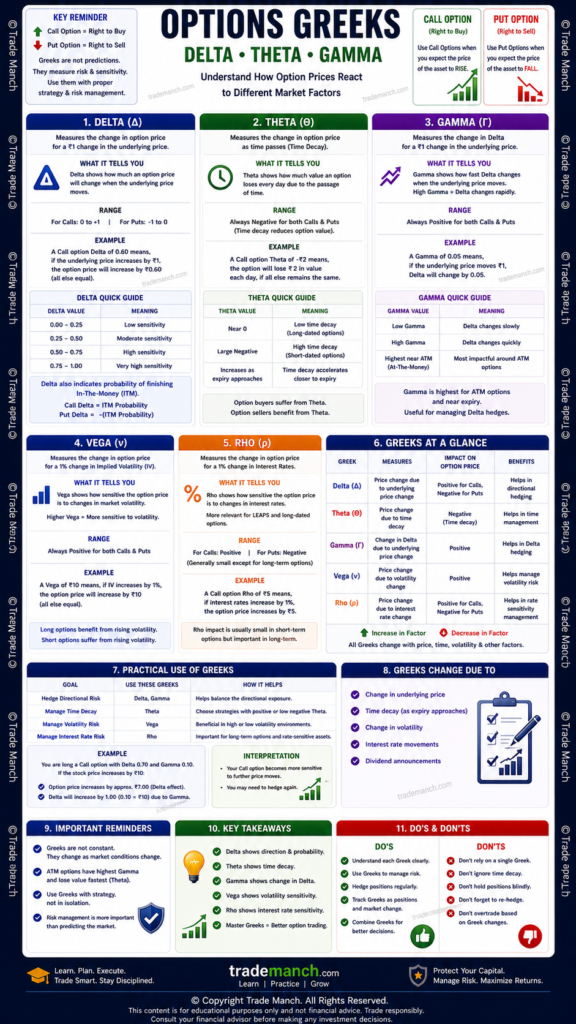
In this beginner-friendly guide, you’ll learn Delta, Theta, and Gamma in simple language with practical examples.
What Are Option Greeks?
Option Greeks are mathematical measures used to estimate how an option’s premium will change when factors such as price, time, and volatility change.
They help traders:
- Measure risk
- Understand option behavior
- Improve trading decisions
- Manage positions effectively
Simple Definition of Option Greeks
Option Greeks are tools that show how an option’s value reacts to changes in market conditions.
Why Are Option Greeks Important?
Option prices are influenced by multiple factors:
- Stock Price
- Time to Expiry
- Volatility
- Interest Rates
Greeks help quantify these effects.
Major Option Greeks
The most important Greeks are:
Delta
Theta
Gamma
Vega
Rho
For beginners, Delta, Theta, and Gamma are the most essential.
Delta (Δ)
What Is Delta?
Delta measures how much an option’s premium is expected to change when the underlying stock moves by ₹1.
Simple Definition of Delta
Delta tells you how sensitive an option is to changes in the underlying asset’s price.
Delta Formula Concept
Δ=Change in Underlying PriceChange in Option Price
Example of Delta
Suppose:
- Call Option Premium = ₹50
- Delta = 0.60
If the stock rises by ₹1:
Expected premium increase:
1×0.60=0.60
New premium ≈ ₹50.60
Delta for Call Options
Call Option Delta ranges between:
0 to 1
Examples:
- Delta 0.20 = Low sensitivity
- Delta 0.50 = Moderate sensitivity
- Delta 0.80 = High sensitivity
Delta for Put Options
Put Option Delta ranges between:
−1 to 0
Examples:
- Delta -0.20
- Delta -0.50
- Delta -0.80
Negative Delta means Put Options generally gain value when stock prices fall.
Understanding Delta Values
Delta Around 0.50
At-the-Money (ATM) Option
Delta Above 0.70
In-the-Money (ITM) Option
Delta Below 0.30
Out-of-the-Money (OTM) Option
Why Delta Matters
Delta helps traders:
Estimate Premium Changes
Understand potential profit or loss.
Measure Directional Exposure
Shows market sensitivity.
Plan Hedge Positions
Useful for advanced strategies.
Theta (Θ)
What Is Theta?
Theta measures the impact of time decay on an option’s premium.
Simple Definition of Theta
Theta shows how much value an option loses each day as expiry approaches.
Why Time Decay Exists
Options have limited life.
As expiry gets closer:
- Less time remains for favorable movement.
- Option value gradually declines.
Theta Formula Concept
Θ=Daily Time Decay of Option Premium
Example of Theta
Suppose:
- Option Premium = ₹100
- Theta = -2
Expected daily loss:
100−2=98
New premium ≈ ₹98
assuming all other factors remain unchanged.
Why Theta Is Important
Theta affects:
Option Buyers
Time decay works against buyers.
Option Sellers
Time decay works in favor of sellers.
Theta Near Expiry
Time decay accelerates as expiry approaches.
This means:
- Option value may decline rapidly.
- OTM options are especially vulnerable.
Benefits of Understanding Theta
Better Entry Timing
Avoid buying options too late.
Improved Strategy Selection
Choose appropriate expiry dates.
Better Risk Management
Understand daily premium erosion.
Gamma (Γ)
What Is Gamma?
Gamma measures how quickly Delta changes when the underlying asset moves.
Simple Definition of Gamma
Gamma tells you how fast Delta changes as stock prices change.
Gamma Formula Concept
Γ=Change in Stock PriceChange in Delta
Example of Gamma
Suppose:
Current Delta = 0.50
Gamma = 0.10
If stock rises by ₹1:
New Delta:
0.50+0.10=0.60
Delta becomes 0.60
Why Gamma Matters
Gamma indicates how quickly an option becomes more or less sensitive to price movement.
High Gamma
Delta changes rapidly.
Usually occurs:
- Near expiry
- At-the-Money options
Low Gamma
Delta changes slowly.
Common in:
- Deep ITM options
- Deep OTM options
Benefits of Understanding Gamma
Understand Delta Risk
Predict how Delta may evolve.
Manage Volatile Positions
Useful during sharp market moves.
Improve Hedging
Important for advanced traders.
Relationship Between Delta, Theta & Gamma
These Greeks work together.
Delta
Measures price sensitivity.
Theta
Measures time decay.
Gamma
Measures Delta’s rate of change.
Example
Suppose:
- Delta = 0.50
- Theta = -2
- Gamma = 0.10
This means:
Delta
Option gains approximately ₹0.50 for every ₹1 stock move.
Theta
Option loses approximately ₹2 daily due to time decay.
Gamma
Delta changes by 0.10 for every ₹1 stock move.
Delta vs Theta vs Gamma
| Greek | Measures | Importance |
|---|---|---|
| Delta | Price Sensitivity | Directional Risk |
| Theta | Time Decay | Expiry Impact |
| Gamma | Delta Change | Volatility Sensitivity |
How Option Buyers Use Greeks
Delta
Choose directional exposure.
Theta
Monitor time decay.
Gamma
Understand responsiveness.
How Option Sellers Use Greeks
Theta Advantage
Time decay generates income.
Delta Control
Manage directional risk.
Gamma Awareness
Avoid sudden risk increases.
Common Beginner Mistakes
Ignoring Theta
Many beginners underestimate time decay.
Buying Cheap OTM Options
Often suffer rapid premium erosion.
Focusing Only on Direction
Option pricing depends on more than market movement.
Trading Near Expiry Without Understanding Gamma
Risk increases significantly.
Practical Tips for Beginners
Learn Delta First
It is the easiest Greek to understand.
Monitor Theta Daily
Time decay matters.
Be Careful Near Expiry
Gamma risk increases substantially.
Use Greeks Along with Technical Analysis
Greeks complement market analysis.
Which Greek Is Most Important?
For beginners:
Delta
Most important for understanding option price movement.
Theta
Second most important because it directly impacts profitability.
Gamma
Becomes increasingly important as experience grows.
Can Greeks Predict Profits?
No.
Greeks help estimate risk and option behavior, but they do not guarantee profitable trades.
Successful options trading still requires:
- Market analysis
- Risk management
- Discipline
- Proper position sizing
Option Greeks are essential tools for understanding how options behave. Delta measures price sensitivity, Theta measures time decay, and Gamma measures how Delta changes. Together, these Greeks help traders evaluate risk, manage positions, and make more informed trading decisions.
For beginners, mastering Delta, Theta, and Gamma is one of the most important steps toward becoming a successful options trader. Understanding these concepts can help you avoid common mistakes and build a stronger foundation in the F&O market.
Remember: successful options trading is not just about predicting market direction—it’s also about understanding how options themselves behave.
Frequently Asked Questions (FAQs)
What are Option Greeks?
Option Greeks are measures that show how option prices react to changes in market conditions.
What is Delta?
Delta measures how much an option’s premium changes when the underlying asset moves by ₹1.
What is Theta?
Theta measures daily time decay in an option’s premium.
What is Gamma?
Gamma measures how quickly Delta changes as the stock price moves.
Why is Delta important?
It helps estimate how sensitive an option is to price changes.
Why is Theta important?
It shows how option value decreases over time.
Why is Gamma important?
It helps traders understand changes in Delta and risk exposure.
Does Theta affect option sellers?
Yes. Time decay generally benefits option sellers.
Which Greek should beginners learn first?
Delta is usually the best starting point.
Can Greeks guarantee profits?
No. Greeks help manage risk and understand option behavior but do not guarantee success.