
Swing trading is one of the most popular trading styles among beginners and working professionals because it does not require constant monitoring of the market. Unlike intraday trading, where positions are closed on the same day, swing traders hold positions for several days or weeks to capture medium-term price movements.
Swing trading combines the benefits of both investing and short-term trading. It allows traders to take advantage of market trends while avoiding the stress of minute-by-minute market fluctuations.
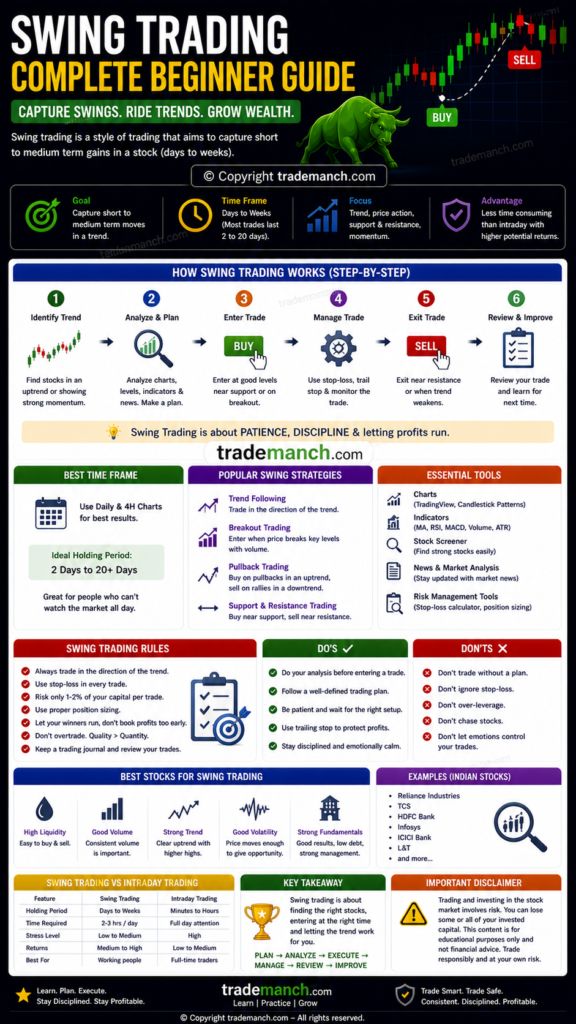
This complete beginner guide will help you understand everything about swing trading, including how it works, strategies, indicators, advantages, risks, and common mistakes.
What Is Swing Trading?
Swing trading is a trading style where traders buy and hold stocks, commodities, forex pairs, or cryptocurrencies for a few days to several weeks to profit from short-term and medium-term price movements.
The goal is to capture a “swing” in price between support and resistance levels or during a trending market.
Simple Definition of Swing Trading
Swing trading is the practice of holding trades for several days or weeks to profit from market price swings.
How Swing Trading Works
Swing traders look for:
- Trend reversals
- Breakouts
- Pullbacks
- Support and resistance opportunities
After identifying a setup, they enter a trade and hold it until the target or stop loss is reached.
Example:
- Buy a stock at ₹500
- Hold for 10 days
- Sell at ₹550
Profit:
550−500=50
Profit per share = ₹50
Swing Trading vs Intraday Trading
| Feature | Swing Trading | Intraday Trading |
|---|---|---|
| Holding Period | Days to Weeks | Same Day |
| Time Requirement | Low | High |
| Stress Level | Lower | Higher |
| Number of Trades | Fewer | More |
| Overnight Risk | Yes | No |
| Suitable for Beginners | Yes | Moderate |
Why Swing Trading Is Popular
Many traders prefer swing trading because:
- Less screen time
- Suitable for working professionals
- More time for analysis
- Lower stress levels
- Better risk-reward opportunities
Who Can Do Swing Trading?
Swing trading is suitable for:
- Students
- Salaried employees
- Business owners
- Part-time traders
- Long-term investors seeking additional returns
You don’t need to watch the market throughout the day.
Advantages of Swing Trading
Less Time Commitment
You can analyze charts after market hours.
Better Risk-Reward Opportunities
Swing trades often target larger price movements.
Lower Trading Costs
Fewer trades mean fewer brokerage charges.
Reduced Emotional Pressure
No need to make rapid decisions like intraday traders.
Suitable for Beginners
Easy to learn compared to high-frequency trading.
Risks of Swing Trading
Overnight Risk
News events can affect prices when markets are closed.
Gap-Up and Gap-Down Movements
Stocks may open significantly higher or lower than the previous close.
Market Volatility
Unexpected events can impact positions.
Trend Reversals
Market conditions can change quickly.
Best Timeframes for Swing Trading
Popular chart timeframes:
| Purpose | Timeframe |
|---|---|
| Trend Analysis | Daily Chart |
| Entry Timing | 4-Hour Chart |
| Long-Term Trend | Weekly Chart |
Most swing traders primarily use:
- Daily Chart
- Weekly Chart
Best Indicators for Swing Trading
Several indicators help identify swing trading opportunities.
Moving Average (EMA)
Helps identify trend direction.
Popular settings:
- 20 EMA
- 50 EMA
- 200 EMA
RSI (Relative Strength Index)
Measures momentum and overbought/oversold conditions.
MACD
Helps identify trend changes and momentum.
Supertrend
Provides trend-following signals.
Volume Analysis
Confirms breakouts and trend strength.
Popular Swing Trading Strategies
Breakout Trading Strategy
A breakout occurs when price moves above resistance or below support.
Buy Setup
- Resistance breakout
- Strong volume confirmation
Possible trend continuation.
Pullback Trading Strategy
Buy during temporary corrections in an uptrend.
Example
- Stock above 50 EMA
- Price pulls back to support
- Bullish candle forms
Possible buying opportunity.
Support and Resistance Strategy
Swing traders often buy near support and sell near resistance.
Moving Average Crossover Strategy
Popular setup:
- 20 EMA crossing above 50 EMA
Possible bullish signal.
Trend Following Strategy
Trade only in the direction of the major trend.
Uptrend
Focus on buying opportunities.
Downtrend
Focus on short-selling opportunities (where permitted).
Risk Management in Swing Trading
Risk management is critical for long-term success.
Risk Per Trade
Many professional traders risk:
- 1% to 2% of trading capital
Example:
Capital = ₹1,00,000
Maximum Risk:
1%×100000=1000
Maximum risk per trade = ₹1,000
Use Stop Loss
Always define a stop-loss level.
Example:
Entry = ₹500
Stop Loss = ₹480
Risk:
500−480=20
Risk per share = ₹20
Maintain Risk-Reward Ratio
Example:
- Risk = ₹500
- Target = ₹1500
Risk-Reward Ratio:
5001500=3:1
Many successful traders prefer a minimum 1:2 ratio.
How to Select Stocks for Swing Trading
Look for:
- High liquidity
- Strong trends
- Good volume
- Strong fundamentals
Popular examples include:
- Reliance Industries
- Infosys
- HDFC Bank
- ICICI Bank
- Tata Consultancy Services
Common Swing Trading Mistakes
No Stop Loss
One bad trade can erase multiple winning trades.
Overtrading
Taking too many positions simultaneously.
Ignoring Market Trend
Always consider the broader trend.
Emotional Decisions
Fear and greed often lead to poor outcomes.
Chasing Stocks
Avoid entering after a stock has already made a huge move.
Swing Trading Psychology
Successful swing traders:
- Stay patient
- Follow their trading plan
- Accept losses
- Focus on consistency
Emotional control is often more important than strategy.
Swing Trading vs Long-Term Investing
| Feature | Swing Trading | Investing |
|---|---|---|
| Holding Period | Days to Weeks | Years |
| Objective | Medium-Term Profit | Wealth Creation |
| Analysis | Technical Analysis | Fundamental Analysis |
| Time Commitment | Moderate | Low |
How Beginners Should Start Swing Trading
Step 1
Learn basic technical analysis.
Step 2
Understand support and resistance.
Step 3
Learn one simple strategy.
Step 4
Practice using historical charts.
Step 5
Start with small capital.
Step 6
Maintain a trading journal.
Can Swing Trading Generate Regular Income?
Yes, some traders generate consistent returns through swing trading.
However, success depends on:
- Strategy
- Discipline
- Risk management
- Market conditions
No income is guaranteed.
Can Swing Trading Guarantee Profits?
No.
Every trade carries risk.
Swing trading improves the probability of success but cannot eliminate losses.
Successful traders focus on:
- Risk management
- Consistency
- Long-term performance
Swing trading is one of the best trading styles for beginners and working professionals. It offers flexibility, lower stress, and the opportunity to profit from medium-term market movements.
By learning technical analysis, following a structured trading plan, managing risk effectively, and maintaining emotional discipline, traders can significantly improve their chances of long-term success.
Remember, successful swing trading is not about winning every trade. It is about managing risk, following a proven process, and staying consistent over time.
Frequently Asked Questions (FAQs)
1. What is swing trading?
Swing trading involves holding positions for several days or weeks to profit from price swings.
2. Is swing trading suitable for beginners?
Yes, it is one of the most beginner-friendly trading styles.
3. What is the best timeframe for swing trading?
Most swing traders use daily and weekly charts.
4. Which indicators are useful for swing trading?
EMA, RSI, MACD, Supertrend, and Volume Analysis.
5. How much capital is needed for swing trading?
There is no fixed amount. Many beginners start with ₹10,000 to ₹50,000.
6. Can I do swing trading while working full-time?
Yes. Swing trading is ideal for working professionals.
7. What is the ideal risk-reward ratio?
Many traders prefer a minimum risk-reward ratio of 1:2.
8. Is swing trading safer than intraday trading?
Generally, it involves less stress but carries overnight risk.
9. How long should a swing trade be held?
Typically from a few days to several weeks.
10. Can swing trading guarantee profits?
No. Like all trading methods, it involves risk and no profits are guaranteed.