
Positional trading is one of the most popular trading styles for investors and traders who want to capture large market moves without constantly monitoring the market. Unlike intraday trading and swing trading, positional traders hold their trades for weeks, months, or even years to benefit from long-term market trends.
This trading style focuses on the bigger picture and is ideal for individuals who cannot spend hours in front of charts every day.
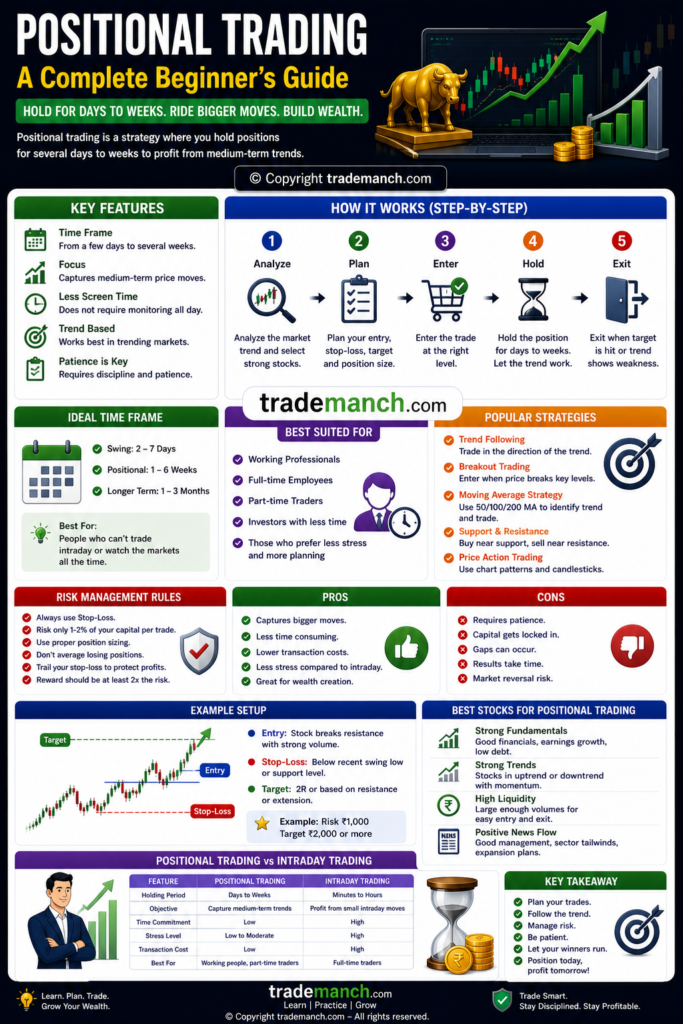
In this complete beginner guide, you will learn everything about positional trading, including how it works, strategies, advantages, risks, indicators, and risk management techniques.
What Is Positional Trading?
Positional trading is a trading style where traders hold positions for an extended period, ranging from several weeks to several months, to benefit from major price trends.
The objective is to capture a significant portion of a long-term market move.
Simple Definition of Positional Trading
Positional trading is a long-term trading approach where traders hold stocks or other assets for weeks, months, or years to profit from major market trends.
How Positional Trading Works
Positional traders:
- Identify strong trends
- Enter positions early
- Hold trades for longer periods
- Ignore short-term market fluctuations
Example:
A trader buys a stock at ₹500 and sells it after six months at ₹750.
Profit:
750−500=250
Profit per share = ₹250
Positional Trading vs Swing Trading
| Feature | Positional Trading | Swing Trading |
|---|---|---|
| Holding Period | Weeks to Months | Days to Weeks |
| Time Requirement | Low | Moderate |
| Number of Trades | Few | More |
| Focus | Long-Term Trend | Short-Term Trend |
| Stress Level | Low | Moderate |
| Profit Potential | Large Moves | Medium Moves |
Positional Trading vs Intraday Trading
| Feature | Positional Trading | Intraday Trading |
|---|---|---|
| Holding Period | Weeks/Months | Same Day |
| Screen Time | Low | High |
| Overnight Risk | Yes | No |
| Stress Level | Low | High |
| Trading Frequency | Low | High |
Why Positional Trading Is Popular
Many traders prefer positional trading because:
- Less screen time
- Lower stress
- Bigger profit potential
- Fewer trades
- Suitable for working professionals
Who Should Consider Positional Trading?
Positional trading is suitable for:
- Salaried employees
- Business owners
- Students
- Long-term investors
- Part-time traders
It is ideal for people who cannot monitor markets continuously.
Advantages of Positional Trading
Captures Large Trends
Positional traders benefit from major market movements.
Less Emotional Pressure
No need to react to every small price fluctuation.
Lower Brokerage Costs
Fewer trades result in lower transaction costs.
Flexible Lifestyle
Requires less daily market monitoring.
Better Risk-Reward Opportunities
Long-term trends often provide larger profit targets.
Risks of Positional Trading
Overnight Risk
Global events can affect positions while markets are closed.
Market Corrections
Temporary declines may occur during long-term trends.
Capital Lock-In
Funds remain invested for extended periods.
Trend Reversals
Unexpected changes in market direction can impact returns.
Best Timeframes for Positional Trading
Positional traders commonly use:
| Purpose | Timeframe |
|---|---|
| Entry Analysis | Daily Chart |
| Trend Analysis | Weekly Chart |
| Long-Term View | Monthly Chart |
The most popular charts are:
- Daily Chart
- Weekly Chart
Best Indicators for Positional Trading
Several indicators help identify long-term trends.
200 EMA (Exponential Moving Average)
One of the most important trend indicators.
Bullish Trend
Price above 200 EMA.
Bearish Trend
Price below 200 EMA.
50 EMA
Helps identify medium-term trends.
MACD
Confirms momentum and trend changes.
RSI (Relative Strength Index)
Measures momentum and trend strength.
Volume Analysis
Confirms institutional participation.
Popular Positional Trading Strategies
Trend Following Strategy
The most common positional trading approach.
Buy Setup
- Price above 200 EMA
- Higher highs and higher lows
- Strong volume
Possible long-term uptrend.
Breakout Strategy
Buy when a stock breaks a major resistance level.
Example
- Six-month resistance breakout
- Strong volume confirmation
Possible long-term move.
Moving Average Strategy
Many traders use:
- 50 EMA
- 200 EMA
to identify major trends.
Golden Cross
Occurs when:
- 50 EMA crosses above 200 EMA
Possible bullish signal.
Fundamental + Technical Analysis Strategy
Combine:
- Strong company fundamentals
- Technical breakout confirmation
This approach is popular among positional traders.
How to Select Stocks for Positional Trading
Look for stocks with:
- Strong fundamentals
- Consistent earnings growth
- High liquidity
- Institutional buying
- Strong technical trends
Popular examples include:
- Reliance Industries
- Infosys
- HDFC Bank
- ICICI Bank
- Tata Consultancy Services
Risk Management in Positional Trading
Risk management remains essential.
Risk Per Trade
Many professional traders risk:
- 1% to 2% of capital
Example:
Capital = ₹5,00,000
Risk:
1%×500000=5000
Maximum risk per trade = ₹5,000
Use Stop Loss
Example:
Entry = ₹500
Stop Loss = ₹470
Risk:
500−470=30
Risk per share = ₹30
Maintain Risk-Reward Ratio
Example:
Risk = ₹1,000
Target = ₹3,000
Risk-Reward Ratio:
10003000=3:1
Importance of Fundamental Analysis
Unlike intraday traders, positional traders often study:
- Revenue growth
- Profit growth
- Debt levels
- Industry position
- Management quality
Fundamental analysis helps identify strong long-term opportunities.
Common Positional Trading Mistakes
Ignoring Fundamentals
Strong technical setups alone may not sustain long-term trends.
Exiting Too Early
Many traders take profits before the trend fully develops.
No Stop Loss
Long-term losses can become significant.
Overtrading
Too many positions reduce focus and performance.
Following Market Noise
Short-term news should not influence long-term plans excessively.
Positional Trading Psychology
Successful positional traders:
- Stay patient
- Trust their analysis
- Ignore short-term fluctuations
- Focus on long-term trends
Patience is one of the most important skills in positional trading.
How Much Capital Is Needed?
There is no fixed amount.
Many traders start with:
- ₹25,000
- ₹50,000
- ₹1,00,000
The focus should be on risk management rather than account size.
Can Positional Trading Generate Wealth?
Yes.
Many successful investors and traders have built wealth through long-term trend participation.
However, success depends on:
- Discipline
- Research
- Risk management
- Patience
How Beginners Should Start Positional Trading
Step 1
Learn market basics.
Step 2
Understand technical analysis.
Step 3
Learn fundamental analysis.
Step 4
Study long-term trends.
Step 5
Start with quality companies.
Step 6
Maintain a trading journal.
Can Positional Trading Guarantee Profits?
No.
No trading method can guarantee profits.
Markets are influenced by:
- Economic conditions
- Company performance
- Global events
- Investor sentiment
Successful traders focus on probability and risk management.
Positional trading is an excellent trading style for beginners, working professionals, and long-term traders. It allows traders to benefit from major market trends without the stress of constant market monitoring.
By combining technical analysis, fundamental analysis, proper risk management, and patience, positional traders can potentially capture large market moves and build long-term wealth.
The key to success is not predicting every market movement but consistently following a disciplined trading process.
Frequently Asked Questions (FAQs)
1. What is positional trading?
Positional trading involves holding trades for weeks, months, or years to profit from long-term trends.
2. Is positional trading suitable for beginners?
Yes, it is one of the most beginner-friendly trading styles.
3. What is the best timeframe for positional trading?
Most traders use daily and weekly charts.
4. Which indicators are useful for positional trading?
200 EMA, 50 EMA, MACD, RSI, and Volume Analysis.
5. How much capital is needed?
Many beginners start with ₹25,000 to ₹1,00,000.
6. Is positional trading better than intraday trading?
It depends on your goals, but positional trading generally requires less time and causes less stress.
7. Should positional traders use fundamental analysis?
Yes, fundamental analysis is very important for long-term trades.
8. What is a Golden Cross?
A bullish signal where the 50 EMA crosses above the 200 EMA.
9. Can positional trading generate regular income?
It can generate profits, but returns are not guaranteed or consistent.
10. Can positional trading guarantee success?
No. Like all trading methods, it involves risk and requires proper risk management.