
A dividend is one of the most attractive benefits of investing in the stock market. Many investors prefer dividend-paying stocks because they provide regular income along with long-term wealth creation.
In this complete beginner-friendly guide, you will learn what a dividend is, how dividends work, types of dividends, advantages, risks, and how investors earn dividend income from stocks.
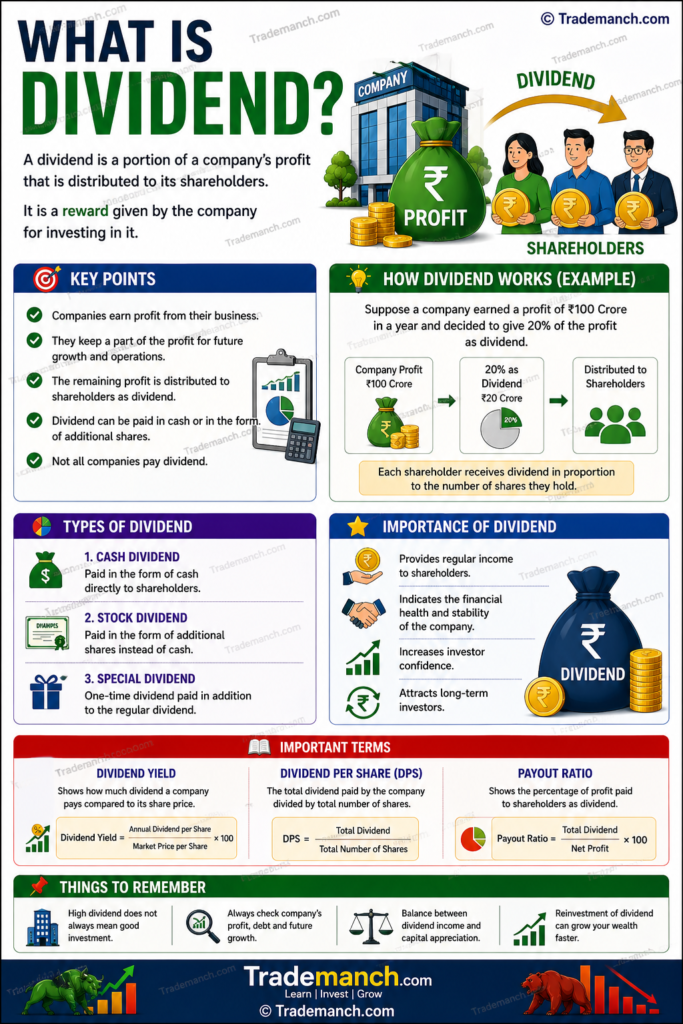
What Is Dividend?
A dividend is a portion of a company’s profit distributed to its shareholders as a reward for investing in the company.
When a company earns profits, it may:
- Reinvest the profits into business growth
or - Share some profits with investors in the form of dividends.
Simple Definition of Dividend
A dividend is money paid by a company to its shareholders from its profits.
Example of Dividend
Suppose:
- You own 100 shares of a company.
- The company declares a dividend of ₹10 per share.
Your total dividend income will be:
100×10=1000
So, you receive ₹1,000 as dividend income.
Why Do Companies Pay Dividends?
Companies pay dividends to:
- Reward shareholders
- Build investor confidence
- Attract long-term investors
- Share profits with investors
Large and stable companies often pay regular dividends.
How Does Dividend Work?
Here is the simple process:
1. Company Earns Profit
The company generates profits through business operations.
2. Dividend Announcement
The board of directors announces dividend payments.
3. Dividend Record Date
Investors holding shares before the record date become eligible.
4. Dividend Payment
Dividend amount is credited to shareholders’ bank accounts.
Types of Dividends
There are mainly different types of dividends.
1. Cash Dividend
The company pays cash directly to shareholders.
This is the most common type of dividend.
2. Stock Dividend
Instead of cash, the company gives additional shares.
3. Interim Dividend
Declared before the financial year ends.
4. Final Dividend
Declared after final annual profits are confirmed.
What Is Dividend Yield?
Dividend yield shows how much dividend a company pays compared to its share price.
The formula is:
Dividend Yield=Share PriceAnnual Dividend Per Share×100
Example of Dividend Yield
Suppose:
- Annual Dividend = ₹20
- Share Price = ₹400
Then:
40020×100=5%
Dividend yield = 5%.
What Is Dividend Per Share (DPS)?
Dividend per share means the dividend amount paid for each share owned.
Example:
- If a company declares ₹5 dividend per share, investors receive ₹5 for every share they own.
Important Dividend Dates
1. Declaration Date
The date when the company announces the dividend.
2. Record Date
Investors holding shares on this date receive dividends.
3. Ex-Dividend Date
Shares bought after this date are not eligible for dividends.
4. Payment Date
The company distributes dividend payments.
Benefits of Dividend Investing
1. Regular Income
Dividends provide passive income to investors.
2. Wealth Creation
Dividend reinvestment can increase long-term returns.
3. Lower Risk
Dividend-paying companies are often financially stable.
4. Protection During Market Downturns
Dividend income can reduce the impact of falling stock prices.
Risks of Dividend Investing
Dividend Cuts
Companies may reduce or stop dividends during financial problems.
Lower Growth Potential
Some high-dividend companies may grow slowly.
Market Risk
Stock prices can still fall even if dividends are paid.
Difference Between Dividend and Capital Gain
| Dividend | Capital Gain |
|---|---|
| Regular income from profits | Profit from rising share prices |
| Paid by company | Earned by selling shares |
| Passive income | Depends on market movement |
Which Companies Usually Pay Dividends?
Companies that commonly pay dividends include:
- Banking companies
- FMCG companies
- Utility companies
- Large stable businesses
Examples:
- ITC
- Coal India
- Hindustan Unilever
What Is Dividend Reinvestment?
Dividend reinvestment means using dividend income to buy more shares.
This helps investors benefit from:
- Compounding growth
- Increased future dividends
How to Earn Dividends
To receive dividends:
- Open a Demat account.
- Buy dividend-paying stocks.
- Hold shares before the ex-dividend date.
Popular brokers include:
- Zerodha
- Groww
- Upstox
Are Dividends Guaranteed?
No, dividends are not guaranteed.
Companies may:
- Increase dividends
- Reduce dividends
- Stop dividends completely
Dividend payments depend on company profits and management decisions.
Dividend vs Bonus Shares
| Dividend | Bonus Shares |
|---|---|
| Cash payment | Additional free shares |
| Direct income | Increases number of shares |
| Paid from profits | Issued from reserves |
Tax on Dividends in India
Dividend income in India is taxable according to the investor’s income tax slab.
Investors should check current tax rules before investing.
Best Dividend Stocks in India
Some popular dividend-paying companies include:
- ITC
- Power Grid Corporation of India
- Coal India
Tips for Dividend Investors
Focus on Stable Companies
Choose financially strong businesses.
Check Dividend History
Look for consistent dividend payments.
Avoid Very High Yields
Extremely high dividend yields may be risky.
Think Long Term
Dividend investing works best over long periods.
Dividend Investing vs Growth Investing
| Dividend Investing | Growth Investing |
|---|---|
| Focus on income | Focus on capital appreciation |
| Stable companies | Fast-growing companies |
| Lower risk | Higher risk |
A dividend is a portion of company profits distributed to shareholders as a reward for investing. Dividend-paying stocks can provide regular income, portfolio stability, and long-term wealth creation.
However, dividends are not guaranteed, and investors should carefully analyze company fundamentals before investing. Beginners should focus on financially strong companies with consistent dividend history and long-term growth potential.
Frequently Asked Questions (FAQs)
1. What is dividend in simple words?
A dividend is money paid by a company to shareholders from its profits.
2. How do dividends work?
Companies distribute part of their profits to eligible shareholders.
3. Are dividends guaranteed?
No, dividends depend on company profits and decisions.
4. What is dividend yield?
Dividend yield shows dividend income compared to share price.
5. Can beginners invest in dividend stocks?
Yes, beginners can invest through a Demat account.
6. Which companies pay dividends?
Large and profitable companies often pay dividends.
7. What is the ex-dividend date?
Shares purchased after this date are not eligible for dividends.
8. Is dividend income taxable in India?
Yes, dividend income is taxable according to tax slabs.
9. What is dividend reinvestment?
Using dividends to buy more shares for compounding growth.
10. Which app is best for dividend investing in India?
Popular apps include Zerodha, Groww, and Upstox.