
Market Capitalization, commonly known as Market Cap, is one of the most important concepts in stock market investing. It helps investors understand the size of a company and categorize stocks into different groups such as Large Cap, Mid Cap, and Small Cap.
Understanding market capitalization is essential because it helps investors evaluate risk, growth potential, stability, and investment opportunities. Whether you are a beginner or an experienced investor, knowing how market cap works can help you build a balanced investment portfolio.
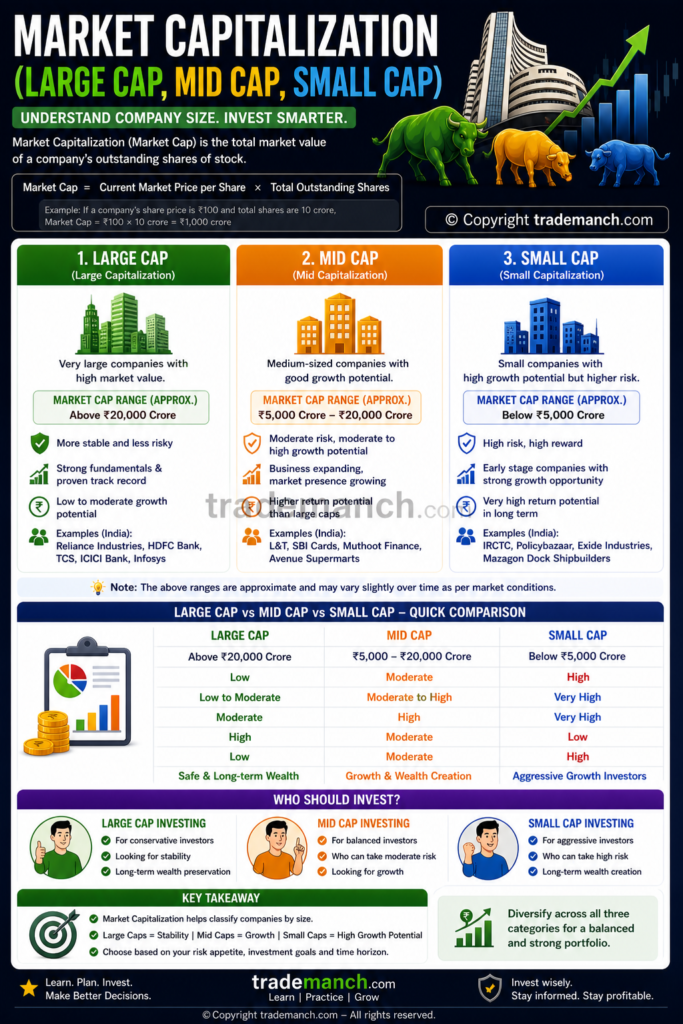
This complete guide explains market capitalization, its calculation, different categories, advantages, risks, and how investors can use market cap for better investment decisions.
What Is Market Capitalization?
Market Capitalization refers to the total market value of a company’s outstanding shares.
It represents how much the market values a company at a particular point in time.
Market capitalization changes continuously as the stock price rises or falls.
Simple Definition of Market Capitalization
Market capitalization is the total value of a company’s publicly traded shares.
Market Capitalization Formula
Market Cap is calculated using:
Market Capitalization=Share Price×Total Outstanding Shares
Where:
- Share Price = Current market price of one share
- Outstanding Shares = Total shares issued by the company
Example of Market Capitalization
Suppose a company has:
- Share Price = ₹500
- Outstanding Shares = 10 Crore
Market Capitalization:
500×10 Crore=5000 Crore
Market Cap = ₹5,000 Crore
Why Market Capitalization Is Important?
Market capitalization helps investors:
- Measure company size
- Assess risk levels
- Compare companies
- Build diversified portfolios
- Understand growth potential
It is often more useful than share price alone.
Categories of Market Capitalization
The stock market generally classifies companies into:
Large Cap Stocks
Mid Cap Stocks
Small Cap Stocks
These categories are based on company size and market value.
Large Cap Stocks
What Are Large Cap Stocks?
Large Cap companies are the biggest and most established companies in the market.
These companies typically:
- Have strong financial performance
- Operate for many years
- Possess stable business models
- Have significant market presence
Large Cap stocks are generally considered less risky.
Characteristics of Large Cap Stocks
- High market capitalization
- Strong brand recognition
- Stable earnings
- High liquidity
- Lower volatility
Examples of Large Cap Companies in India
Examples include:
- Reliance Industries
- Tata Consultancy Services
- HDFC Bank
- Infosys
- ICICI Bank
Advantages of Large Cap Stocks
Stability
Large businesses are generally more stable.
Lower Risk
Price fluctuations are often smaller.
Dividend Income
Many large companies pay regular dividends.
Strong Liquidity
Easy buying and selling.
Disadvantages of Large Cap Stocks
Slower Growth
Growth rates may be lower than smaller companies.
Limited Multibagger Potential
Large companies may not grow as rapidly as emerging businesses.
Mid Cap Stocks
What Are Mid Cap Stocks?
Mid Cap companies are medium-sized businesses that have already established themselves but still have significant growth potential.
They are often considered a balance between stability and growth.
Characteristics of Mid Cap Stocks
- Moderate market capitalization
- Growing businesses
- Higher growth potential
- Moderate risk
Advantages of Mid Cap Stocks
Growth Opportunities
Can grow faster than large companies.
Better Return Potential
May generate higher returns over time.
Expanding Market Presence
Often moving toward large-cap status.
Disadvantages of Mid Cap Stocks
Higher Volatility
Prices can fluctuate more significantly.
Economic Sensitivity
May be more affected by economic downturns.
Small Cap Stocks
What Are Small Cap Stocks?
Small Cap companies are smaller businesses with relatively low market capitalization.
These companies often have:
- High growth potential
- Limited resources
- Greater business risk
Characteristics of Small Cap Stocks
- Small market value
- Higher volatility
- Lower liquidity
- High growth potential
Advantages of Small Cap Stocks
High Growth Potential
Some small companies become future industry leaders.
Multibagger Opportunities
Potential for significant returns.
Early-Stage Business Growth
Investors participate in company expansion.
Disadvantages of Small Cap Stocks
Higher Risk
Business failure risk is greater.
Higher Volatility
Prices can fluctuate sharply.
Lower Liquidity
Buying and selling may be more difficult.
Large Cap vs Mid Cap vs Small Cap
| Feature | Large Cap | Mid Cap | Small Cap |
|---|---|---|---|
| Company Size | Large | Medium | Small |
| Risk Level | Low | Moderate | High |
| Growth Potential | Moderate | High | Very High |
| Volatility | Low | Moderate | High |
| Liquidity | High | Moderate | Lower |
| Dividend Income | Often Available | Sometimes Available | Less Common |
Which Market Cap Category Is Best?
The answer depends on:
- Risk tolerance
- Investment goals
- Investment horizon
Choose Large Cap Stocks If:
- You prefer stability.
- You want lower risk.
- You seek regular dividends.
Choose Mid Cap Stocks If:
- You want a balance between growth and stability.
- You can tolerate moderate risk.
Choose Small Cap Stocks If:
- You seek high growth potential.
- You can handle higher volatility.
- You have a long investment horizon.
Market Cap and Risk
Generally:
- Large Cap = Lower Risk
- Mid Cap = Moderate Risk
- Small Cap = Higher Risk
Higher potential returns usually come with higher risk.
Market Cap and Portfolio Diversification
Many investors diversify across all categories.
Example Portfolio:
- 50% Large Cap
- 30% Mid Cap
- 20% Small Cap
This approach balances:
- Stability
- Growth
- Risk
Market Cap and Economic Cycles
Different market cap categories perform differently during economic conditions.
During Economic Expansion
Mid Cap and Small Cap stocks often outperform.
During Economic Uncertainty
Large Cap stocks often perform better.
How Market Cap Affects Investment Decisions
Investors use market capitalization to:
- Assess company maturity
- Evaluate growth opportunities
- Manage portfolio risk
- Diversify investments
Market cap is often one of the first factors analyzed before investing.
Common Beginner Mistakes
Buying Only Small Caps
High returns often come with high risk.
Ignoring Diversification
Spread investments across categories.
Judging Stocks Only by Share Price
A high share price does not necessarily mean a larger company.
Ignoring Fundamentals
Always evaluate:
- Earnings
- Debt
- Management
- Industry position
How Beginners Should Invest Based on Market Cap
Step 1
Start with Large Cap companies.
Step 2
Gradually add Mid Cap exposure.
Step 3
Allocate a smaller portion to Small Caps.
Step 4
Diversify across sectors.
Step 5
Review portfolio periodically.
Can Small Caps Make You Rich?
Some Small Cap companies have generated extraordinary returns.
However:
- Many fail.
- Volatility is high.
- Research is critical.
Never invest based solely on market cap.
Market Capitalization is one of the most important measures used to classify companies and assess investment opportunities. Large Cap stocks provide stability, Mid Cap stocks offer a balance of growth and risk, and Small Cap stocks provide the highest growth potential along with the highest risk.
A well-diversified portfolio often includes a mix of Large, Mid, and Small Cap stocks based on an investor’s goals, risk tolerance, and investment horizon.
Understanding market capitalization is an essential step toward becoming a successful investor in the stock market.
Frequently Asked Questions (FAQs)
1. What is market capitalization?
Market capitalization is the total market value of a company’s outstanding shares.
2. How is market capitalization calculated?
Market Capitalization=Share Price×Outstanding Shares
3. What are Large Cap stocks?
Large Cap stocks are shares of large, established companies with high market capitalization.
4. What are Mid Cap stocks?
Mid Cap stocks belong to medium-sized companies with growth potential.
5. What are Small Cap stocks?
Small Cap stocks belong to smaller companies with high growth potential and higher risk.
6. Which category is safest?
Large Cap stocks are generally considered the safest.
7. Which category offers the highest growth potential?
Small Cap stocks often offer the highest growth potential.
8. Should beginners invest in Small Caps?
Beginners should approach Small Caps carefully and maintain diversification.
9. Why is market capitalization important?
It helps assess company size, risk, and growth opportunities.
10. Can market capitalization change?
Yes. Market capitalization changes whenever the stock price changes.