
The stock market is heavily influenced by government budgets, economic policies, taxation, interest rates, and regulatory decisions. Whenever the government announces a new budget or major policy change, the stock market often reacts immediately because these decisions directly affect companies, industries, investors, and the economy.
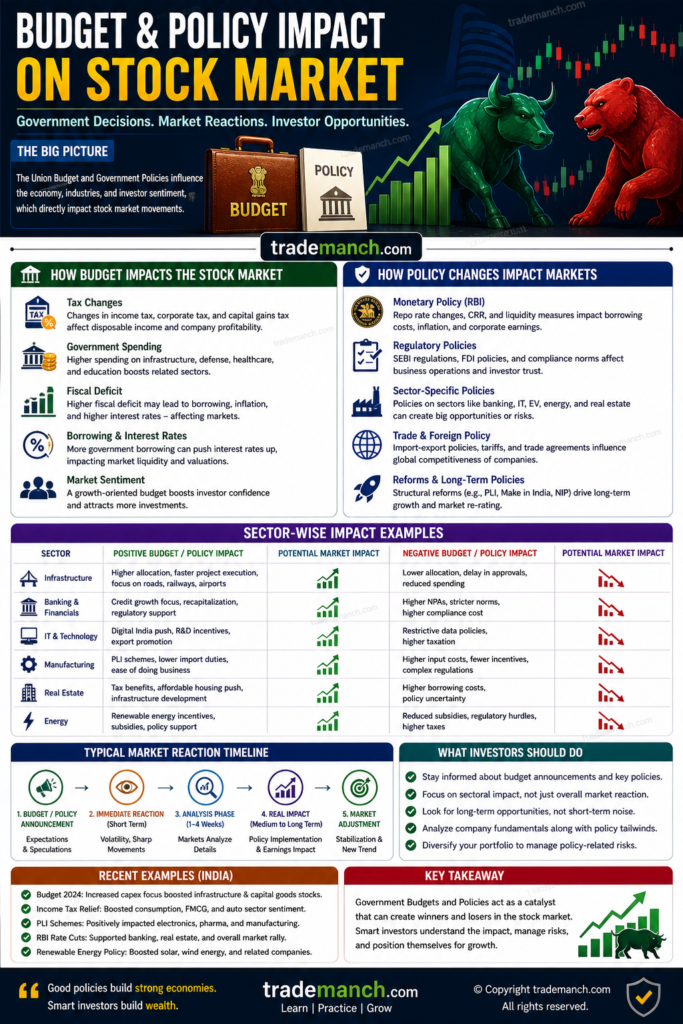
Understanding how budgets and policies impact the stock market is very important for investors and traders because it helps them:
- Understand market movements
- Identify sector opportunities
- Manage risk
- Make smarter investment decisions
In this complete beginner-friendly guide, you will learn what budgets and policies are, how they affect the stock market, which sectors benefit, and how investors should react to policy changes in 2026.
What Is a Government Budget?
A government budget is a financial plan presented by the government that includes:
- Revenue
- Expenditure
- Taxation
- Economic policies
- Development plans
In India, the Union Budget is presented annually by the Finance Minister.
What Is Economic Policy?
Economic policies are government decisions related to:
- Taxation
- Interest rates
- Infrastructure
- Trade
- Subsidies
- Investment
- Regulations
These policies influence:
- Businesses
- Consumers
- Financial markets
Why Budget and Policy Matter in the Stock Market
Budgets and policies affect:
- Company profits
- Industry growth
- Investor confidence
- Economic growth
Positive policies often boost markets, while negative policies may create fear and volatility.
How Budget Impacts the Stock Market
1. Tax Changes
Changes in taxes directly impact companies and investors.
Examples:
- Corporate tax reduction
- Capital gains tax changes
- GST revisions
Positive Tax Impact
Lower taxes can increase company profits.
This may boost stock prices.
Example:
If corporate tax falls from 30% to 25%, companies retain higher profits.
Negative Tax Impact
Higher taxes may reduce:
- Company earnings
- Investor returns
This may negatively affect markets.
2. Infrastructure Spending
Government spending on:
- Roads
- Railways
- Power
- Construction
often benefits infrastructure companies.
Examples:
- Larsen & Toubro
- NTPC
Infrastructure-focused budgets often boost related sectors.
3. Banking and Financial Policies
Banking reforms and financial policies affect:
- Loan growth
- Credit availability
- Banking profits
Major banking stocks include:
- HDFC Bank
- ICICI Bank
4. Agriculture Policies
Policies related to:
- Farming subsidies
- Rural spending
- Fertilizers
can impact agriculture-related companies.
5. Manufacturing Policies
Government initiatives like:
- Make in India
- Production-linked incentives (PLI)
support manufacturing and industrial growth.
How Interest Rates Affect the Stock Market
Interest rates are controlled by:
- Reserve Bank of India (RBI)
Lower Interest Rates
Lower rates usually:
- Boost borrowing
- Increase business activity
- Support stock markets
Higher Interest Rates
Higher rates may:
- Slow economic growth
- Reduce company profits
- Pressure stock markets
What Is Monetary Policy?
Monetary policy refers to RBI decisions regarding:
- Interest rates
- Money supply
- Inflation control
Monetary policy strongly impacts:
- Banking sector
- Real estate
- Consumer spending
What Is Fiscal Policy?
Fiscal policy refers to government decisions regarding:
- Taxation
- Public spending
- Budget deficits
Fiscal policy influences:
- Economic growth
- Corporate earnings
- Market sentiment
Budget Impact on Different Sectors
1. Banking Sector
Positive policies:
- Lower NPAs
- Credit growth
- Banking reforms
can boost banking stocks.
Examples:
- State Bank of India
- HDFC Bank
2. IT Sector
Policies promoting:
- Digitalization
- Technology investment
- AI growth
can benefit IT companies.
Examples:
- Infosys
- Tata Consultancy Services
3. Infrastructure Sector
Higher infrastructure spending benefits:
- Construction
- Cement
- Engineering companies
4. Automobile Sector
Tax cuts and EV policies may boost auto stocks.
Examples:
- Tata Motors
- Mahindra & Mahindra
5. Pharma Sector
Healthcare spending and medical reforms affect pharma companies.
Examples:
- Sun Pharmaceutical
- Dr. Reddy’s Laboratories
Why Markets Become Volatile During Budget Announcements
Budget announcements create uncertainty because:
- Investors expect policy changes
- Traders react quickly to news
- Market sentiment changes rapidly
This increases:
- Volatility
- Trading activity
Bullish Budget vs Bearish Budget
| Bullish Budget | Bearish Budget |
|---|---|
| Supports growth | Creates economic concerns |
| Lower taxes | Higher taxes |
| Infrastructure spending | Weak policy support |
| Investor-friendly reforms | Negative market sentiment |
Policy Reforms That Impacted Indian Markets
Some major reforms include:
- GST implementation
- Demonetization
- Corporate tax cuts
- Make in India initiative
- Digital India initiative
These reforms affected different sectors differently.
What Is Market Sentiment?
Market sentiment refers to investor mood:
- Optimism → Bullish market
- Fear → Bearish market
Budgets and policies strongly influence sentiment.
Global Policies and Indian Stock Market
Global events also impact Indian markets:
- US Federal Reserve decisions
- Oil prices
- Global inflation
- Trade wars
Indian markets are connected to global financial systems.
Foreign Institutional Investors (FIIs)
Government policies affect foreign investments.
Positive reforms may attract:
- Foreign Institutional Investors (FIIs)
Higher foreign investment often supports stock markets.
How Traders Use Budget Announcements
Traders focus on:
- Volatility opportunities
- Sector rotation
- Short-term momentum
Budget days often see:
- Sharp price movements
- High trading volume
How Long-Term Investors React to Policies
Long-term investors focus more on:
- Fundamental impact
- Economic growth
- Industry opportunities
They avoid emotional reactions to short-term volatility.
Best Strategy During Budget Season
Avoid Emotional Trading
Markets may move unpredictably.
Focus on Strong Fundamentals
Quality companies usually recover over time.
Diversify Investments
Avoid excessive concentration in one sector.
Think Long Term
Long-term investing reduces short-term policy volatility impact.
Risks of Policy Changes
Policy risks include:
- Sudden taxation changes
- Regulatory uncertainty
- Economic slowdown
- Inflation pressure
All investments involve policy-related risk.
Importance of Economic Growth
Strong economic growth generally supports:
- Corporate profits
- Employment
- Consumer spending
- Stock market growth
Budgets aim to improve economic performance.
Budget Impact on Nifty and Sensex
Positive budgets often boost:
- National Stock Exchange Nifty 50
- Bombay Stock Exchange Sensex
Negative surprises may lead to market corrections.
Common Beginner Mistakes
Panic During Volatility
Budget volatility is normal.
Following Rumors
Always rely on proper information.
Short-Term Emotional Decisions
Long-term investing requires patience.
Ignoring Risk Management
Protect capital during uncertain periods.
Best Practices for Investors
Stay Informed
Understand major policy changes.
Focus on Quality Stocks
Strong companies survive economic cycles.
Avoid Overreaction
Markets often stabilize after volatility.
Maintain Diversification
Spread risk across sectors.
Government budgets and economic policies have a major impact on the stock market because they influence company profits, investor sentiment, economic growth, taxation, and industry performance. Positive reforms often support stock markets, while negative or uncertain policies may increase volatility.
For beginners, understanding budget and policy impact is important for making informed investment decisions. Instead of reacting emotionally to short-term market movements, investors should focus on long-term fundamentals, diversification, and disciplined investing strategies.
Frequently Asked Questions (FAQs)
1. How does the budget affect the stock market?
Budgets impact taxation, spending, and economic growth, which affect stock prices.
2. Why is the stock market volatile during the budget?
Investors react quickly to policy announcements and economic expectations.
3. Which sectors benefit from infrastructure spending?
Infrastructure, cement, engineering, and construction sectors often benefit.
4. How do interest rates affect the stock market?
Lower interest rates generally support stock market growth.
5. What is fiscal policy?
Fiscal policy includes government taxation and spending decisions.
6. What is monetary policy?
Monetary policy refers to RBI decisions on interest rates and money supply.
7. Can government policy increase stock prices?
Yes, positive reforms can improve investor confidence and company growth.
8. What is a bullish budget?
A budget that supports economic growth and investor confidence.
9. How should beginners react to budget volatility?
Beginners should avoid emotional trading and focus on long-term investing.
10. Which indices reflect budget impact in India?
National Stock Exchange Nifty 50 and Bombay Stock Exchange Sensex reflect overall market reaction.