
Global Market Impact” The global stock market is strongly influenced by the policies of the United States Federal Reserve (US Fed) and inflation data. Even though investors may trade in India or other countries, decisions made by the US Federal Reserve can affect:
Global investor sentiment
Stock markets
Gold prices
Cryptocurrency
Bond markets
Currency exchange rates
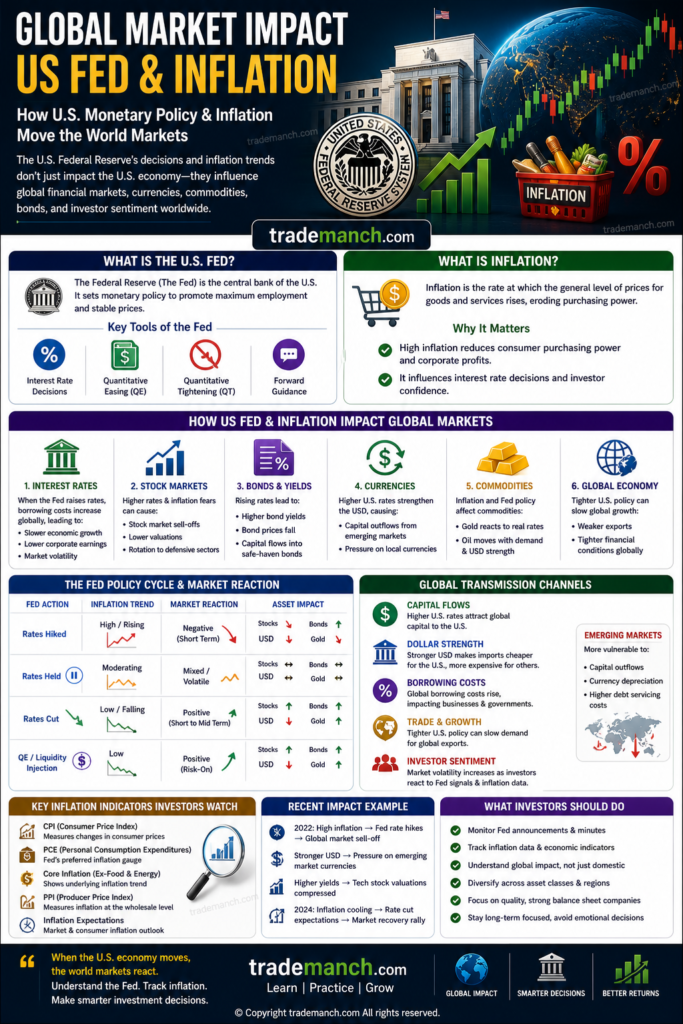
Understanding the impact of the US Fed and inflation is very important for traders and investors because global markets are highly interconnected in 2026.
In this complete beginner-friendly guide, you will learn what the US Federal Reserve is, what inflation means, and how both influence the Indian and global stock markets.
What Is the US Federal Reserve?
The Federal Reserve System, commonly called the US Fed, is the central banking system of the United States.
It controls:
- Interest rates
- Money supply
- Inflation management
- Economic stability
The US Fed plays a major role in global financial markets because the US economy is the world’s largest economy.
Simple Definition of the US Fed
The US Federal Reserve is America’s central bank that controls monetary policy and interest rates.
What Is Inflation?
Inflation means:
- Rising prices of goods and services over time.
When inflation increases:
- Purchasing power decreases.
Example:
If inflation rises, products become more expensive.
Simple Example of Inflation
Suppose:
- A product costs ₹100 today.
- After one year, it costs ₹110.
Inflation increase:
110−100=10
Price increased by ₹10 due to inflation.
Why Inflation Matters in Financial Markets
High inflation affects:
- Consumer spending
- Business costs
- Company profits
- Interest rates
- Economic growth
Because of this, stock markets closely monitor inflation data.
How the US Fed Controls Inflation
The US Fed mainly controls inflation through:
- Interest rate changes
Higher Interest Rates
When inflation rises too much, the Fed may:
- Increase interest rates
This helps:
- Reduce spending
- Slow inflation
Lower Interest Rates
When economic growth slows:
- The Fed may reduce interest rates
Lower rates encourage:
- Borrowing
- Investment
- Economic growth
What Is Monetary Policy?
Monetary policy refers to central bank actions related to:
- Interest rates
- Money supply
- Inflation control
The US Fed’s monetary policy strongly impacts global markets.
Why Global Markets Follow the US Fed
The US dollar is the world’s most important currency.
Many global investments are connected to:
- US interest rates
- US economy
- US bond yields
Therefore, Fed decisions affect markets worldwide.
How US Fed Rate Hikes Affect Stock Markets
1. Stock Markets Often Fall
Higher interest rates may:
- Reduce business growth
- Increase borrowing costs
- Lower investor confidence
This can pressure stock markets globally.
2. Foreign Investors Withdraw Money
Foreign investors may move money from emerging markets to safer US assets.
This may impact:
- Indian stock market
- Emerging economies
3. Technology Stocks Often Face Pressure
High-growth tech companies are sensitive to rising interest rates.
Examples:
- Apple
- Microsoft
How Lower US Interest Rates Affect Markets
Lower rates generally:
- Support economic growth
- Increase liquidity
- Boost stock markets
Investors often prefer equities during low-rate environments.
Impact of US Inflation on Indian Stock Market
High US inflation may cause:
- US Fed rate hikes
- Global market weakness
- Foreign investment outflows
This can negatively affect:
- National Stock Exchange Nifty 50
- Bombay Stock Exchange Sensex
Why Indian Markets React to US Data
India receives significant foreign investments.
Global investors monitor:
- US inflation
- US jobs data
- Fed policy statements
These influence global capital flows.
What Is CPI Inflation?
CPI stands for:
- Consumer Price Index
It measures changes in prices paid by consumers.
High CPI inflation signals rising price pressure.
What Is Core Inflation?
Core inflation excludes:
- Food
- Energy prices
It helps central banks analyze long-term inflation trends.
What Is Recession?
A recession is a period of:
- Economic slowdown
- Weak business activity
- Reduced consumer spending
Aggressive interest rate hikes may increase recession fears.
Relationship Between Inflation and Interest Rates
Usually:
- High inflation → Higher interest rates
- Low inflation → Lower interest rates
Central banks try to balance:
- Economic growth
- Inflation control
How Inflation Impacts Companies
High inflation increases:
- Raw material costs
- Salaries
- Production expenses
This may reduce company profits.
Sectors Affected by US Fed and Inflation
1. Banking Sector
Higher interest rates may benefit banks initially through higher lending rates.
Examples:
- HDFC Bank
- ICICI Bank
2. IT Sector
IT stocks may react strongly to US economic conditions because:
- Many Indian IT companies earn revenue from US clients.
Examples:
- Infosys
- Tata Consultancy Services
3. Gold Market
Gold often rises during:
- Economic uncertainty
- Inflation fears
Investors view gold as a safe-haven asset.
4. Cryptocurrency Market
Crypto markets are highly sensitive to:
- Global liquidity
- Interest rates
- Investor risk appetite
Examples:
- Bitcoin
- Ethereum
What Is Liquidity in Markets?
Liquidity refers to:
- Availability of money in the financial system.
Low interest rates increase liquidity and often support markets.
What Is Quantitative Tightening (QT)?
QT means reducing liquidity from the economy.
This may negatively impact:
- Stocks
- Crypto
- Risk assets
What Is Quantitative Easing (QE)?
QE means central banks inject money into the economy.
QE often supports:
- Stock markets
- Economic growth
Why Traders Watch Fed Meetings
Fed meetings provide clues about:
- Future interest rates
- Inflation outlook
- Economic conditions
Markets react strongly to Fed announcements.
What Is FOMC?
FOMC stands for:
- Federal Open Market Committee
This committee decides US monetary policy and interest rates.
How Dollar Strength Impacts India
A strong US dollar may:
- Increase import costs
- Pressure emerging markets
- Impact Indian rupee
Why Crude Oil Prices Matter
High crude oil prices increase inflation because:
- Transportation costs rise
- Manufacturing costs increase
India is heavily affected because it imports oil.
Global Events That Affect Markets
Markets react to:
- Wars
- Recessions
- Inflation data
- Fed decisions
- Oil prices
- Global crises
Modern markets are globally connected.
How Long-Term Investors Should React
Long-term investors should:
- Avoid panic
- Focus on quality companies
- Think long term
- Maintain diversification
Short-term volatility is normal.
Common Beginner Mistakes
Panic Selling During Market Falls
Markets naturally fluctuate.
Following News Emotionally
Always think rationally.
Ignoring Risk Management
Protect capital during volatile periods.
Trying to Predict Every Fed Move
Market timing is very difficult.
Best Strategy During High Inflation Periods
Focus on Strong Companies
Financially strong companies usually survive economic cycles.
Diversify Investments
Spread investments across sectors.
Avoid Excessive Leverage
High volatility increases trading risk.
Think Long Term
Short-term volatility often stabilizes over time.
The US Federal Reserve and inflation are among the most powerful factors influencing global financial markets. Interest rate changes, inflation data, and monetary policies affect stocks, bonds, gold, cryptocurrencies, currencies, and investor sentiment worldwide.
For Indian investors, understanding the impact of US inflation and Fed decisions is important because global capital flows and economic conditions strongly influence the Indian stock market. Instead of reacting emotionally to short-term volatility, investors should focus on long-term investing, diversification, risk management, and disciplined financial planning.
Frequently Asked Questions (FAQs)
1. What is the US Federal Reserve?
The Federal Reserve System is the central bank of the United States.
2. What is inflation?
Inflation means rising prices of goods and services over time.
3. How does the US Fed affect Indian markets?
Fed interest rate decisions impact global investments and investor sentiment.
4. Why do stock markets fall when interest rates rise?
Higher rates increase borrowing costs and reduce economic growth expectations.
5. What is CPI inflation?
CPI measures changes in consumer prices.
6. Why is gold affected by inflation?
Gold is often considered a hedge against inflation and uncertainty.
7. How does inflation impact companies?
Higher inflation increases business costs and may reduce profits.
8. What is a recession?
A recession is a period of economic slowdown.
9. What is quantitative easing?
QE means injecting liquidity into the economy to support growth.
10. How should beginners react to market volatility?
Beginners should focus on long-term investing and avoid emotional decisions.