
The Futures and Options (F&O) market is one of the most popular segments of the stock market. It attracts traders because of its potential for higher returns, leverage, hedging opportunities, and flexibility. However, F&O trading also carries significant risk and requires proper understanding before participating.
Many beginners hear terms like Futures, Call Options, Put Options, Premium, Expiry, and Strike Price but often find them confusing. This guide will simplify these concepts and help you understand how the F&O market works.
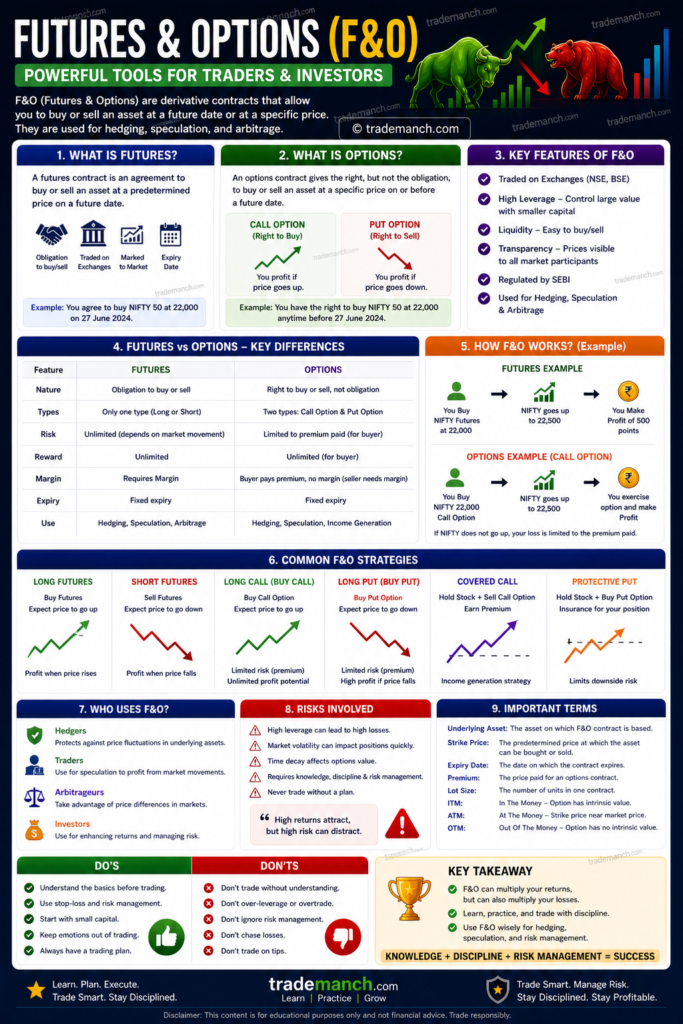
What Are Futures & Options (F&O)?
Futures and Options are financial contracts known as derivatives. Their value is derived from an underlying asset such as:
- Stocks
- Indices
- Commodities
- Currencies
F&O allows traders to speculate on price movements or hedge existing investments.
Simple Definition of F&O
Futures and Options are derivative contracts that allow traders to buy or sell an asset at a predetermined price in the future.
What Are Derivatives?
A derivative is a financial instrument whose value depends on another asset.
Examples:
- Stock Futures
- Index Futures
- Stock Options
- Commodity Futures
The underlying asset determines the derivative’s value.
Why Are F&O Contracts Used?
Traders and investors use F&O for:
- Hedging risk
- Speculation
- Portfolio protection
- Leverage
- Income generation
Futures Trading
What Is a Futures Contract?
A Futures contract is an agreement between two parties to buy or sell an asset at a predetermined price on a future date.
Both buyer and seller are obligated to fulfill the contract.
Simple Definition of Futures
A futures contract is a legal agreement to buy or sell an asset at a fixed price on a future date.
How Futures Work
Suppose a stock is trading at:
₹1,000
You believe the price will rise.
You buy a futures contract at ₹1,000.
If the stock rises to ₹1,100:
Profit:
1100−1000=100
Profit per share = ₹100
Features of Futures Contracts
Standardized Contracts
Exchanges define contract specifications.
Expiry Date
Every futures contract has a fixed expiration date.
Margin Requirement
Only a fraction of the contract value is required.
Leverage
Allows larger exposure with less capital.
Advantages of Futures Trading
Higher Profit Potential
Leverage increases returns.
Hedging Tool
Useful for protecting portfolios.
High Liquidity
Popular contracts often have strong trading activity.
Risks of Futures Trading
High Leverage Risk
Losses can also be magnified.
Unlimited Loss Potential
Theoretically, losses can be substantial.
Margin Calls
Additional funds may be required if trades move against you.
Options Trading
What Is an Options Contract?
An option gives the buyer the right, but not the obligation, to buy or sell an asset at a predetermined price before expiry.
Simple Definition of Options
Options are contracts that give the holder the right, but not the obligation, to buy or sell an asset at a specific price.
Types of Options
There are two main types:
Call Option
Put Option
Call Option
What Is a Call Option?
A Call Option gives the buyer the right to buy an asset at a specified price before expiry.
Call options are generally purchased when traders expect prices to rise.
Example of Call Option
Stock Price:
₹1,000
Strike Price:
₹1,000
Premium:
₹20
If stock rises to ₹1,100:
Profit Potential Increases.
Call buyers benefit from rising prices.
When Traders Buy Call Options
Bullish Market View
Expecting prices to rise.
Limited Risk
Maximum loss is limited to premium paid.
Put Option
What Is a Put Option?
A Put Option gives the buyer the right to sell an asset at a specified price before expiry.
Put options are generally purchased when traders expect prices to fall.
Example of Put Option
Stock Price:
₹1,000
Strike Price:
₹1,000
Premium:
₹20
If stock falls to ₹900:
Put option value generally increases.
When Traders Buy Put Options
Bearish Market View
Expecting prices to decline.
Portfolio Protection
Used as insurance against market declines.
Important F&O Terminology
Strike Price
The predetermined price at which the option can be exercised.
Premium
The price paid to buy an option.
Expiry Date
The date on which the contract expires.
Lot Size
The number of shares in one derivative contract.
Open Interest
The total number of outstanding contracts.
Intrinsic Value
The actual value of an option.
Time Value
Additional value due to remaining time before expiry.
Option Buyers vs Option Sellers
Option Buyer
Advantages
- Limited risk
- Unlimited profit potential (for calls)
Disadvantages
- Time decay affects option value
Option Seller
Advantages
- Earns premium income
Disadvantages
- Potentially unlimited risk
Futures vs Options
| Feature | Futures | Options |
|---|---|---|
| Obligation | Yes | No |
| Risk | High | Limited for Buyers |
| Premium | No | Yes |
| Leverage | High | High |
| Profit Potential | High | High |
Why F&O Is Popular in India
F&O trading is widely used on:
- National Stock Exchange of India
- Bombay Stock Exchange
because it offers:
- Leverage
- Hedging opportunities
- Trading flexibility
F&O and Leverage
Leverage allows traders to control large positions with relatively small capital.
Example:
Contract Value:
₹5,00,000
Margin Required:
₹1,00,000
Leverage:
100000500000=5
5x leverage
Benefits of F&O Trading
Hedging
Protect investments from market declines.
Speculation
Profit from price movements.
Capital Efficiency
Leverage reduces initial capital requirements.
Multiple Strategies
Supports bullish, bearish, and neutral strategies.
Risks of F&O Trading
High Volatility
Prices can change rapidly.
Time Decay
Options lose value as expiry approaches.
Emotional Trading
Leverage often increases psychological pressure.
Complex Strategies
Advanced strategies require experience.
Who Should Trade F&O?
F&O may be suitable for:
- Experienced traders
- Active market participants
- Investors seeking hedging tools
Beginners should learn thoroughly before trading.
Common Beginner Mistakes
Trading Without Understanding Options
Always learn the basics first.
Ignoring Risk Management
Use stop-loss and position sizing.
Overusing Leverage
Excessive leverage increases risk.
Buying Far Out-of-the-Money Options
Many expire worthless.
Trading Based on Tips
Always perform your own analysis.
How Beginners Should Learn F&O
Step 1
Understand market basics.
Step 2
Learn Call and Put Options.
Step 3
Understand Futures Contracts.
Step 4
Study risk management.
Step 5
Practice with paper trading.
Step 6
Start with small positions.
F&O Trading vs Equity Investing
| Feature | Equity Investing | F&O Trading |
|---|---|---|
| Risk | Moderate | High |
| Time Horizon | Long-Term | Short-Term |
| Ownership | Yes | No |
| Leverage | No | Yes |
| Complexity | Lower | Higher |
Can F&O Make You Rich?
F&O offers significant profit potential but also carries substantial risk.
Successful traders focus on:
- Education
- Discipline
- Risk management
- Consistent strategy execution
There are no guaranteed profits in derivatives trading.
Futures and Options (F&O) are powerful financial instruments that provide opportunities for speculation, hedging, and portfolio management. Futures contracts create obligations for buyers and sellers, while options provide rights without obligations.
Although F&O trading offers leverage and flexibility, it also involves higher risks than traditional stock investing. Beginners should focus on learning the fundamentals, practicing risk management, and gaining experience before trading with significant capital.
Remember: In F&O trading, protecting capital is more important than chasing quick profits.
Frequently Asked Questions (FAQs)
What is F&O in the stock market?
F&O stands for Futures and Options, which are derivative contracts based on underlying assets.
What is a futures contract?
A futures contract is an agreement to buy or sell an asset at a predetermined price on a future date.
What is an option contract?
An option gives the buyer the right, but not the obligation, to buy or sell an asset.
What is a Call Option?
A Call Option gives the right to buy an asset at a specified price.
What is a Put Option?
A Put Option gives the right to sell an asset at a specified price.
What is a strike price?
The predetermined price at which an option can be exercised.
What is option premium?
The amount paid to purchase an option contract.
Is F&O trading risky?
Yes. F&O involves leverage and can result in significant losses if not managed properly.
Can beginners trade F&O?
Beginners should first learn the basics and practice risk management before trading.
Which is better: Equity or F&O?
Equity investing is generally safer for beginners, while F&O is more suitable for experienced traders.