
Choosing the right trading time is very important for success in the stock market. Many beginners enter trades randomly without understanding how market timing affects:
Profit opportunities
Volatility
Liquidity
Price movement
Risk
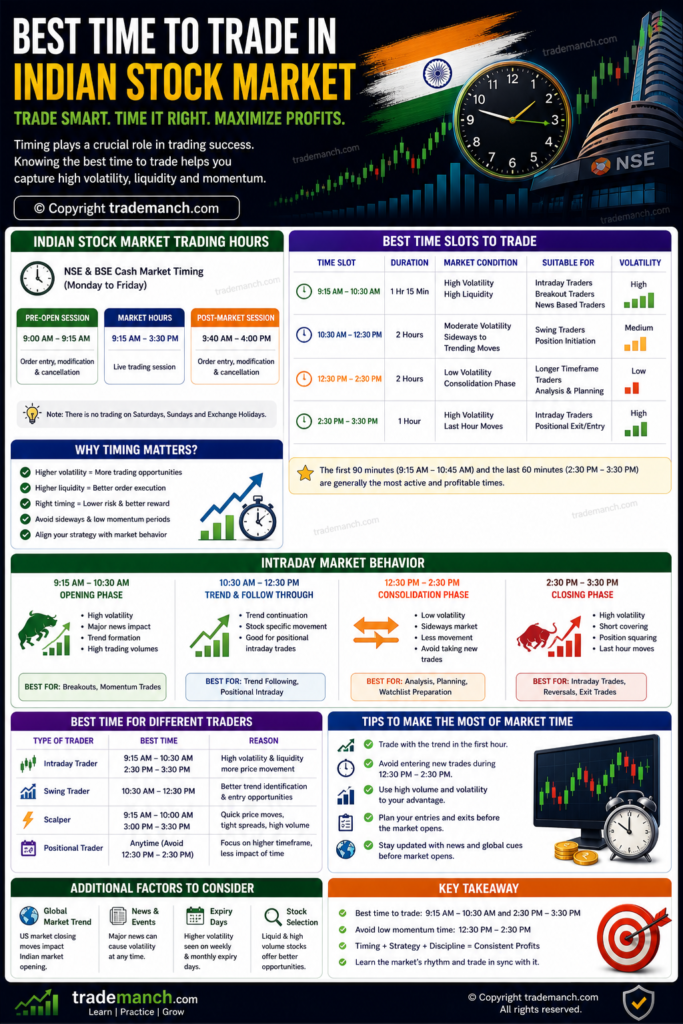
In the Indian stock market, different trading sessions behave differently. Some periods are highly volatile, while others are more stable and suitable for beginners.
In this complete beginner-friendly guide, you will learn the best trading times for:
- Intraday trading
- Swing trading
- Options trading
- Beginners
- Professional traders
You will also learn how market opening, global markets, and volatility affect trading opportunities.
Indian Stock Market Trading Hours
The Indian stock market mainly operates through:
- National Stock Exchange (NSE)
- Bombay Stock Exchange (BSE)
Normal Market Timing
Equity Market Timing
- Market Opens: 9:15 AM
- Market Closes: 3:30 PM
(Monday to Friday)
Pre-Open Market Session
Timing:
- 9:00 AM to 9:15 AM
This session helps determine:
- Opening prices
- Initial market sentiment
Post-Closing Session
Timing:
- 3:30 PM to 4:00 PM
Limited trading activities happen during this period.
Why Timing Matters in Trading
Different market hours have:
- Different volatility levels
- Different trading volumes
- Different price behavior
Proper timing helps traders:
- Reduce risk
- Improve entries
- Avoid unnecessary losses
Best Time for Intraday Trading in India
1. First Hour: 9:15 AM to 10:15 AM
This is one of the most volatile periods.
Reasons:
- Overnight global news reaction
- Institutional activity
- Gap-up and gap-down openings
Advantages
- Strong price movement
- High liquidity
- Good breakout opportunities
Risks
- High volatility
- False breakouts
- Emotional trading pressure
Is It Good for Beginners?
Generally:
- Beginners should avoid trading immediately after market open.
The market can be unpredictable during the first 15–30 minutes.
2. Best Time for Beginners: 10:30 AM to 1:30 PM
This is often considered the best trading time for beginners.
Reasons:
- Market becomes more stable
- Trends become clearer
- Reduced opening volatility
Advantages
- Better trend confirmation
- Lower emotional pressure
- More controlled movements
Why Professionals Prefer This Time
Professional traders often wait for:
- Clear setups
- Confirmed trends
- Reduced noise
3. Afternoon Session: 1:30 PM to 2:30 PM
This session may show:
- Trend continuation
- Lower volatility
- Institutional adjustments
Suitable for:
- Experienced traders
- Trend-following setups
4. Last Hour: 2:30 PM to 3:30 PM
The final hour often becomes active again.
Reasons:
- Position closing
- Institutional adjustments
- Expiry-related movement
Advantages
- Strong momentum opportunities
- Trend continuation setups
Risks
- Sudden reversals
- High volatility near close
Best Time for Options Trading
Options trading usually works best during:
- High volatility
- Strong trend movement
Popular times:
- 9:30 AM to 11:30 AM
- 2:00 PM to 3:15 PM
Best Time for Swing Trading
Swing traders focus more on:
- End-of-day analysis
- Daily chart setups
Best time for analysis:
- After market close
Swing traders do not need constant monitoring.
Best Time for Delivery Investing
Long-term investors focus less on exact timing.
However:
- Market corrections
- Panic selling phases
often create good investment opportunities.
Why Market Opening Is Volatile
At market open:
- Traders react to overnight news
- Global markets influence sentiment
- Institutional orders enter market
This creates:
- Rapid price movement
- Uncertainty
Impact of Global Markets on Indian Market Timing
Indian markets are influenced by:
- US markets
- Asian markets
- European markets
Examples:
- S&P 500
- NASDAQ Composite
Strong global moves can affect Indian market opening.
Best Days for Trading
Some traders believe:
- Tuesday to Thursday often provide more stable setups.
Mondays may react to weekend news, while Fridays may show profit booking.
However:
- Good setups can appear any day.
What Is Volatility?
Volatility means:
- Speed and size of price movement.
Higher volatility:
- Increases opportunity
- Increases risk
Best Time for Scalping
Scalpers prefer:
- High liquidity
- High volatility
Popular scalping periods:
- 9:15 AM to 10:00 AM
- 2:30 PM to 3:15 PM
Best Time for Beginners to Avoid Trading
Beginners should be cautious during:
- First 15 minutes after market open
- Major news announcements
- Expiry-day extreme volatility
What Is Expiry Day Volatility?
On options expiry days:
- Market movement becomes faster
- Volatility increases sharply
Especially in:
- NIFTY 50
- BANK NIFTY
Best Timeframe for Intraday Analysis
Popular chart timeframes:
- 5-minute chart
- 15-minute chart
- 1-hour chart
Beginners often prefer:
- 15-minute charts
because they are less noisy.
Importance of Volume During Trading Hours
Volume is highest during:
- Market opening
- Market closing
High volume improves:
- Liquidity
- Trade execution
Professional Traders vs Beginner Timing
| Professional Traders | Beginners |
|---|---|
| Can trade opening volatility | Prefer stable sessions |
| Handle fast momentum | Need clearer setups |
| Experience with volatility | Lower emotional control |
Common Beginner Mistakes Related to Timing
Trading Immediately After Market Open
High volatility creates false signals.
Overtrading Entire Day
More trades do not guarantee profits.
Ignoring Global News
US markets and economic data influence Indian markets.
Trading During Low Liquidity
Avoid illiquid stocks and low-volume periods.
Best Strategy for Beginners
Wait for Confirmation
Avoid impulsive entries.
Trade Fewer High-Quality Setups
Focus on quality, not quantity.
Avoid Emotional Trading
Stay disciplined.
Follow Risk Management
Use:
- Stop loss
- Position sizing
- Proper risk-reward ratio
Best Stocks for Intraday Trading
Intraday traders usually prefer liquid stocks like:
- Reliance Industries
- HDFC Bank
- Infosys
These stocks have:
- High liquidity
- Strong volume
- Better price movement
Best Time for Bank Nifty Trading
BANK NIFTY is highly volatile.
Popular trading periods:
- 9:20 AM to 11:00 AM
- 2:00 PM onward
Bank Nifty is more suitable for experienced traders.
Is There a Perfect Trading Time?
No single timing guarantees profits.
Successful trading depends on:
- Strategy
- Discipline
- Risk management
- Experience
Timing only improves probability.
The best trading time in the Indian stock market depends on trading style, experience, and risk tolerance. For beginners, the period between 10:30 AM and 1:30 PM is often considered safer because market volatility becomes more stable and trends are clearer.
Professional traders may prefer the opening and closing hours for stronger momentum opportunities. However, successful trading is not only about timing. It also requires:
- Risk management
- Emotional control
- Patience
- Discipline
- Proper learning
Understanding market timing helps traders improve decision-making and avoid unnecessary mistakes in the stock market.
Frequently Asked Questions (FAQs)
1. What is the best time for intraday trading in India?
Many traders prefer 10:30 AM to 1:30 PM for more stable market conditions.
2. What are Indian stock market timings?
The market operates from 9:15 AM to 3:30 PM.
3. Why is market opening volatile?
Because traders react to overnight news and global market movement.
4. Is the first hour good for beginners?
Generally, beginners should avoid early high volatility.
5. Which is the best time for options trading?
High volatility periods like morning and late afternoon are popular.
6. What is the safest trading time for beginners?
Mid-session trading hours are usually safer.
7. Why is Bank Nifty highly volatile?
Banking stocks react strongly to market sentiment and institutional activity.
8. Which stocks are best for intraday trading?
Liquid stocks like Reliance Industries and HDFC Bank are commonly preferred.
9. Is timing alone enough for successful trading?
No, strategy and risk management are equally important.
10. Can beginners do intraday trading?
Yes, but beginners should start carefully with proper learning and discipline.