
Many beginner traders enter the stock market with one goal: making profits. While earning profits is important, professional traders understand that capital protection comes first. Before thinking about how much money you can make, you must focus on how much money you can afford to lose.
The world’s most successful traders survive in the market because they protect their capital. Once capital is lost, recovering it becomes increasingly difficult. A trader who protects capital can always find new opportunities, but a trader who loses most of their account may struggle to continue trading.
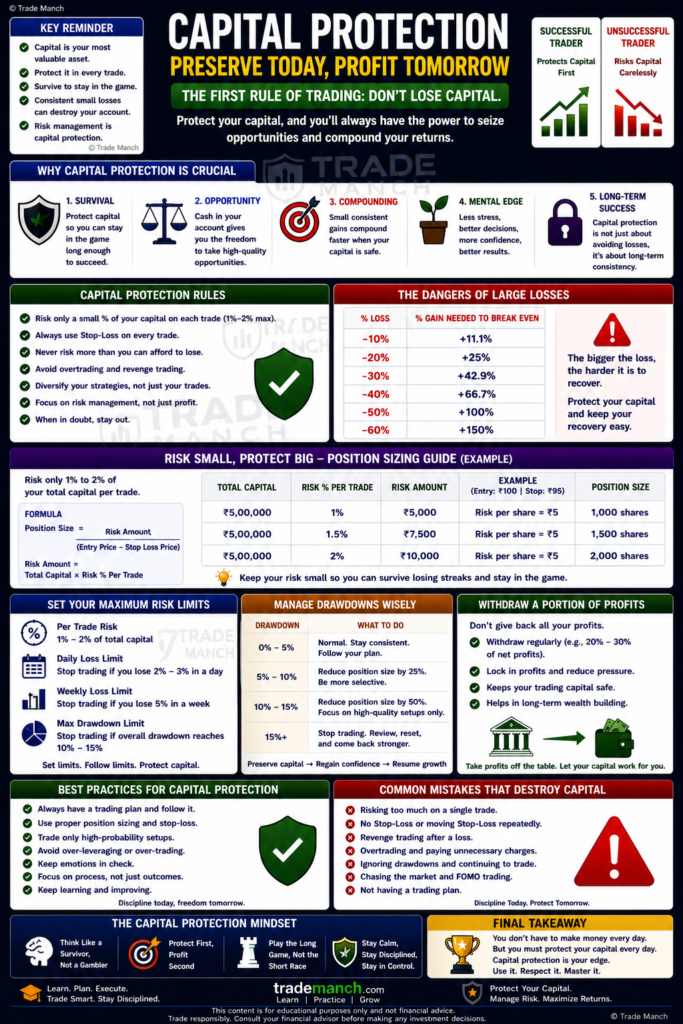
This complete guide explains why capital protection is the foundation of successful trading and how you can safeguard your trading account.
What Is Capital Protection?
Capital protection refers to strategies and techniques used to preserve your trading capital and minimize losses.
The primary objective is:
- Avoid large losses
- Maintain trading capital
- Stay in the market long-term
Capital protection is more important than maximizing short-term profits.
Simple Definition of Capital Protection
Capital protection means managing risk in a way that prevents significant damage to your trading account.
Why Capital Protection Is Important
Most traders fail not because they lack profitable strategies but because they:
- Take excessive risks
- Ignore stop-losses
- Overtrade
- Use excessive leverage
- Let emotions control decisions
Protecting capital allows traders to survive losing periods and benefit from future opportunities.
The Mathematics of Losses
Many traders underestimate how difficult it is to recover from large losses.
Consider the following:
| Loss | Required Gain to Recover |
|---|---|
| 10% | 11.1% |
| 20% | 25% |
| 30% | 42.9% |
| 40% | 66.7% |
| 50% | 100% |
| 60% | 150% |
| 70% | 233% |
Example:
If ₹1,00,000 becomes ₹50,000:
To recover:
50000100000−50000×100=100%
You need a 100% return just to break even.
This is why protecting capital is critical.
Rule #1: Never Risk Too Much on One Trade
Professional traders rarely risk more than:
- 1% to 2% of total capital per trade
Example:
Trading Capital = ₹1,00,000
Maximum Risk = 1%
Risk Amount:
100000×1%=1000
Maximum loss per trade = ₹1,000
This prevents a single trade from causing major damage.
Use Stop-Loss on Every Trade
A stop-loss helps limit losses automatically.
Example:
Entry Price = ₹500
Stop-Loss = ₹490
Maximum Risk:
500−490=10
Loss per share = ₹10
Without a stop-loss, losses can become much larger.
Follow Proper Position Sizing
Position sizing determines how much capital you allocate to each trade.
Formula:
Position Size=Risk Per ShareAccount Risk
Proper position sizing ensures that risk remains controlled regardless of market conditions.
Avoid Excessive Leverage
Leverage can increase profits, but it can also magnify losses.
Example:
Capital = ₹50,000
Leverage = 10x
Trading Exposure:
50000×10=500000
A small market move against you can create substantial losses.
Beginners should use leverage cautiously.
Maintain a Favorable Risk-Reward Ratio
Before entering a trade:
- Define risk
- Define target
Example:
Risk = ₹500
Reward = ₹1,500
Risk-Reward Ratio:
5001500=3:1
Favorable ratios help improve long-term profitability.
Diversify Your Capital
Avoid concentrating all funds in a single stock or trade.
Example Portfolio:
- 40% Large Cap Stocks
- 25% Mid Cap Stocks
- 15% Small Cap Stocks
- 10% Gold
- 10% Cash
Diversification helps reduce overall risk.
Preserve Mental Capital
Capital protection is not only about money.
It also involves:
- Emotional stability
- Confidence
- Discipline
Large losses often damage a trader’s psychology and decision-making ability.
Avoid Revenge Trading
After a loss, some traders attempt to recover money immediately.
This often leads to:
- Larger losses
- Emotional decisions
- Overtrading
Successful traders accept losses and move on.
Set Daily Loss Limits
Many professional traders establish daily loss limits.
Example:
Maximum Daily Loss = ₹2,000
Once reached:
- Stop trading for the day.
This prevents emotional decisions.
Protect Capital During Market Volatility
During uncertain market conditions:
- Reduce position size
- Trade less frequently
- Wait for high-quality setups
Sometimes the best trade is no trade.
Importance of Cash Management
Holding cash provides:
- Flexibility
- Opportunity
- Protection during market corrections
Cash is a position too.
Learn to Accept Small Losses
Small losses are normal.
Successful traders understand:
- Losses are part of trading.
- Large losses are avoidable.
Protecting capital means accepting controlled losses.
Common Capital Protection Mistakes
No Stop-Loss
One of the biggest reasons traders fail.
Risking Too Much
Large position sizes increase account risk.
Overtrading
Too many trades often lead to poor decisions.
Ignoring Market Conditions
Different market environments require different approaches.
Chasing Losses
Trying to recover losses quickly often creates bigger problems.
Capital Protection in Different Trading Styles
Intraday Trading
- Tight stop-losses
- Strict daily limits
Swing Trading
- Moderate position sizing
- Technical stop-losses
Positional Trading
- Wider stops
- Smaller position sizes
Long-Term Investing
- Diversification
- Asset allocation
- Fundamental analysis
The 90% Rule
Many trading failures occur because traders focus on:
- Profit maximization
instead of:
- Risk minimization
Professional traders often think:
“Protect capital first, profits will follow.”
Building a Capital Protection Plan
Every trader should have:
Risk Per Trade
Maximum 1%–2%
Daily Loss Limit
Predefined amount
Weekly Loss Limit
To avoid emotional trading
Position Sizing Rules
Based on stop-loss and account size
Trading Journal
Track performance and mistakes
Capital Protection and Long-Term Success
The primary goal of trading is not to make money quickly.
The primary goal is:
- Stay in the game long enough to let skill, discipline, and experience work in your favor.
Capital protection creates the foundation for long-term profitability.
Can Capital Protection Guarantee Success?
No.
No strategy can guarantee success.
However, proper capital protection can:
- Reduce losses
- Improve consistency
- Increase survival rate
- Improve long-term performance
Capital protection is the first and most important rule of successful trading. Profits come and go, but preserving capital ensures that you always have the opportunity to participate in future market opportunities.
Successful traders understand that their primary job is not to predict every market movement but to manage risk effectively. By using stop-losses, proper position sizing, diversification, favorable risk-reward ratios, and disciplined risk management, traders can protect their capital and build a strong foundation for long-term success.
Remember: The trader who survives the longest often wins in the end.
Frequently Asked Questions (FAQs)
1. What is capital protection in trading?
Capital protection refers to preserving trading capital by managing risk and limiting losses.
2. Why is capital protection important?
It helps traders survive losing periods and remain active in the market.
3. How much should I risk per trade?
Many professional traders risk only 1%–2% of their total capital.
4. What role does a stop-loss play?
A stop-loss limits losses and protects capital automatically.
5. Can leverage harm capital protection?
Yes. Excessive leverage can magnify losses significantly.
6. Why is diversification important?
Diversification reduces the impact of losses from any single investment.
7. What is a daily loss limit?
A predefined amount that limits losses for a trading day.
8. Should beginners focus on profits or capital protection?
Capital protection should always come first.
9. Can capital protection eliminate risk?
No, but it can significantly reduce risk.
10. Is capital protection important for investors too?
Yes. Investors also use diversification, asset allocation, and risk management to protect capital.