
Long-term investing is one of the most effective ways to build wealth and achieve financial freedom. Unlike trading, which focuses on short-term price movements, long-term investing focuses on holding quality assets for years or even decades to benefit from business growth, compounding, and wealth creation.
Many of the world’s most successful investors have built their fortunes through long-term investing rather than frequent trading. By investing in strong companies and staying invested through market cycles, investors can potentially generate significant returns over time.
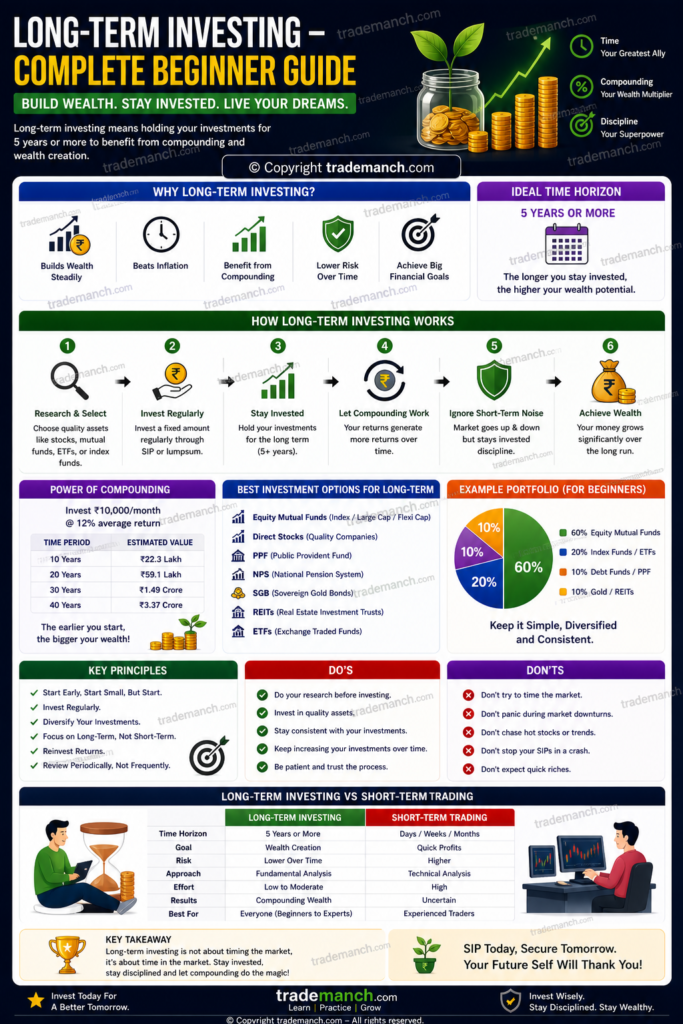
This complete beginner guide explains everything about long-term investing, including its benefits, strategies, risks, and how to get started.
What Is Long-Term Investing?
Long-term investing is the practice of buying and holding investments such as stocks, mutual funds, ETFs, or other assets for several years with the goal of achieving substantial wealth growth.
Long-term investors focus on:
- Business growth
- Earnings growth
- Dividend income
- Compounding returns
rather than short-term market fluctuations.
Simple Definition of Long-Term Investing
Long-term investing means purchasing quality assets and holding them for many years to benefit from their growth and compounding returns.
Why Is Long-Term Investing Important?
Long-term investing helps investors:
- Build wealth
- Beat inflation
- Achieve financial goals
- Benefit from compounding
- Reduce emotional decision-making
It is one of the most reliable methods of wealth creation.
How Long Is Long-Term Investing?
Generally:
| Investment Period | Category |
|---|---|
| Less than 1 Year | Short-Term |
| 1–3 Years | Medium-Term |
| More than 3–5 Years | Long-Term |
| 10+ Years | Wealth Building |
Many successful investors hold investments for decades.
How Long-Term Investing Works
The process is simple:
- Identify quality investments.
- Invest regularly.
- Reinvest earnings and dividends.
- Stay invested for years.
- Allow compounding to work.
The longer you stay invested, the greater the potential impact of compounding.
Understanding the Power of Compounding
Compounding occurs when your earnings generate additional earnings.
Example:
Investment = ₹1,00,000
Annual Return = 12%
After one year:
100000×1.12=112000
Value = ₹1,12,000
The following year, returns are earned on ₹1,12,000 rather than ₹1,00,000.
Over time, this effect can become extremely powerful.
Why Long-Term Investing Is Better Than Frequent Trading for Many People
Long-term investing offers:
- Lower stress
- Less time commitment
- Lower transaction costs
- Tax efficiency
- Better wealth-building potential
Most successful retail investors prefer long-term investing.
Advantages of Long-Term Investing
Compounding Growth
The biggest advantage is the power of compounding.
Lower Stress
No need to monitor markets daily.
Reduced Trading Costs
Fewer transactions mean lower brokerage fees.
Lower Emotional Impact
Investors focus on long-term goals rather than short-term fluctuations.
Wealth Creation
Historically, quality businesses have generated significant long-term returns.
Risks of Long-Term Investing
Market Risk
Stock prices can decline temporarily.
Business Risk
Poor company performance can affect returns.
Economic Risk
Economic downturns can impact investments.
Inflation Risk
Low-return investments may fail to beat inflation.
What Can You Invest In?
Long-term investors commonly invest in:
Stocks
Ownership in companies.
Mutual Funds
Professionally managed investment portfolios.
ETFs (Exchange-Traded Funds)
Diversified baskets of securities.
Index Funds
Funds that track market indices.
Bonds
Fixed-income investments.
Long-Term Investing Strategies
Buy and Hold Strategy
One of the simplest and most effective approaches.
Process:
- Buy quality assets.
- Hold for many years.
Ignore short-term market noise.
SIP (Systematic Investment Plan)
Invest a fixed amount regularly.
Example:
₹5,000 per month
Annual Investment:
5000×12=60000
Annual contribution = ₹60,000
SIPs help build discipline and reduce timing risk.
Value Investing
Buy quality companies when they appear undervalued.
This approach was popularized by:
- Warren Buffett
Growth Investing
Focus on companies with strong growth potential.
Examples often include:
- Technology companies
- Consumer businesses
- Emerging industries
Dividend Investing
Invest in companies that regularly distribute profits to shareholders.
Benefits:
- Passive income
- Long-term wealth growth
How to Select Stocks for Long-Term Investing
Look for companies with:
- Strong revenue growth
- Consistent profits
- Low debt
- Competitive advantages
- Strong management
Examples include:
- Reliance Industries
- Infosys
- Tata Consultancy Services
- HDFC Bank
- ICICI Bank
Importance of Diversification
Diversification means spreading investments across multiple assets.
Benefits:
- Reduces risk
- Protects against individual company problems
Avoid investing all your money in a single stock.
Asset Allocation
Asset allocation refers to dividing investments among:
- Stocks
- Bonds
- Gold
- Cash
- Real Estate
A balanced portfolio helps manage risk.
Long-Term Investing vs Trading
| Feature | Long-Term Investing | Trading |
|---|---|---|
| Holding Period | Years | Days/Weeks |
| Objective | Wealth Creation | Short-Term Profit |
| Stress Level | Lower | Higher |
| Time Requirement | Low | High |
| Analysis | Fundamentals | Technical Analysis |
How Much Money Do You Need to Start?
You can start with small amounts.
Examples:
- ₹500
- ₹1,000
- ₹5,000
Many investors begin through SIPs.
The most important factor is consistency.
Common Long-Term Investing Mistakes
Chasing Quick Profits
Wealth creation requires patience.
Investing Without Research
Always understand what you are buying.
Panic Selling
Temporary market declines are normal.
Lack of Diversification
Avoid concentrating investments.
Trying to Time the Market
Consistent investing often works better than predicting short-term movements.
Long-Term Investing Psychology
Successful investors:
- Stay patient
- Ignore market noise
- Focus on fundamentals
- Maintain discipline
Emotional control is critical.
How Beginners Can Start Long-Term Investing
Step 1
Define financial goals.
Step 2
Open a Demat and trading account.
Step 3
Learn basic investing concepts.
Step 4
Choose quality investments.
Step 5
Start regular investing.
Step 6
Review portfolio periodically.
Can Long-Term Investing Make You Rich?
Long-term investing has created wealth for millions of investors worldwide.
However:
- Results take time.
- Returns are not guaranteed.
- Consistency and patience are essential.
The earlier you start, the greater the potential benefit of compounding.
Can Long-Term Investing Guarantee Profits?
No.
All investments carry risk.
However, historically, diversified long-term investing has generally outperformed many short-term trading approaches.
Long-term investing is one of the most powerful tools for building wealth and achieving financial goals. By investing in quality assets, staying disciplined, and allowing compounding to work over time, investors can potentially create substantial wealth.
The key principles of successful long-term investing are:
- Patience
- Consistency
- Diversification
- Research
- Discipline
Remember, wealth is rarely built overnight. Long-term investing is a journey that rewards those who stay committed to their financial goals.
Frequently Asked Questions (FAQs)
1. What is long-term investing?
Long-term investing involves holding investments for several years to benefit from growth and compounding.
2. How long should I hold investments?
Generally, more than 3–5 years is considered long-term investing.
3. What is compounding?
Compounding occurs when investment earnings generate additional earnings over time.
4. Is long-term investing safer than trading?
It often involves less stress and fewer transactions, but all investments carry risk.
5. Can I start investing with ₹500?
Yes, many investment options allow small starting amounts.
6. What are the best assets for long-term investing?
Stocks, mutual funds, ETFs, and index funds are common choices.
7. Should I invest regularly?
Yes, regular investing through SIPs is a popular strategy.
8. What is diversification?
Diversification means spreading investments across multiple assets to reduce risk.
9. Can long-term investing create wealth?
Yes, many successful investors have built wealth through long-term investing.
10. Can long-term investing guarantee profits?
No. Investments always involve risk, and returns are never guaranteed.