
A trading plan is the foundation of successful trading. Most beginner traders focus on finding the perfect indicator or strategy, but professional traders know that long-term success comes from having a well-defined trading plan.
Without a trading plan, traders often:
Break trading rules
Make emotional decisions
Overtrade
Ignore risk management
Chase losses
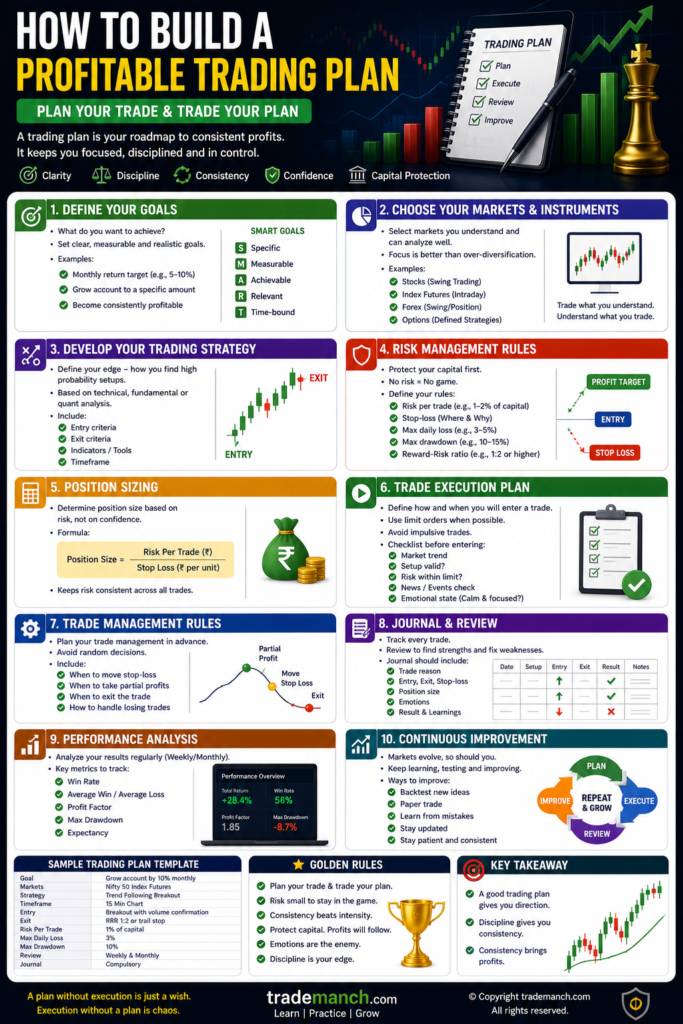
A profitable trading plan helps you stay disciplined, manage risk, and make consistent trading decisions.
In this complete beginner’s guide, you will learn how to create a professional trading plan step by step.
What Is a Trading Plan?
A trading plan is a written set of rules that defines how you will trade in the financial markets.
It includes:
- Trading goals
- Market selection
- Entry rules
- Exit rules
- Risk management
- Position sizing
- Trading psychology guidelines
A trading plan acts like a business plan for your trading career.
Why Is a Trading Plan Important?
A trading plan helps traders:
- Reduce emotional trading
- Improve discipline
- Maintain consistency
- Control risk
- Measure performance
- Avoid impulsive decisions
Professional traders follow their trading plan regardless of market conditions.
Benefits of Having a Trading Plan
Some major benefits include:
Better Risk Management
You know exactly how much money you can risk on each trade.
Consistent Decision Making
You follow predefined rules instead of emotions.
Improved Confidence
A tested plan builds confidence during market fluctuations.
Easier Performance Tracking
You can analyze what works and what needs improvement.
Step 1: Define Your Trading Goals
Before entering any trade, decide what you want to achieve.
Examples:
- Generate monthly income
- Build long-term wealth
- Learn professional trading
- Grow trading capital
Your goals should be realistic and measurable.
Good Goal Example
“Earn 10% annual returns while risking no more than 1% per trade.”
Bad Goal Example
“Double my money every month.”
Step 2: Choose Your Trading Style
Different traders use different trading styles.
Intraday Trading
Trades are opened and closed on the same day.
Suitable for:
- Full-time traders
- Active market participants
Swing Trading
Trades are held for several days or weeks.
Suitable for:
- Working professionals
- Part-time traders
Positional Trading
Trades are held for months.
Suitable for:
- Long-term investors
Choose a trading style that matches your lifestyle and available time.
Step 3: Select Your Market
Decide which market you will trade.
Popular choices:
- Stock Market
- Forex Market
- Cryptocurrency Market
- Commodity Market
- Options Trading
- Futures Trading
Avoid trading too many markets at the beginning.
Focus on mastering one market first.
Step 4: Define Your Trading Strategy
Your trading strategy should clearly define:
Entry Rules
When will you enter a trade?
Example:
- Price above 50 EMA
- RSI above 50
- Bullish candlestick pattern
Exit Rules
When will you exit?
Example:
- Target achieved
- Stop loss hit
- Trend reversal signal
Trade Filters
Conditions that must be met before taking a trade.
Example:
- ADX above 25
- Strong volume confirmation
Step 5: Create a Risk Management Plan
Risk management is more important than finding the perfect strategy.
Many successful traders focus more on risk than profit.
Risk Per Trade
Most professionals risk:
- 1% to 2% of total capital per trade
Example:
Trading Capital = ₹1,00,000
Maximum Risk:
1% of 100000=1000
Maximum loss per trade = ₹1,000
Risk-Reward Ratio
A profitable trader always seeks favorable risk-reward opportunities.
Example:
- Risk = ₹500
- Target = ₹1500
Risk-Reward Ratio:
5001500=3:1
Many professional traders prefer at least:
- 1:2
- 1:3
risk-reward ratios.
Step 6: Determine Position Size
Position sizing helps protect your capital.
Factors to consider:
- Account size
- Risk percentage
- Stop-loss distance
Never increase position size emotionally after a winning or losing trade.
Step 7: Set Entry Rules
Every trading plan should have clear entry conditions.
Example Trading Setup:
Buy Conditions
- Price above 50 EMA
- RSI above 55
- Volume increasing
- Bullish candlestick confirmation
Enter only when all conditions are satisfied.
Step 8: Set Exit Rules
Many traders know when to enter but not when to exit.
Your trading plan must define:
Profit Target
Predetermined exit point.
Stop Loss
Maximum acceptable loss.
Time-Based Exit
Close trade after a certain period if setup fails.
Step 9: Maintain a Trading Journal
A trading journal records:
- Entry price
- Exit price
- Profit/loss
- Reason for trade
- Emotions during trade
A journal helps identify strengths and weaknesses.
Example Trading Journal Fields
- Date
- Stock Name
- Entry Price
- Exit Price
- Stop Loss
- Target
- Result
- Notes
Review your journal regularly.
Step 10: Develop Trading Discipline
Even the best trading plan fails without discipline.
Successful traders:
- Follow rules strictly
- Accept losses calmly
- Avoid revenge trading
- Stay patient
Discipline is often more important than strategy.
Common Trading Plan Mistakes
No Written Plan
Many beginners trade without documented rules.
Risking Too Much Capital
Large losses can destroy trading accounts.
Overtrading
Taking too many trades leads to emotional decisions.
Changing Strategies Frequently
Constantly switching strategies prevents consistency.
Ignoring Market Conditions
Different strategies work in different environments.
Sample Beginner Trading Plan
Trading Style
Swing Trading
Market
Indian Stocks
Timeframe
Daily Chart
Entry Rules
- Price above 50 EMA
- RSI above 50
- Bullish candle pattern
Risk Per Trade
1%
Risk-Reward Ratio
1:3
Exit Rules
- Target hit
- Stop loss hit
- Trend reversal
Trading Psychology Rules
Every trading plan should include mental rules.
Examples:
- Never revenge trade
- Never increase risk after losses
- Follow stop loss strictly
- Focus on process, not profits
Strong psychology creates long-term success.
How to Test Your Trading Plan
Before risking real money:
Backtesting
Test the strategy on historical charts.
Paper Trading
Trade using a demo account.
Forward Testing
Test in live market with small capital.
Only use larger capital after proving consistency.
How Often Should You Update Your Trading Plan?
Review your plan:
- Monthly
- Quarterly
Update only after sufficient data and analysis.
Avoid changing rules after a few losses.
Characteristics of a Profitable Trading Plan
A good trading plan should be:
- Simple
- Clear
- Measurable
- Repeatable
- Risk-controlled
If your plan is too complex, it becomes difficult to follow consistently.
Can a Trading Plan Guarantee Profits?
No.
No trading plan can guarantee profits.
However, a good trading plan can:
- Reduce losses
- Improve consistency
- Increase discipline
- Improve decision-making
Over time, these factors can significantly improve trading performance.
A profitable trading plan is the foundation of successful trading. It helps eliminate emotional decisions and creates a structured approach to the market. A complete trading plan should define:
- Trading goals
- Strategy
- Entry rules
- Exit rules
- Risk management
- Position sizing
- Trading psychology
Remember, successful trading is not about winning every trade. It is about following a disciplined process and managing risk effectively.
The traders who consistently follow a well-tested trading plan are far more likely to achieve long-term success than those who trade based on emotions and guesswork.
Frequently Asked Questions (FAQs)
1. What is a trading plan?
A trading plan is a written set of rules that guides trading decisions.
2. Why is a trading plan important?
It helps maintain discipline, consistency, and risk control.
3. How much should I risk per trade?
Most professional traders risk 1% to 2% of their trading capital.
4. What is a good risk-reward ratio?
Many traders prefer at least a 1:2 or 1:3 risk-reward ratio.
5. Should beginners use a trading journal?
Yes, a trading journal is essential for tracking performance and improvement.
6. Can a trading plan guarantee profits?
No, but it can improve consistency and reduce mistakes.
7. How often should I update my trading plan?
Typically monthly or quarterly after reviewing results.
8. What is the biggest mistake beginners make?
Trading without a written plan and proper risk management.
9. Should I backtest my strategy?
Yes, backtesting helps evaluate strategy performance before using real money.
10. Is trading psychology part of a trading plan?
Yes, psychology is one of the most important components of a successful trading plan.