
Algorithmic trading, commonly known as Algo Trading, is one of the fastest-growing technologies in the stock market. Today, large financial institutions, hedge funds, banks, and even retail traders use algorithmic trading systems to execute trades automatically using computer programs.
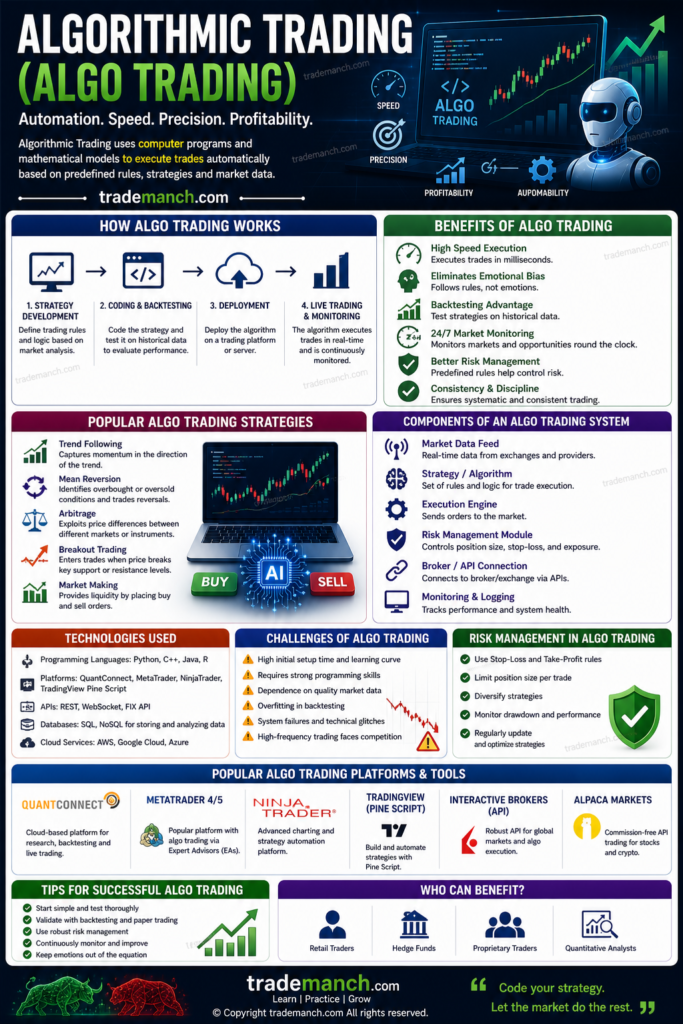
Algo trading has changed modern financial markets by making trading:
- Faster
- Automated
- Data-driven
- More efficient
In this complete beginner-friendly guide, you will learn what algo trading is, how it works, its advantages, risks, strategies, and how beginners can start learning algorithmic trading in 2026.
What Is Algo Trading?
Algo trading means using:
- Computer programs
- Automated systems
- Mathematical rules
to buy and sell stocks automatically in the financial market.
In simple words:
- Algo trading uses software to execute trades based on predefined conditions.
Simple Definition of Algo Trading
Algorithmic trading is automated trading where computers place trades according to programmed instructions.
How Algo Trading Works
An algorithm follows specific rules such as:
- Price movement
- Technical indicators
- Volume
- Time
- Trend conditions
When conditions match:
- The system automatically executes trades.
Example of Algo Trading
Suppose a trader creates an algorithm:
Buy Rule
- Buy stock when 50 EMA crosses above 200 EMA.
Sell Rule
- Sell stock when 50 EMA crosses below 200 EMA.
The computer automatically executes trades whenever these conditions occur.
What Is an Algorithm?
An algorithm is a step-by-step set of instructions followed by a computer.
In trading:
- Algorithms analyze market data
- Generate signals
- Execute trades automatically
Types of Algo Trading
1. Trend Following Algorithms
These algorithms follow market trends using:
- Moving averages
- Breakouts
- Momentum indicators
Most beginner algorithms use trend-following strategies.
2. Arbitrage Trading
Arbitrage algorithms profit from price differences between markets.
Example:
- Buying at lower price on one exchange
- Selling at higher price on another exchange
3. Mean Reversion Strategy
Assumes price eventually returns to average levels.
4. High-Frequency Trading (HFT)
Uses ultra-fast systems to execute thousands of trades within milliseconds.
Large institutions mainly use HFT.
5. Market Making Algorithms
Provide liquidity by continuously placing buy and sell orders.
Advantages of Algo Trading
1. Faster Execution
Computers execute trades within milliseconds.
Much faster than manual trading.
2. No Emotional Trading
Algorithms trade based on rules, not:
- Fear
- Greed
- Panic
3. 24/7 Market Monitoring
Algorithms continuously scan markets automatically.
4. Better Discipline
Trades follow predefined rules consistently.
5. Backtesting Capability
Strategies can be tested using historical data.
What Is Backtesting?
Backtesting means testing a trading strategy on historical market data.
It helps traders:
- Analyze performance
- Identify weaknesses
- Improve strategies
Example of Backtesting
Suppose:
- You test a moving average strategy on 5 years of historical data.
The system shows:
- Win rate
- Profitability
- Maximum drawdown
Risks of Algo Trading
1. Technical Failures
Software bugs or internet problems may cause losses.
2. Market Volatility
Unexpected market movements can damage strategies.
3. Over-Optimization
Strategies may work only on past data but fail in real markets.
4. Lack of Risk Management
Poor algorithms may generate large losses quickly.
5. Dependency on Technology
Algo trading requires:
- Stable internet
- Reliable systems
- Good infrastructure
Is Algo Trading Legal in India?
Yes, algo trading is legal in India under regulations by:
- Securities and Exchange Board of India (SEBI)
Stock exchanges also regulate algorithmic trading activities.
Who Uses Algo Trading?
Algo trading is used by:
- Hedge funds
- Banks
- Institutional investors
- Proprietary trading firms
- Retail traders
Popular Markets for Algo Trading
Algo trading is commonly used in:
- Stocks
- Forex
- Crypto
- Commodities
- Futures and options
What Skills Are Needed for Algo Trading?
Algo trading combines:
- Trading knowledge
- Programming
- Mathematics
- Data analysis
Programming Languages Used in Algo Trading
Popular languages include:
- Python
- C++
- Java
Beginners often start with Python because it is easier to learn.
Why Python Is Popular in Algo Trading
Python offers:
- Simple syntax
- Powerful libraries
- Data analysis tools
- AI integration
Popular Python libraries:
- Pandas
- NumPy
- Backtrader
Algo Trading vs Manual Trading
| Algo Trading | Manual Trading |
|---|---|
| Automated execution | Human execution |
| Faster speed | Slower decisions |
| No emotions | Emotional trading possible |
| Requires programming | Easier for beginners initially |
What Is API in Algo Trading?
API stands for:
- Application Programming Interface
APIs connect trading software with brokers.
They allow:
- Automatic order placement
- Data access
- Portfolio management
Popular brokers offering APIs:
- Zerodha
- Upstox
- Angel One
Basic Components of an Algo Trading System
An algo trading system usually includes:
- Market data
- Trading strategy
- Risk management
- Order execution
- Monitoring system
Importance of Risk Management in Algo Trading
Risk management is extremely important.
Algorithms should include:
- Stop loss
- Position sizing
- Maximum drawdown limits
Example of Position Sizing
Suppose:
- Trading capital = ₹1,00,000
- Risk per trade = 1%
Risk amount:
100000×0.01=1000
Maximum risk per trade = ₹1,000.
Popular Indicators Used in Algo Trading
Algorithms commonly use:
- RSI
- MACD
- Moving averages
- Bollinger Bands
- VWAP
What Is Quantitative Trading?
Quantitative trading uses:
- Mathematics
- Statistics
- Data models
to create trading strategies.
Algo trading and quantitative trading are closely related.
Can Beginners Learn Algo Trading?
Yes, beginners can learn algo trading gradually.
Start with:
- Stock market basics
- Technical analysis
- Risk management
- Python programming
How to Start Learning Algo Trading
Step 1: Learn Trading Basics
Understand:
- Charts
- Indicators
- Market structure
- Risk management
Step 2: Learn Programming
Python is recommended for beginners.
Step 3: Understand APIs
Learn how brokers connect with trading systems.
Step 4: Practice Backtesting
Test strategies safely before live trading.
Step 5: Start With Demo Trading
Avoid risking real money initially.
Common Beginner Mistakes in Algo Trading
Blindly Copying Strategies
Understand strategies before using them.
Ignoring Risk Management
Risk control is essential.
Over-Optimization
Do not design strategies only for past data.
Unrealistic Expectations
Algo trading does not guarantee profits.
Best Platforms for Algo Trading
Popular platforms include:
- TradingView
- MetaTrader
- QuantConnect
AI and Algo Trading
Modern algo trading increasingly uses:
- Artificial Intelligence
- Machine learning
- Predictive models
AI helps:
- Improve pattern recognition
- Optimize strategies
- Analyze large datasets
Future of Algo Trading in India
Algo trading is expected to grow rapidly because of:
- Increased retail participation
- Better internet access
- AI adoption
- Advanced broker APIs
More traders are expected to use automated systems in the future.
Is Algo Trading Profitable?
Algo trading can be profitable with:
- Good strategy
- Proper testing
- Risk management
- Discipline
However:
- No strategy guarantees profits.
Algo trading is transforming modern financial markets through automation, speed, and data-driven decision-making. By using algorithms, traders can automate strategies, reduce emotional trading, and improve efficiency.
However, successful algo trading requires:
- Market understanding
- Programming knowledge
- Strong risk management
- Continuous learning
Beginners should start slowly, focus on learning basics, practice backtesting, and avoid unrealistic profit expectations. In 2026, algorithmic trading is becoming an increasingly important skill in the world of trading and investing.
Frequently Asked Questions (FAQs)
1. What is algo trading?
Algo trading means automated trading using computer programs.
2. Is algo trading legal in India?
Yes, algo trading is legal under SEBI regulations.
3. Which programming language is best for algo trading?
Python is widely preferred for beginners.
4. Can beginners learn algo trading?
Yes, with proper learning and practice.
5. What is backtesting?
Backtesting means testing strategies using historical data.
6. Is algo trading profitable?
It can be profitable, but no profits are guaranteed.
7. What is API in algo trading?
API connects trading software with brokers for automated execution.
8. Do algo traders use indicators?
Yes, many algorithms use indicators like RSI and MACD.
9. Is algo trading risky?
Yes, all trading involves risk.
10. Which brokers support algo trading in India?
Popular brokers include Zerodha, Upstox, and Angel One.