
The Falling Wedge Pattern is one of the most reliable bullish chart patterns in technical analysis. It typically appears during a downtrend and signals that selling pressure is weakening. As the pattern develops, buyers gradually gain strength, increasing the probability of a bullish breakout.
Traders use the Falling Wedge pattern to identify potential trend reversals, breakout opportunities, and high-probability entry points.
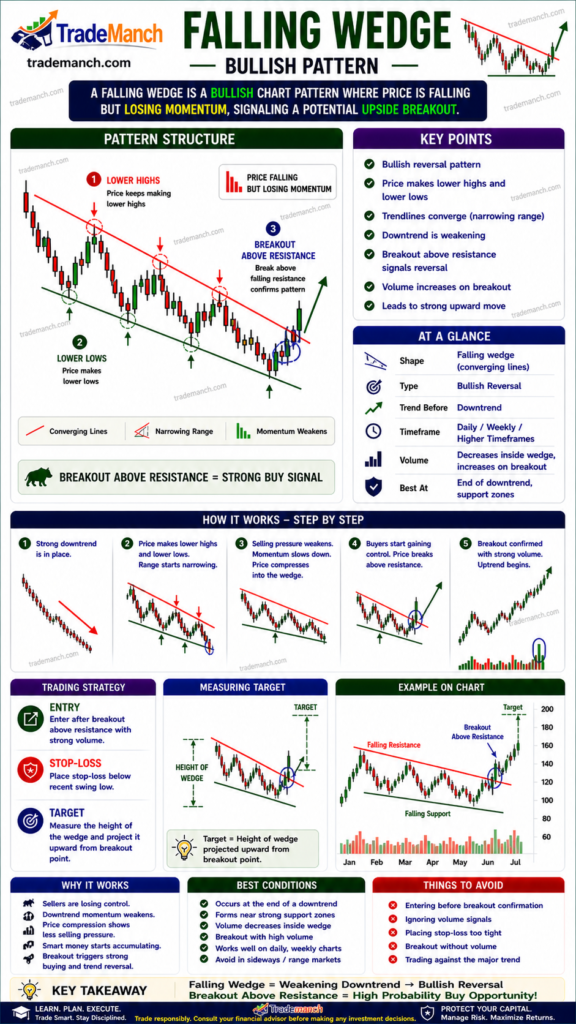
This guide explains the Falling Wedge Pattern in simple language with practical examples and trading strategies.
What Is a Falling Wedge Pattern?
A Falling Wedge is a bullish chart pattern formed by two downward-sloping trendlines that converge toward each other.
The pattern indicates:
- Decreasing selling pressure
- Lower volatility
- Potential bullish reversal
- Possible breakout opportunity
Simple Definition of Falling Wedge Pattern
A Falling Wedge is a bullish chart pattern that signals a weakening downtrend and a potential upward breakout.
Why Is the Falling Wedge Bullish?
Although prices continue moving downward inside the wedge, the rate of decline slows over time.
This suggests:
Sellers Are Losing Strength
Each new low becomes smaller.
Buyers Are Becoming Active
Demand gradually increases.
Downtrend Weakens
The market prepares for a potential reversal.
Structure of a Falling Wedge
The pattern consists of:
Upper Trendline
Connects lower highs.
Lower Trendline
Connects lower lows.
Converging Shape
Both lines move downward but gradually come closer together.
Characteristics of a Falling Wedge
| Feature | Description |
|---|---|
| Pattern Type | Bullish |
| Trend Before Pattern | Usually Downtrend |
| Shape | Converging Downward Trendlines |
| Signal | Bullish Breakout |
| Reliability | High with Confirmation |
| Volume | Usually Declines During Formation |
Market Psychology Behind the Pattern
Understanding market psychology helps explain why the pattern works.
Stage 1: Strong Selling Pressure
The market is in a downtrend.
Sellers dominate.
Stage 2: Lower Highs Continue
Price continues falling.
However, bearish momentum begins weakening.
Stage 3: Smaller Price Swings
Both highs and lows continue falling but at a slower pace.
Volatility decreases.
Stage 4: Buyers Gain Confidence
Demand slowly increases.
Selling pressure weakens further.
Stage 5: Bullish Breakout
Price breaks above the upper trendline.
Buyers gain control.
How to Identify a Falling Wedge
Step 1
Identify an existing downtrend.
Step 2
Connect lower highs with a downward trendline.
Step 3
Connect lower lows with another downward trendline.
Step 4
Ensure both lines converge.
Step 5
Wait for a bullish breakout.
Volume Analysis
Volume plays a critical role in validating the pattern.
During Pattern Formation
Volume generally decreases.
This reflects declining selling interest.
During Breakout
Volume should increase significantly.
This confirms buyer strength.
Falling Wedge Breakout
The most important event is the breakout above the upper trendline.
Bullish Breakout
Price closes above wedge resistance.
Confirmation
Strong volume increases reliability.
Market Signal
Potential trend reversal.
Trading Strategy for Falling Wedge
Step 1
Identify the wedge pattern.
Step 2
Wait for a breakout above resistance.
Step 3
Confirm with volume.
Step 4
Enter the trade after confirmation.
Step 5
Place stop-loss below recent swing low.
Entry Strategy
Aggressive Entry
Enter immediately after breakout.
Conservative Entry
Wait for a retest of the broken trendline.
Stop-Loss Placement
Risk management is essential.
Common Stop-Loss Level
Below the wedge’s last swing low.
Alternative Method
Below the lower trendline.
Profit Target Calculation
Target is usually calculated using the height of the wedge.
Formula
Target=Breakout Point+Pattern Height
Example
Suppose:
Highest Point = ₹1,000
Lowest Point = ₹900
Pattern Height:
1000−900=100
Breakout Point = ₹950
Target:
950+100=1050
Potential Target = ₹1,050
Falling Wedge vs Descending Channel
Many beginners confuse these patterns.
| Feature | Falling Wedge | Descending Channel |
|---|---|---|
| Trendlines | Converging | Parallel |
| Signal | Bullish | Neutral to Bearish |
| Momentum | Weakening Downtrend | Stable Downtrend |
| Breakout Probability | Higher Bullish Probability | Lower |
Falling Wedge vs Rising Wedge
| Feature | Falling Wedge | Rising Wedge |
|---|---|---|
| Signal | Bullish | Bearish |
| Trendlines | Downward | Upward |
| Market Sentiment | Improving | Weakening |
| Breakout Direction | Upward | Downward |
Best Indicators to Combine with Falling Wedge
RSI (Relative Strength Index)
Look for:
Bullish Divergence
Improves reliability.
MACD
Bullish crossover strengthens the signal.
Moving Averages
Confirm trend reversal.
Volume Analysis
Confirms breakout strength.
Advantages of Falling Wedge Pattern
Strong Bullish Signal
Indicates weakening bearish momentum.
Clear Entry and Exit Levels
Easy trade planning.
Works Across Markets
Stocks, forex, commodities, and cryptocurrencies.
Good Risk-Reward Opportunities
Often offers attractive setups.
Limitations of Falling Wedge Pattern
False Breakouts
Not every breakout succeeds.
Requires Confirmation
Volume and price confirmation are important.
Pattern Recognition Skills Needed
Practice improves accuracy.
Common Beginner Mistakes
Entering Before Breakout
Wait for confirmation.
Ignoring Volume
Volume validates the pattern.
Forcing Pattern Identification
Only trade clear formations.
No Stop-Loss
Always manage risk.
Best Time Frames for Trading
Intraday Trading
5-minute and 15-minute charts.
Swing Trading
Daily charts.
Positional Trading
Weekly charts.
Practical Example
Suppose a stock:
- Falls from ₹1,000 to ₹800
- Forms a Falling Wedge
- Breaks above wedge resistance at ₹850
Possible Setup:
Entry
Above ₹850
Stop-Loss
Below recent swing low
Target
Based on wedge height
How Reliable Is the Falling Wedge Pattern?
The Falling Wedge is considered one of the more reliable bullish reversal patterns when:
- The trendlines clearly converge
- Volume increases on breakout
- Additional indicators confirm the signal
However, no pattern guarantees success.
Best Combination for Beginners
Use:
Falling Wedge Pattern
Support & Resistance
RSI
Volume Analysis
for stronger confirmation.
The Falling Wedge Pattern is a powerful bullish chart pattern that signals a weakening downtrend and increasing buyer strength. It often appears before a significant upward move and provides traders with clear entry points, stop-loss levels, and profit targets.
When combined with volume confirmation, RSI, MACD, and proper risk management, the Falling Wedge can become a highly effective tool for identifying bullish trading opportunities.
Remember: wait for the breakout confirmation before entering a trade. Patience and discipline are essential for successful trading.
Frequently Asked Questions (FAQs)
1. What is a Falling Wedge Pattern?
A Falling Wedge is a bullish chart pattern formed by two converging downward-sloping trendlines.
2. Why is the Falling Wedge considered bullish?
It indicates that selling pressure is weakening and buyers may soon take control.
3. Where does the Falling Wedge usually appear?
Most commonly during a downtrend or market correction.
4. When is the pattern confirmed?
The pattern is confirmed when price breaks above the upper trendline.
5. Why is volume important?
Higher volume during the breakout increases the reliability of the pattern.
6. How is the profit target calculated?
By adding the wedge height to the breakout point.
7. What is the ideal stop-loss placement?
Below the recent swing low or lower trendline.
8. Which indicators work best with Falling Wedge?
RSI, MACD, Moving Averages, and Volume Analysis.
9. Can the Falling Wedge pattern fail?
Yes. False breakouts can occur, which is why confirmation and risk management are important.
10. Is the Falling Wedge suitable for beginners?
Yes. It is one of the easiest bullish reversal patterns to learn and trade.