
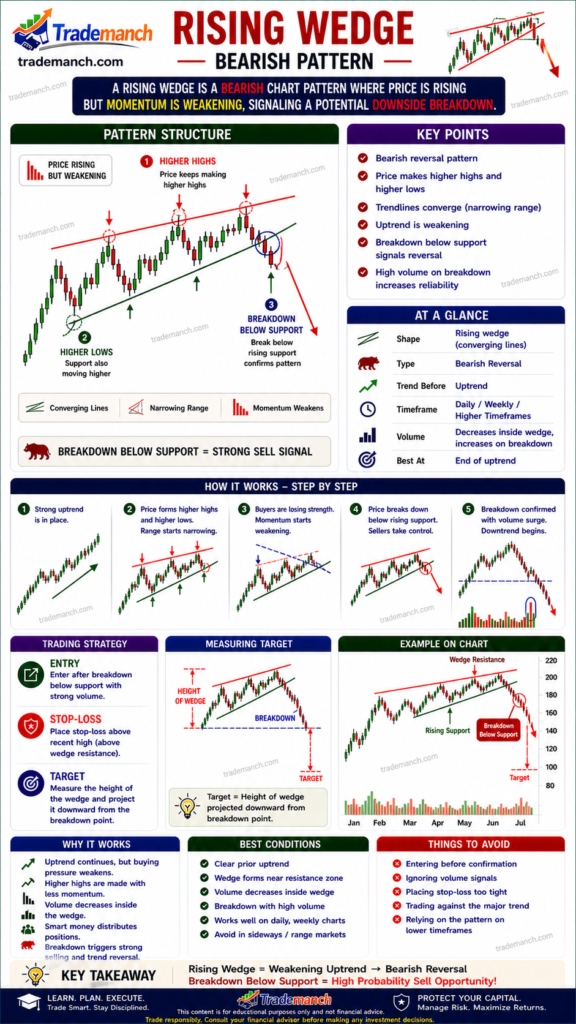
The Rising Wedge is a bearish chart pattern that signals a potential trend reversal or continuation to the downside. It forms when the price is moving upward but losing momentum, indicating that the uptrend is weakening.
🔍 What is a Rising Wedge?
A Rising Wedge forms when:
- Price makes higher highs and higher lows
- Both trendlines are sloping upward
- The range between highs and lows is narrowing (converging)
This shows that although price is rising, the buying strength is fading.
📈 Structure of Rising Wedge
- Higher Highs: Price continues to rise but at a slower pace
- Higher Lows: Buyers still push price up, but momentum weakens
- Converging Trendlines: Range tightens over time
- Breakdown: Price breaks below support, confirming bearish move
🧠 Market Psychology
- Buyers are still active but losing strength ⚠️
- Sellers slowly gain control ❌
- Price rises with reduced momentum
- Eventually → bearish breakdown occurs
This pattern reflects exhaustion in the uptrend.
🚀 How to Trade Rising Wedge
✅ Entry Point
- Enter after breakdown below the lower trendline
- Confirm with strong volume
🛑 Stop Loss
- Place stop loss above the recent swing high
🎯 Target Price
- Measure the height of the wedge (widest part)
- Subtract it from the breakdown point
📊 Key Characteristics
- Upward sloping support and resistance lines
- Converging pattern (narrowing range)
- Decreasing momentum despite rising price
- Volume often decreases during formation
- Breakdown usually accompanied by volume spike
⚠️ Important Tips
- Can act as both reversal (after uptrend) and continuation (in downtrend)
- Avoid trading before confirmed breakdown
- Watch for false breakouts
- Use indicators like RSI divergence, MACD for confirmation
- Works best on higher timeframes