
Investing in the stock market can be approached in different ways, but two of the most popular and successful strategies are Value Investing and Growth Investing. Both methods have created wealth for investors worldwide, yet they follow completely different philosophies.
Some investors look for undervalued companies trading below their intrinsic value, while others focus on companies that are growing rapidly and have strong future potential.
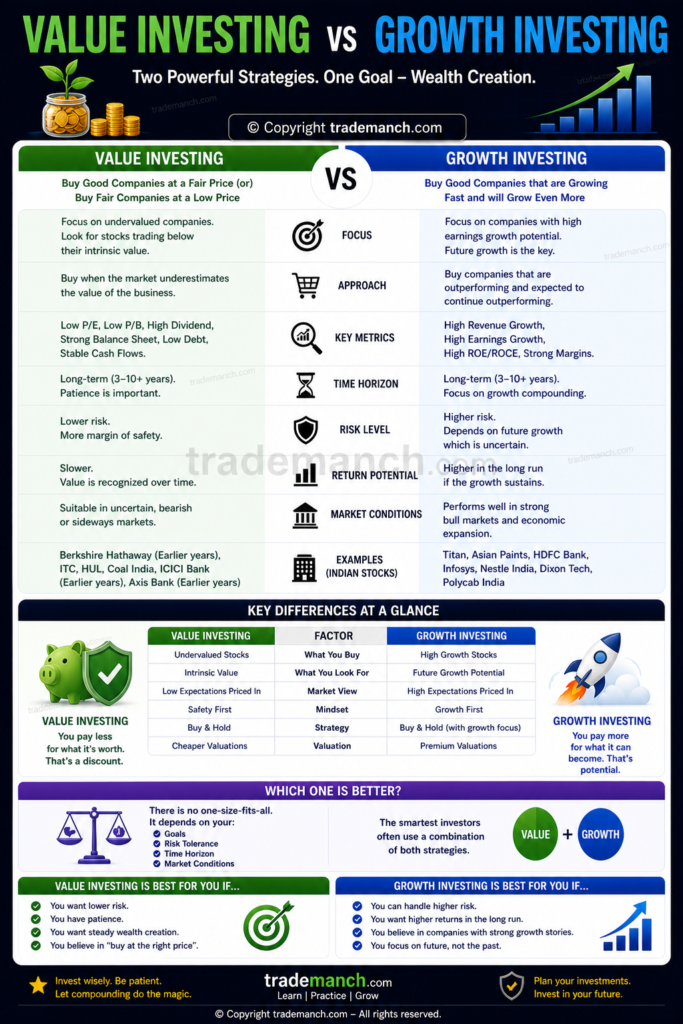
Understanding the difference between Value Investing and Growth Investing can help you choose the strategy that best matches your financial goals, risk tolerance, and investment style.
This complete guide explains both approaches, their advantages, disadvantages, key differences, and how beginners can decide which strategy is right for them.
What Is Value Investing?
Value investing is an investment strategy that involves buying stocks that appear to be trading below their intrinsic or fair value.
Value investors believe that the market sometimes undervalues good companies due to temporary issues, market sentiment, or economic conditions.
The goal is to:
- Buy undervalued stocks
- Hold them patiently
- Profit when the market recognizes their true value
Simple Definition of Value Investing
Value investing means purchasing quality stocks at a discount to their intrinsic value.
Famous Value Investors
Some well-known value investors include:
- Warren Buffett
- Benjamin Graham
- Charlie Munger
Characteristics of Value Stocks
Value stocks often have:
- Low P/E Ratio
- Low P/B Ratio
- Stable earnings
- Established businesses
- Consistent dividends
These companies may be temporarily overlooked by the market.
Example of Value Investing
Suppose a company’s intrinsic value is estimated at ₹1,000 per share.
Current market price:
₹700
Potential discount:
1000−700=300
The stock is trading ₹300 below estimated value.
A value investor may see this as an opportunity.
Advantages of Value Investing
Lower Risk
Buying below intrinsic value can provide a margin of safety.
Potential for Strong Long-Term Returns
Profits may occur when the market recognizes the stock’s true value.
Dividend Income
Many value stocks pay regular dividends.
Less Dependence on Market Hype
Value investors focus on business fundamentals.
Disadvantages of Value Investing
Requires Patience
It may take years for the market to recognize undervaluation.
Value Traps
Some stocks appear cheap because the business is deteriorating.
Slower Growth
Value stocks often grow more slowly than growth stocks.
What Is Growth Investing?
Growth investing focuses on companies expected to grow revenue, earnings, and market share faster than average.
Growth investors prioritize future potential over current valuation.
The goal is to:
- Identify high-growth companies early
- Benefit from rapid business expansion
- Generate substantial capital appreciation
Simple Definition of Growth Investing
Growth investing means investing in companies with strong future growth potential, even if their current valuations appear expensive.
Characteristics of Growth Stocks
Growth stocks often have:
- High revenue growth
- High earnings growth
- Strong innovation
- Expanding market share
- High valuation ratios
These companies typically reinvest profits rather than paying dividends.
Example of Growth Investing
Suppose a technology company grows earnings by 30% annually.
Current price:
₹1,000
Future growth may justify a higher valuation.
Growth investors buy based on expected future performance rather than current valuation.
Famous Growth Investors
Some investors associated with growth investing include:
- Peter Lynch
- Philip Fisher
Advantages of Growth Investing
High Return Potential
Successful growth companies can generate extraordinary returns.
Capital Appreciation
Growth stocks often experience significant price increases.
Participation in Emerging Industries
Investors can benefit from technological and economic innovation.
Strong Business Expansion
Growth companies often increase market share rapidly.
Disadvantages of Growth Investing
Higher Valuations
Growth stocks may trade at expensive prices.
Greater Volatility
Prices can fluctuate significantly.
Higher Expectations
Even small disappointments can trigger sharp declines.
Lower Dividend Income
Most growth companies reinvest profits rather than distribute dividends.
Value Investing vs Growth Investing: Key Differences
| Feature | Value Investing | Growth Investing |
|---|---|---|
| Focus | Undervalued Stocks | Fast-Growing Companies |
| Valuation | Low | High |
| Risk Level | Lower | Higher |
| Dividend Yield | Often Higher | Usually Lower |
| Growth Rate | Moderate | High |
| Investment Horizon | Long-Term | Long-Term |
| Volatility | Lower | Higher |
| Main Objective | Buy Cheap | Buy Growth |
Financial Metrics Used in Value Investing
Value investors often analyze:
Price-to-Earnings (P/E) Ratio
Lower ratios may indicate undervaluation.
Price-to-Book (P/B) Ratio
Measures stock price relative to book value.
Dividend Yield
Shows income generated from dividends.
Debt Levels
Strong balance sheets are preferred.
Financial Metrics Used in Growth Investing
Growth investors focus on:
Revenue Growth
Increasing sales over time.
Earnings Growth
Consistent profit expansion.
Return on Equity (ROE)
Measures management effectiveness.
Market Opportunity
Large future growth potential.
Value Investing During Market Crashes
Value stocks often perform relatively better during market downturns because:
- Valuations are lower
- Businesses are more mature
- Dividends provide support
Growth Investing During Bull Markets
Growth stocks often outperform during:
- Economic expansion
- Low interest rates
- Strong investor optimism
Which Strategy Is Better?
There is no universally superior strategy.
The best approach depends on:
- Financial goals
- Risk tolerance
- Investment horizon
- Personality
Choose Value Investing If You:
- Prefer lower risk
- Like undervalued opportunities
- Want dividend income
- Have patience
Choose Growth Investing If You:
- Seek higher returns
- Can tolerate volatility
- Believe in future innovation
- Focus on capital appreciation
Can You Combine Both Strategies?
Yes.
Many successful investors use a blended approach known as:
- Growth at a Reasonable Price (GARP)
This strategy seeks:
- Strong growth
- Reasonable valuations
Examples of Value and Growth Stocks
Value-oriented sectors often include:
- Banking
- Utilities
- Consumer Goods
Growth-oriented sectors often include:
- Technology
- Artificial Intelligence
- E-commerce
- Healthcare Innovation
Common Mistakes Beginners Make
Buying Cheap Stocks Without Research
A low price does not automatically mean value.
Chasing Popular Growth Stocks
Avoid buying solely because a stock is trending.
Ignoring Fundamentals
Both strategies require proper analysis.
Lack of Diversification
Always spread investments across multiple companies and sectors.
Risk Management for Both Strategies
Regardless of the approach:
- Diversify investments
- Invest gradually
- Maintain a long-term perspective
- Avoid emotional decisions
Long-Term Performance
Historically:
- Value stocks have often outperformed during certain market cycles.
- Growth stocks have often outperformed during periods of economic expansion.
Performance leadership changes over time.
Which Strategy Is Best for Beginners?
Many beginners benefit from:
- Learning both approaches
- Starting with diversified investments
- Combining value and growth principles
This provides balance and flexibility.
Value Investing and Growth Investing are two of the most successful investment strategies in the stock market. Value investors seek undervalued companies with strong fundamentals, while growth investors focus on businesses with exceptional future potential.
Neither strategy is inherently better than the other. The right choice depends on your goals, risk tolerance, and investment philosophy.
Many successful investors combine elements of both approaches to build diversified portfolios capable of generating long-term wealth while managing risk effectively.
Frequently Asked Questions (FAQs)
1. What is value investing?
Value investing involves buying stocks that trade below their estimated intrinsic value.
2. What is growth investing?
Growth investing focuses on companies expected to grow faster than average.
3. Who is the most famous value investor?
Warren Buffett is widely regarded as one of the greatest value investors.
4. Are growth stocks riskier than value stocks?
Generally, growth stocks tend to be more volatile and carry higher risk.
5. Do value stocks pay dividends?
Many value stocks provide regular dividend income.
6. Do growth stocks pay dividends?
Most growth companies reinvest profits and pay little or no dividends.
7. Which strategy offers higher return potential?
Growth investing often offers higher potential returns but also higher risk.
8. Can I combine value and growth investing?
Yes, many investors use a blended approach.
9. Which strategy is better during market crashes?
Value stocks often perform relatively better during downturns.
10. Which strategy is best for beginners?
A balanced approach combining value and growth principles is often suitable for beginners.