
If you are learning about the Indian stock market, two names you will hear regularly are Nifty 50 and Sensex. These are the two most important stock market indices in India and are widely used by investors, traders, analysts, mutual funds, and financial institutions.
Understanding Nifty and Sensex is essential because they help investors:
Make better trading and investing decisions
Understand overall market direction
Analyze economic conditions
Compare investment performance
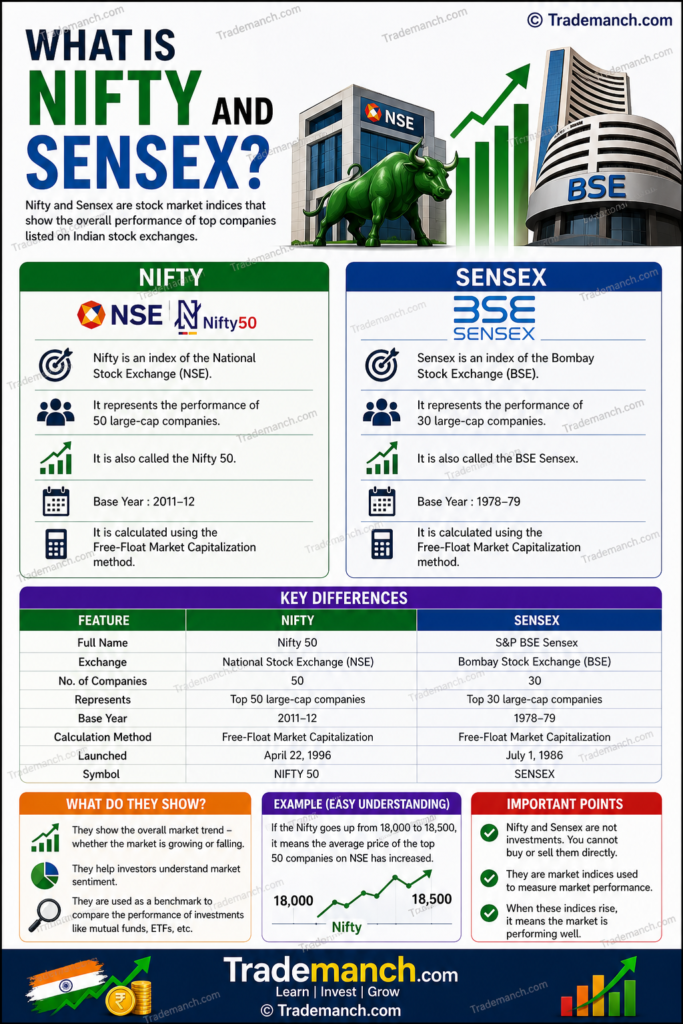
In this complete beginner-to-advanced guide, you will learn what Nifty 50 and Sensex are, how they work, their differences, calculation methods, importance, advantages, and how investors use them in real-world investing.
What Is a Stock Market Index?
A stock market index is a group of selected stocks used to measure the performance of a stock market or a particular sector.
An index helps investors understand:
- Whether the market is rising or falling
- Overall market sentiment
- Economic strength
Examples of stock market indices:
- Nifty 50
- Sensex
- Bank Nifty
- Nifty IT
What Is Nifty 50?
National Stock Exchange Nifty 50 is the benchmark stock market index of the National Stock Exchange (NSE).
The word “Nifty” comes from:
- National + Fifty
Nifty 50 contains:
- 50 large and financially strong companies listed on NSE.
It represents major sectors of the Indian economy.
What Is Sensex?
Bombay Stock Exchange Sensex is the benchmark stock market index of the Bombay Stock Exchange (BSE).
The word “Sensex” comes from:
- Sensitive + Index
Sensex contains:
- 30 major companies listed on BSE.
It is one of the oldest stock market indices in India.
Simple Meaning of Nifty and Sensex
In simple words:
- Nifty tracks top 50 companies on NSE.
- Sensex tracks top 30 companies on BSE.
Both indicate overall stock market performance.
History of Nifty and Sensex
Sensex Launch
Sensex was launched in:
- 1986
It is India’s oldest benchmark index.
Nifty Launch
Nifty 50 was launched in:
- 1996
It became one of the most popular indices among traders and investors.
Why Nifty and Sensex Are Important
1. Measure Market Performance
They indicate:
- Market strength
- Investor sentiment
- Economic confidence
2. Benchmark for Investments
Mutual funds compare performance against:
- Nifty
- Sensex
3. Help in Economic Analysis
Strong indices usually reflect:
- Economic growth
- Corporate profitability
4. Used for Trading and Investing
Traders and investors use indices for:
- Futures trading
- Options trading
- ETFs
- Index funds
How Nifty and Sensex Work
Both indices are based on:
- Free-float market capitalization
This means companies with larger market value have higher impact on the index.
What Is Free-Float Market Capitalization?
Free-float market capitalization considers only publicly available shares for trading.
Formula:
Free Float Market Cap=Share Price×Publicly Available Shares
Example of Index Movement
Suppose major companies like:
- Reliance Industries
- HDFC Bank
- Infosys
rise strongly.
Then:
- Nifty and Sensex usually move upward.
Difference Between Nifty and Sensex
| Nifty 50 | Sensex |
|---|---|
| Index of NSE | Index of BSE |
| Contains 50 companies | Contains 30 companies |
| Started in 1996 | Started in 1986 |
| Broader market coverage | Smaller basket |
| Managed by NSE Indices | Managed by BSE |
| More commonly used in derivatives | Older benchmark index |
Nifty 50 Companies
Nifty includes major companies from sectors like:
- Banking
- IT
- FMCG
- Pharma
- Telecom
- Energy
Examples:
- Reliance Industries
- Infosys
- ICICI Bank
Sensex Companies
Sensex also contains large companies across sectors.
Examples:
- Tata Consultancy Services
- HDFC Bank
- Bharti Airtel
Which Is Better: Nifty or Sensex?
Both are excellent benchmark indices.
Why Many Traders Prefer Nifty
- Broader market coverage
- More liquid derivatives market
- Widely used for futures and options
Why Sensex Is Important
- Historical importance
- Strong representation of major companies
Most investors track both indices.
What Is Nifty 50 Used For?
Nifty is used for:
- Index investing
- Futures trading
- Options trading
- ETFs
- Market analysis
What Is Sensex Used For?
Sensex is used for:
- Market performance tracking
- Long-term investing
- Economic analysis
- Benchmark comparison
What Happens When Nifty or Sensex Rise?
When indices rise:
- Investor confidence improves
- Stock prices generally increase
- Economic outlook becomes positive
This is often called a:
- Bull market
What Happens When Nifty or Sensex Fall?
When indices fall:
- Fear increases
- Market sentiment weakens
- Stock prices decline
This is called a:
- Bear market
Factors Affecting Nifty and Sensex
Economic Growth
Strong GDP growth supports markets.
Inflation and Interest Rates
Higher inflation may negatively impact stocks.
Company Earnings
Better profits increase stock prices.
Global Events
Wars, crises, and international markets affect Indian indices.
Government Policies
Tax reforms and economic policies influence markets.
What Is Bank Nifty?
Bank Nifty is a sectoral index tracking major banking stocks.
It includes banks like:
- HDFC Bank
- ICICI Bank
Bank Nifty is popular among traders due to high volatility.
Can Beginners Invest in Nifty and Sensex?
Yes, beginners can invest through:
- Index funds
- ETFs
- Mutual funds
These options are considered relatively safer for beginners.
What Is Index Investing?
Index investing means investing in funds that track:
- Nifty 50
- Sensex
Benefits:
- Diversification
- Lower cost
- Long-term wealth creation
Nifty vs Sensex for Long-Term Investing
Both are good for long-term investing.
Nifty is often preferred because:
- It includes more companies
- Offers broader market exposure
Advantages of Index Investing
Diversification
Investment spreads across multiple companies.
Lower Risk
Lower company-specific risk.
Low Expense Ratio
Index funds usually have lower fees.
Long-Term Wealth Creation
Indices generally grow with the economy over time.
Risks of Index Investing
Market Risk
Indices fall during market crashes.
Economic Slowdown
Weak economy affects overall market.
Short-Term Volatility
Prices fluctuate daily.
Common Mistakes Beginners Make
Panic During Market Falls
Market corrections are normal.
Trying to Time the Market
Long-term investing is usually more effective.
Following Market Hype
Emotional investing increases risk.
Ignoring Diversification
Always spread investments properly.
Nifty and Sensex in Trading
Traders use indices for:
- Futures trading
- Options trading
- Intraday trading
- Swing trading
Index trading is popular because:
- Liquidity is high
- Volatility creates opportunities
Nifty vs Sensex: Which Is More Popular?
Nifty is generally more popular among:
- Traders
- Derivatives market participants
- ETF investors
Sensex remains important as:
- India’s oldest benchmark index
Best Strategy for Beginners
Start With Index Funds
Good for long-term investing.
Learn Market Basics
Understand:
- Trends
- Risk
- Diversification
Think Long Term
Avoid short-term emotional decisions.
Nifty 50 and Sensex are the two most important stock market indices in India. Nifty tracks 50 companies listed on NSE, while Sensex tracks 30 companies listed on BSE. Both help investors understand market direction, economic conditions, and investment opportunities.
For beginners, learning about Nifty and Sensex is essential for understanding the Indian stock market. Long-term investors often use index investing through mutual funds and ETFs to build wealth steadily with lower risk.
Frequently Asked Questions (FAQs)
1. What is Nifty 50?
Nifty 50 is the benchmark index of NSE containing 50 major companies.
2. What is Sensex?
Sensex is the benchmark index of BSE containing 30 major companies.
3. Which is better, Nifty or Sensex?
Both are important, but Nifty offers broader market coverage.
4. What is the full form of Nifty?
National Fifty.
5. What is the full form of Sensex?
Sensitive Index.
6. Can beginners invest in Nifty?
Yes, through index funds and ETFs.
7. Why do Nifty and Sensex rise or fall?
Due to company performance, economic conditions, and investor sentiment.
8. What is index investing?
Investing in funds that track market indices like Nifty or Sensex.
9. Is Nifty better for long-term investment?
Many investors prefer Nifty due to broader diversification.
10. What is Bank Nifty?
Bank Nifty is a banking sector index tracking major Indian banks.