
AI in Stock Market: Artificial Intelligence (AI) is rapidly changing the stock market and the way people trade and invest. From algorithmic trading and stock prediction to robo-advisors and market analysis, AI is helping traders and investors make faster, smarter, and data-driven decisions.
In 2026, AI has become one of the biggest technologies shaping the future of financial markets. Large institutions, hedge funds, brokers, and even retail traders are now using AI-powered tools for stock analysis and automated trading.
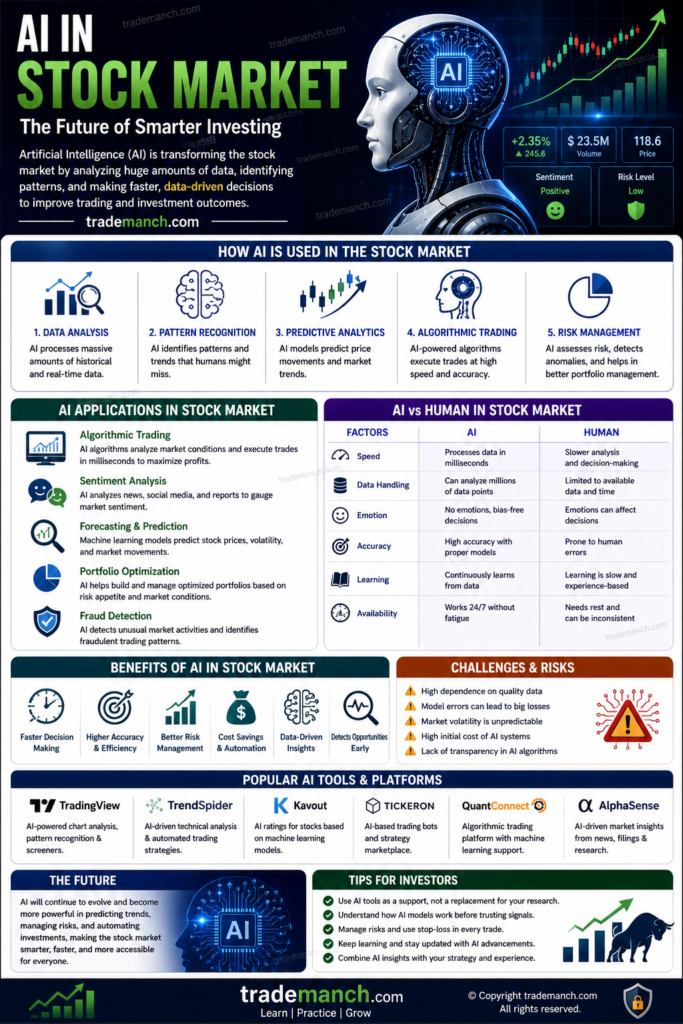
In this complete beginner-friendly guide, you will learn what AI in the stock market is, how it works, its advantages, risks, applications, and the future of AI-based investing and trading.
What Is AI in the Stock Market?
AI in the stock market refers to the use of:
- Artificial Intelligence
- Machine Learning
- Data Analysis
- Automation
to analyze markets, predict price movements, manage investments, and improve trading decisions.
In simple words:
- AI helps computers analyze huge amounts of stock market data and make intelligent decisions.
Simple Definition of AI in Trading
AI trading means using computer systems and algorithms to analyze stock market data and assist in trading or investing decisions.
How AI Works in the Stock Market
AI systems analyze:
- Stock prices
- Market trends
- Financial news
- Company reports
- Economic data
- Trading volume
- Investor sentiment
AI can process millions of data points much faster than humans.
Technologies Used in AI Trading
1. Machine Learning
Machine learning helps systems:
- Learn from market data
- Improve predictions over time
2. Natural Language Processing (NLP)
NLP helps AI understand:
- Financial news
- Social media sentiment
- Earnings reports
3. Big Data Analysis
AI analyzes huge amounts of market information quickly.
4. Algorithmic Trading
Algorithms automatically execute trades based on predefined rules.
Applications of AI in the Stock Market
1. AI-Based Stock Prediction
AI systems analyze historical data and patterns to predict possible future price movements.
AI may analyze:
- Price trends
- Technical indicators
- News sentiment
- Volume patterns
2. Algorithmic Trading
Algorithmic trading uses computer programs to execute trades automatically.
Benefits:
- Faster execution
- Reduced emotional trading
- High-speed decision making
Large institutions heavily use algorithmic trading.
3. Robo-Advisors
Robo-advisors are AI-powered investment platforms that help users:
- Build portfolios
- Manage investments
- Plan finances
Popular robo-advisors globally include:
- Betterment
- Wealthfront
4. Sentiment Analysis
AI analyzes:
- Social media
- News headlines
- Market discussions
to measure investor sentiment.
Positive sentiment may indicate bullish momentum.
5. Risk Management
AI helps traders:
- Detect unusual market conditions
- Manage portfolio risk
- Optimize position sizing
6. Fraud Detection
Financial institutions use AI to:
- Detect suspicious activity
- Prevent fraud
- Improve cybersecurity
Advantages of AI in the Stock Market
1. Faster Data Analysis
AI processes huge amounts of data within seconds.
Humans cannot match this speed.
2. Reduced Emotional Trading
AI systems follow rules without fear or greed.
3. Better Accuracy
AI may identify patterns humans often miss.
4. 24/7 Monitoring
AI systems continuously monitor markets.
5. Automation
AI can automate:
- Trade execution
- Portfolio management
- Market scanning
Risks and Limitations of AI in Trading
1. No Guaranteed Profits
AI cannot predict markets perfectly.
Markets remain unpredictable.
2. Overfitting Problems
AI models may perform well on past data but fail in live markets.
3. Market Crashes and Black Swan Events
Unexpected events can confuse AI systems.
Examples:
- Financial crises
- Wars
- Pandemics
4. High Dependence on Data
Poor-quality data can produce wrong predictions.
5. Technical Failures
Software bugs or system failures may cause losses.
AI vs Human Traders
| AI Trading | Human Trading |
|---|---|
| Faster analysis | Emotional decision-making |
| No emotions | Fear and greed |
| Processes large data | Limited data handling |
| Consistent execution | May break discipline |
However, humans still play an important role in:
- Strategy design
- Risk management
- Market interpretation
Can AI Predict the Stock Market?
AI can improve probability and analysis, but:
- No AI system can predict the stock market with 100% accuracy.
Markets are influenced by:
- Human emotions
- Global events
- Economic uncertainty
AI helps improve decision-making, not eliminate risk.
AI in Intraday Trading
AI is widely used in:
- High-frequency trading (HFT)
- Intraday trading
- Scalping systems
AI systems execute trades within milliseconds.
AI in Long-Term Investing
AI also helps long-term investors by:
- Screening good stocks
- Analyzing fundamentals
- Building diversified portfolios
AI Trading Bots
Trading bots are automated software programs that:
- Buy and sell stocks automatically
- Follow predefined rules
Popular features:
- Auto-entry
- Auto-exit
- Risk management
- Backtesting
What Is Backtesting?
Backtesting means testing a strategy using historical data.
AI systems often backtest strategies before live trading.
AI and Technical Analysis
AI can analyze:
- RSI
- MACD
- Moving averages
- Price patterns
- Candlestick formations
much faster than manual traders.
AI and Fundamental Analysis
AI helps investors analyze:
- Financial statements
- Earnings reports
- Valuation ratios
- Industry trends
Popular AI Tools in Trading
Some AI-powered trading and investing platforms include:
- TradingView
- TrendSpider
- Tickeron
AI Stocks in India
Indian companies benefiting from AI growth include:
- Infosys
- Tata Consultancy Services
- Wipro
These companies are involved in:
- AI development
- Automation
- Digital transformation
Future of AI in the Stock Market
AI is expected to become even more important in:
- Trading automation
- Portfolio management
- Financial analysis
- Personalized investing
- Risk prediction
Retail investors will increasingly use AI-powered tools in the coming years.
Can Beginners Use AI for Trading?
Yes, beginners can use AI tools for:
- Market analysis
- Chart scanning
- Portfolio tracking
- Educational purposes
However:
- Beginners should first understand stock market basics.
AI should support learning, not replace it.
Common Mistakes Beginners Make With AI Trading
Blindly Trusting AI Signals
AI tools are not always correct.
Ignoring Risk Management
AI cannot eliminate trading risk.
Overdependence on Automation
Human understanding remains important.
Chasing “Guaranteed Profit” Bots
No AI bot can guarantee profits.
Is AI Trading Legal in India?
Yes, AI-based trading and algorithmic trading are legal in India when used according to exchange and regulatory rules.
Regulators include:
- Securities and Exchange Board of India (SEBI)
Best Practices for Beginners
Learn Stock Market Basics First
Understand:
- Risk management
- Trading psychology
- Technical analysis
Use AI as a Support Tool
AI should assist decision-making.
Avoid Unrealistic Expectations
No AI system guarantees success.
Focus on Risk Management
Protect capital first.
AI is transforming the stock market by improving data analysis, automation, market prediction, and investment management. From algorithmic trading and robo-advisors to AI-based chart analysis and portfolio optimization, artificial intelligence is becoming a major force in global financial markets.
However, AI is not a magic solution. Successful investing and trading still require:
- Risk management
- Market understanding
- Discipline
- Human judgment
Beginners should use AI as a learning and support tool while continuing to build strong stock market knowledge and trading discipline.
Frequently Asked Questions (FAQs)
1. What is AI in the stock market?
AI in the stock market means using artificial intelligence for market analysis and trading decisions.
2. Can AI predict stock prices?
AI can improve analysis but cannot predict markets perfectly.
3. What is algorithmic trading?
Algorithmic trading uses computer programs to execute trades automatically.
4. Is AI trading safe?
AI trading still involves market risk and no guaranteed profits.
5. What are trading bots?
Trading bots are automated software systems for buying and selling assets.
6. Can beginners use AI trading tools?
Yes, beginners can use AI tools for learning and analysis.
7. Is AI better than human traders?
AI is faster in data analysis, but human judgment remains important.
8. Which companies are involved in AI in India?
Companies like Infosys and Tata Consultancy Services are active in AI technologies.
9. Is AI trading legal in India?
Yes, AI and algorithmic trading are legal under SEBI regulations.
10. Can AI remove stock market risk?
No, all investments and trading involve risk.