
Stock market indices are among the most important tools used by investors, traders, analysts, and financial institutions to measure the performance of the stock market. When you hear news headlines such as “Nifty rises 200 points” or “Sensex falls 500 points,” they are referring to stock market indices.
In India, the two most popular stock market indices are:
- NIFTY 50
- BSE Sensex
These indices represent the overall health and direction of the Indian stock market.
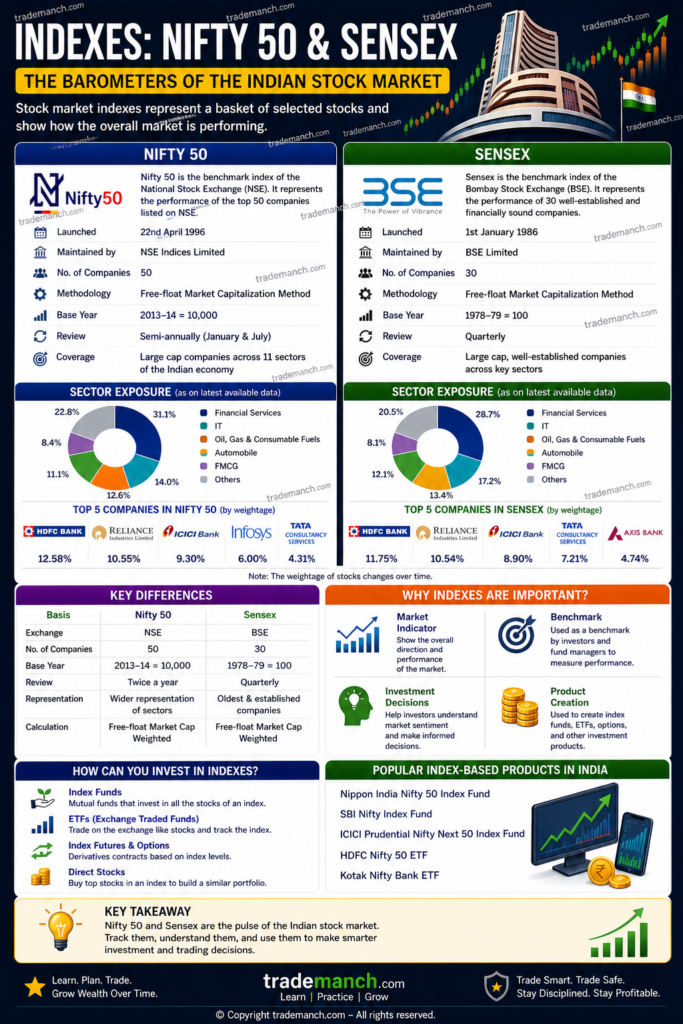
This complete beginner guide explains what stock market indices are, how Nifty 50 and Sensex work, their importance, and how investors use them.
What Is a Stock Market Index?
A stock market index is a group of selected stocks that represents the performance of a particular market, sector, or economy.
An index acts like a scorecard for the stock market.
Instead of tracking thousands of stocks individually, investors can look at an index to understand overall market performance.
Simple Definition of Stock Market Index
A stock market index is a basket of selected stocks used to measure the performance of a stock market or a specific segment of the market.
Why Are Stock Market Indices Important?
Indices help investors:
- Measure market performance
- Track economic trends
- Compare portfolio returns
- Analyze market sentiment
- Create index funds and ETFs
They provide a quick snapshot of market conditions.
What Is Nifty 50?
NIFTY 50 is the benchmark stock market index of the National Stock Exchange (NSE).
It consists of:
- 50 leading companies
- Multiple sectors of the economy
Nifty represents some of the largest and most actively traded companies in India.
Key Features of Nifty 50
- Managed by NSE Indices
- Contains 50 large companies
- Covers major sectors
- Widely used by investors and traders
What Is Sensex?
BSE Sensex is the benchmark stock market index of the Bombay Stock Exchange (BSE).
It consists of:
- 30 major companies
- Various industries and sectors
Sensex is one of the oldest stock market indices in India.
Key Features of Sensex
- Managed by BSE
- Contains 30 large companies
- Represents major sectors
- Widely followed by investors
Nifty 50 vs Sensex
| Feature | Nifty 50 | Sensex |
|---|---|---|
| Exchange | NSE | BSE |
| Number of Companies | 50 | 30 |
| Launch Year | 1996 | 1986 |
| Coverage | Broader | Slightly Narrower |
| Popularity | Very High | Very High |
Both indices generally move in the same direction because they contain many leading Indian companies.
How Stock Market Indices Are Calculated
Modern indices use a method called:
Free-Float Market Capitalization
This method considers:
- Market capitalization
- Publicly available shares
Formula:
Index Value∝Free Float Market Capitalization
Companies with larger market capitalization have greater influence on index movement.
What Is Free-Float Market Capitalization?
Free-float market capitalization includes only shares available for public trading.
It excludes:
- Promoter holdings
- Government holdings
- Restricted shares
This provides a more realistic market representation.
Why Nifty and Sensex Move Up or Down
Indices move based on the price changes of their constituent companies.
If most major stocks rise:
- Index rises
If most major stocks fall:
- Index declines
Example of Index Movement
Suppose large companies within Nifty 50 report strong earnings.
Investors buy shares.
Stock prices increase.
As a result:
- Nifty 50 rises
The same principle applies to Sensex.
Major Companies in Nifty and Sensex
Examples include:
- Reliance Industries
- HDFC Bank
- Infosys
- ICICI Bank
- Tata Consultancy Services
These companies significantly influence index movements.
Why Investors Follow Nifty and Sensex
Investors use indices to:
Measure Market Performance
Determine whether the market is rising or falling.
Compare Portfolio Returns
Evaluate investment performance against benchmarks.
Identify Market Trends
Understand bullish and bearish phases.
Track Economic Health
Strong markets often reflect strong economic conditions.
What Is Benchmarking?
Benchmarking means comparing portfolio performance to an index.
Example:
Portfolio Return = 12%
Nifty Return = 10%
Outperformance:
12%−10%=2%
Portfolio outperformed the benchmark by 2%.
Sectoral Indices
Besides Nifty and Sensex, there are specialized sector indices.
Examples:
- Banking Index
- IT Index
- Pharma Index
- Auto Index
These help investors track specific sectors.
What Is Nifty Bank?
NIFTY Bank is an index representing major banking companies.
It is widely followed by traders and investors.
What Is Nifty Next 50?
NIFTY Next 50 consists of the next 50 companies after Nifty 50.
Many investors view it as a future large-cap segment.
Advantages of Stock Market Indices
Easy Market Tracking
Provides a quick market overview.
Diversification
Represents multiple companies and sectors.
Performance Measurement
Useful for benchmarking investments.
Basis for Index Funds
Many mutual funds and ETFs track indices.
What Are Index Funds?
Index funds are mutual funds that track an index such as:
- NIFTY 50
- BSE Sensex
Their goal is to replicate index performance.
What Are ETFs?
Exchange-Traded Funds (ETFs) are investment products that trade on stock exchanges and often track indices.
Benefits include:
- Diversification
- Low costs
- Ease of trading
Nifty and Sensex During Bull Markets
During bull markets:
- Stock prices rise
- Investor confidence increases
- Indices trend upward
Nifty and Sensex During Bear Markets
During bear markets:
- Stock prices decline
- Fear increases
- Indices fall
Common Beginner Mistakes
Judging the Entire Market by One Stock
Indices provide a broader market picture.
Ignoring Benchmark Performance
Always compare returns with relevant indices.
Following Index Movements Emotionally
Short-term fluctuations are normal.
Assuming Indices Always Rise
Markets move in cycles.
How Beginners Should Use Nifty and Sensex
Step 1
Track overall market direction.
Step 2
Compare portfolio performance.
Step 3
Learn market cycles.
Step 4
Study major index constituents.
Step 5
Consider index funds for diversification.
Can You Invest Directly in Nifty or Sensex?
No.
You cannot buy the index itself.
However, you can invest through:
- Index Funds
- ETFs
- Derivatives (for traders)
that track these indices.
Nifty vs Sensex: Which Is Better?
Both are excellent benchmarks.
Many investors prefer:
- Nifty for broader market coverage
- Sensex for historical significance
In practice, both reflect the overall direction of the Indian stock market.
Stock market indices such as the Nifty 50 and Sensex are essential tools for understanding market performance. They provide a snapshot of the economy, help investors benchmark returns, and serve as the foundation for index funds and ETFs.
Whether you are a trader, investor, or beginner, understanding how Nifty and Sensex work is crucial for making informed financial decisions. By tracking these indices, investors can better understand market trends, economic conditions, and investment opportunities.
Frequently Asked Questions (FAQs)
1. What is a stock market index?
A stock market index is a group of selected stocks used to measure market performance.
2. What is Nifty 50?
NIFTY 50 is the benchmark index of the National Stock Exchange containing 50 major companies.
3. What is Sensex?
BSE Sensex is the benchmark index of the Bombay Stock Exchange containing 30 major companies.
4. What is the difference between Nifty and Sensex?
Nifty contains 50 companies and tracks NSE, while Sensex contains 30 companies and tracks BSE.
5. Why are stock indices important?
They help measure market performance and investor sentiment.
6. Can I invest directly in Nifty or Sensex?
No, but you can invest through index funds and ETFs.
7. How are indices calculated?
Most modern indices use the free-float market capitalization method.
8. What is an index fund?
An index fund is a mutual fund that tracks a stock market index.
9. What causes Nifty and Sensex to rise?
Rising stock prices of constituent companies.
10. Are Nifty and Sensex good indicators of the economy?
They are widely used indicators of market sentiment and economic confidence.